
Sculpture "Psyche Revived by Cupid's Kiss" (1793), reduction in artificial marble


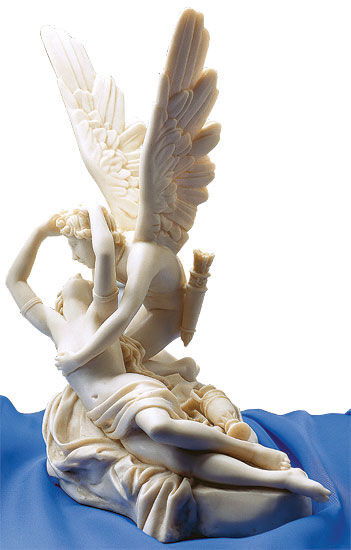
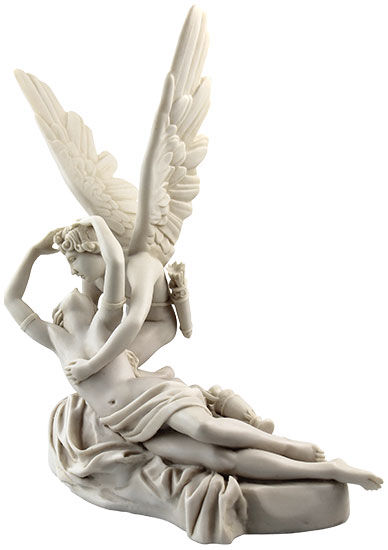
Sculpture "Psyche Revived by Cupid's Kiss" (1793), reduction in artificial marble
Quick info
artificial marble | handmade | reduction | size 37 x 20 x 39 cm
Detailed description
Sculpture "Psyche Revived by Cupid's Kiss" (1793), reduction in artificial marble
Canova's best-known sculptural group is probably the most graceful depiction of the famous mythical love story. Cupid bends tenderly over Psyche and with his wings, shoos away the death-like sleep into which Psyche had fallen due to a trick of the jealous Aphrodite. Blessedly, his beloved reaches out to kiss him. The great love between the god and the beautiful daughter of the king moved even the Olympian gods: Zeus bestowed immortality on Psyche so that both could become a symbol of eternal love that would outlast all the storms of time.
Original: Sculpture in marble, 155 x 168 cm. Musée du Louvre, Paris.
Reduction. Size 37 x 20 x 39 cm. Hand-cast in white, polymer-bonded artificial marble.
Producer: ars mundi Edition Max Büchner GmbH, Bödekerstraße 13, 30161 Hanover, Germany, [email protected]
About Antonio Canova
1757-1822
Born in 1757 in Possagno near Bassano, Antonio Canova was considered the greatest sculptural genius since Michelangelo. At the young age of 15, he was already working in his sculpture workshop for the Italian aristocracy. He was successful throughout his whole life until he died in Venice in 1822. Canova became the leading exponent of Italian classicism, admired throughout Europe.
The Getty Museum in Malibu, California, offered around 10 million euros for Canova's "Three Graces". But thanks to the persistent intervention of the British government and ultimately also the generosity of the art collectors and patrons J. Paul Getty and Baron Hans Heinrich Thyssen-Bornemisza that this unique gem of European sculpture was preserved for the British Kingdom.
A term used for artistic movements that draw inspiration from ancient, primarily Greek, models.
According to the current understanding, Classicism refers to the period between 1750 and 1840, during which late Baroque art was gradually replaced by classicist-oriented styles. The great explorations of Greek art and architecture at that time awakened a true enthusiasm for antique models. The Glyptothek in Munich, the Panthéon in Paris, The New Guard House (Neue Wache) and the Brandenburg Gate in Berlin are just a few examples of this revived classical style.
The leaders of the statuary art were Antonio Canova, Bertel Thorvaldsen, and in Germany, Johann Gottfried Schadow and Christian Daniel Rauch.
In painting, the outstanding representatives of this style are Jaques-Louis David or Jean-Auguste-Dominique Ingres.
Marble powder is polymer-bonded. Artificial marble is characterised by a fine white surface that appears very similar to natural marble.
A true-to-the-original reproduction of an artwork in the same size and with the best possible material and colour uniformity.
The mould is usually taken directly from the original so that the replication reproduces even the finest details. After casting the replication, using the most appropriate method, the surface is polished, patinated, gilded or painted according to the original.
A replication of ars mundi is a recognizable copy of the original.
A plastic work of sculptural art made of wood, stone, ivory, bronze or other metals.
While sculptures made of wood, ivory, or stone are carved directly from the material block, in bronze casting, a working model is prepared at first. Usually, it is made of clay or other easily mouldable materials.
The prime time of sculpture after the Greek and Roman antiquity was the Renaissance. Impressionism gave a new impulse to the sculptural arts. Contemporary artists such as Jorg Immendorf, Andora, and Markus Lupertz also enriched sculptures with outstanding works.