
Garden sculpture "Sun, Moon and Earth", bronze

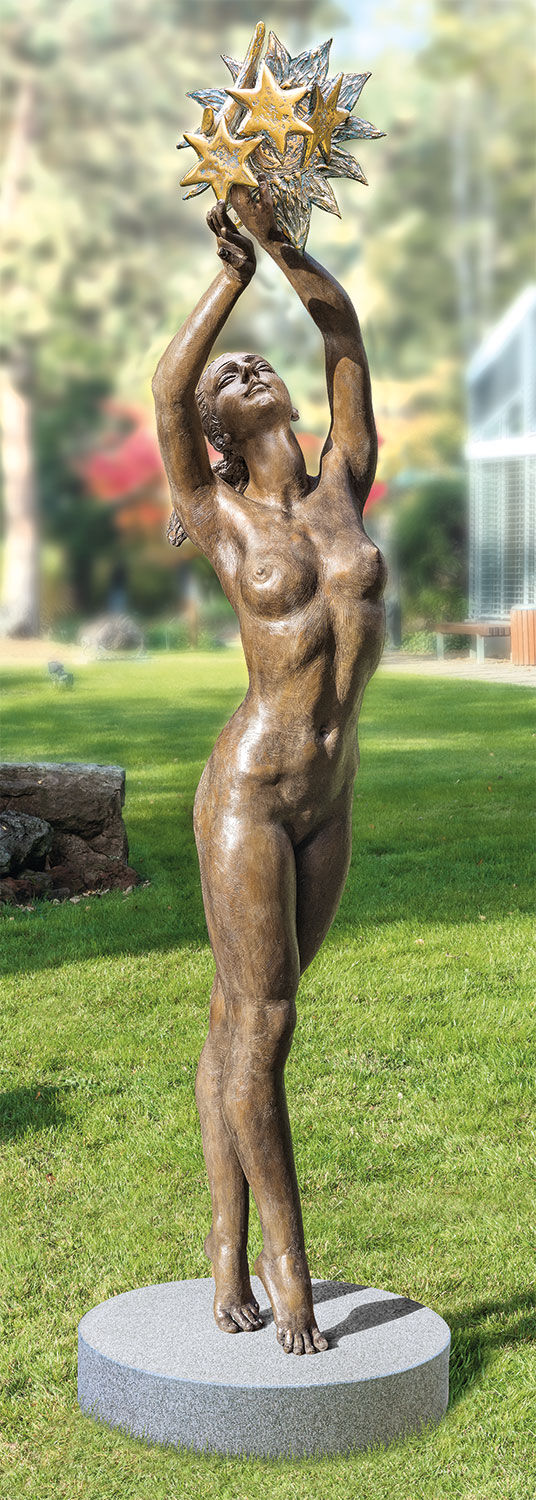
Garden sculpture "Sun, Moon and Earth", bronze
Quick info
limited, 9 copies | numbered | signed | bronze | chased | patinated | size total 263 x 42 x 58 cm (h/w/d) | weight approx. 211 kg
Detailed description
Garden sculpture "Sun, Moon and Earth", bronze
Since Einstein, we have known what keeps suns, planets and satellites in their orbits: The universal force of gravity. This knowledge has brought us further in the field of science, but there is no doubt that the old explanations were much more poetic. For example, when they interpreted the harmonious circling as the "dance of the universe". It revolves in an eternal round dance around our central star.
Beth Newman-Maguire finds the picture of a ballet dancer in the basic position for this round dance. In the next moment, it seems, she begins her dance - and thus sets the mechanics of the world-building in motion.
Edition in bronze, cast using the Lost-Wax-Process, chiselled and patinated by hand. Limited edition of 9 copies, numbered and signed. Size incl. pedestal 263 x 42 x 58 cm (h/w/d). Weight approx. 211 kg.
An alloy of copper with other metals (especially with tin) used since ancient times. It is an ideal metal for high-quality artistic castings, capable of enduring for millennia.
When casting bronze, the artist usually applies the lost-wax technique which is dating back more than 5000 years. This is the best, but also the most complex method of producing sculptures.
First, the artist forms a model of their work. This model is embedded in a liquid silicone rubber mass. Once the material has solidified, the model is cut out, leaving a negative mould. Liquid wax is then poured into the negative mould. After cooling down, the wax cast is removed from the mould, provided with sprues and dipped into ceramic mass. The ceramic mass is hardened in a kiln, where the wax melts away (lost mould).
Finally, the negative mould is ready, into which the 1400° C hot molten bronze is poured. After the bronze had cooled down, the ceramic shell is broken apart, reavoling the sculpture.
Next, the sprues are removed, the surfaces are polished, patinated and numbered by the artist or by a specialist, following their instructions. Thus, each casting is an original work.
For lower-quality bronze castings, the sand casting method is often used, which, however, does not achieve the results of a more elaborate lost-wax technique in terms of surface characteristics and quality.
Term for an art object (sculpture, installation) that, according to the artist’s intention, is produced in multiple copies within a limited and numbered edition.
Multiples enable the "democratization" of art by making the work accessible and affordable for a wider audience.