
Picture "Sundays in the Museum (28)" (2025), framed
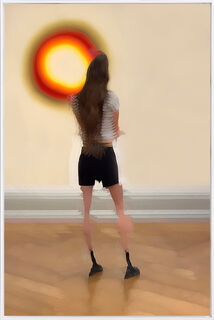


Picture "Sundays in the Museum (28)" (2025), framed
Quick info
limited, 7 copies | numbered | signed | photo edition on canvas | on stretcher frame | framed | size 122 x 83 cm (h/w)
Detailed description
Picture "Sundays in the Museum (28)" (2025), framed
Photo edition on canvas, stretched on stretcher frame. Limited edition of 7 copies. Hand signed and numbered. Stretcher frame size 120 x 80 cm (h/w). Framed in a white solid wood shadow gap frame. Size 122 x 83 cm (h/w).
Producer: ars mundi Edition Max Büchner GmbH, Bödekerstraße 13, 30161 Hanover, Germany, [email protected]
About Betty Schmidt
Betty Schmidt breaks with the conventions of photography, transforming her camera into a paintbrush.
Her works are moving pictures - consciously using blurring, fading and shaking as stylistic elements to detach the viewer's gaze from the usual reality. Through the use of long exposures and dynamic camera movement, she creates unique works where landscapes transform into rhythmic vibrations, and architectural structures seem to dance.
Her works are exhibited in galleries, museums, and at trade fairs in Germany, Denmark and Switzerland. In 2018 and 2020, Betty Schmidt was awarded the [KUN:ST] Prize by Kunst Stuttgart International e. V.
A process for producing images by the action of light, which became widely known in 1839. Photography quickly became the basis for the expanding image industry that pushed the manually produced pictures, paintings and drawings aside.
The avant-garde painting adopted photographic form elements, to restore the painting’s rightful significance. In the 1920s, many avant-garde painters devoted themselves to photography. With his photographs and photomontages, called "rayographs", the American painter Man Ray developed new means of expression in modern art.
The Pop Art of the 1960s varied and alienated the public photograph through technical means. The American pop artist Andy Warhol (1928 - 1987) is the most famous master of this art movement with his images and image series created in this way.
Depiction of typical scenes from daily life in painting, with distinctions between rural, bourgeois, and courtly genres.
The genre reached its peak and immense popularity in Dutch paintings of the 17th century. In the 18th century, especially in France, the courtly and gallant painting became prominent, while in Germany, a more bourgeois character developed.