


Quick info
original Dietz replica | Made in Germany | screenprint on wooden panel | gold-plated | disc diameter approx. 14.5 cm | framed | size 30 x 30 cm
Detailed description
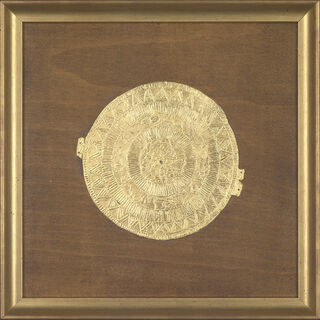
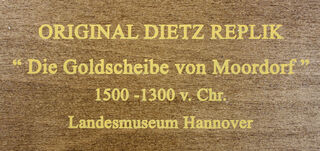
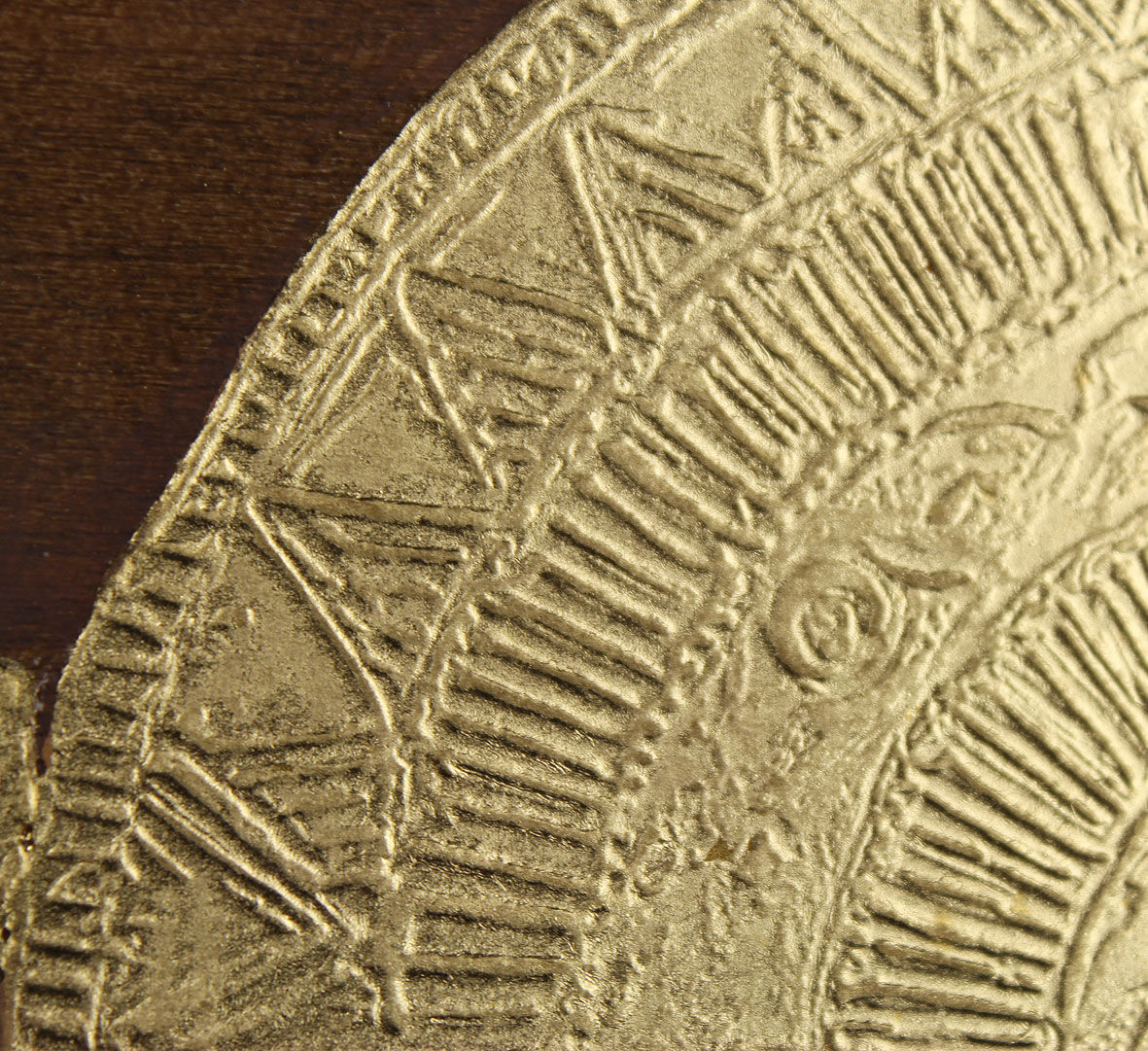
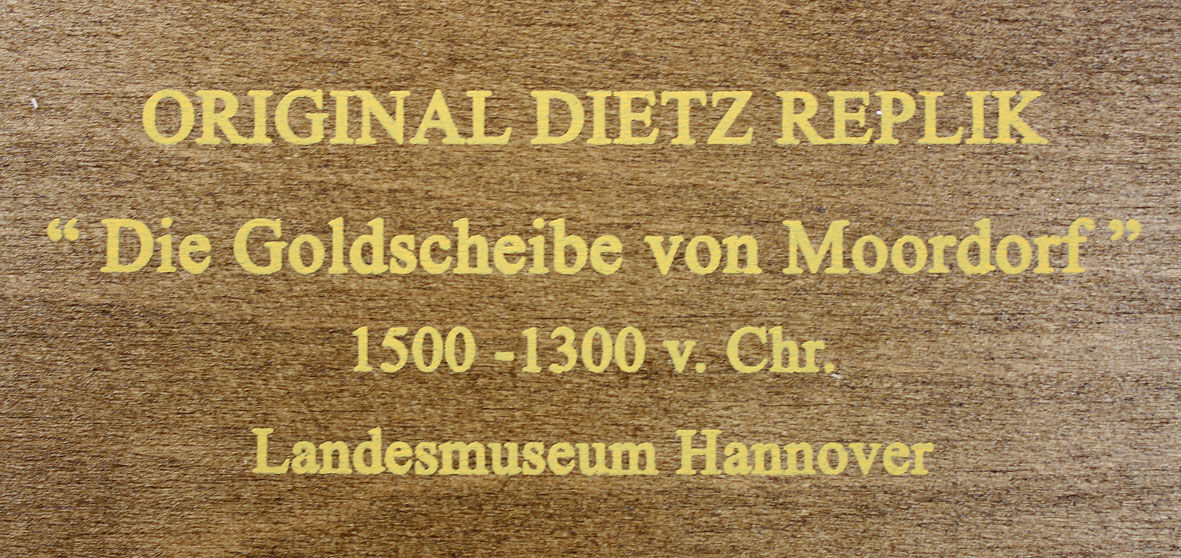
Dietz replica "The Moordorf Gold Disc" (c. 1500-1300 BC), framed
The Moordorf Gold Disc is one of the most significant gold finds from the Bronze Age in northern Germany. It was discovered in 1910 while peat was being cut in the moor near Moordorf in East Frisia and is now held by the Lower Saxony State Museum in Hanover, Germany.
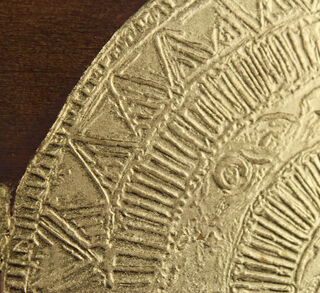
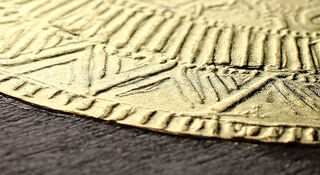
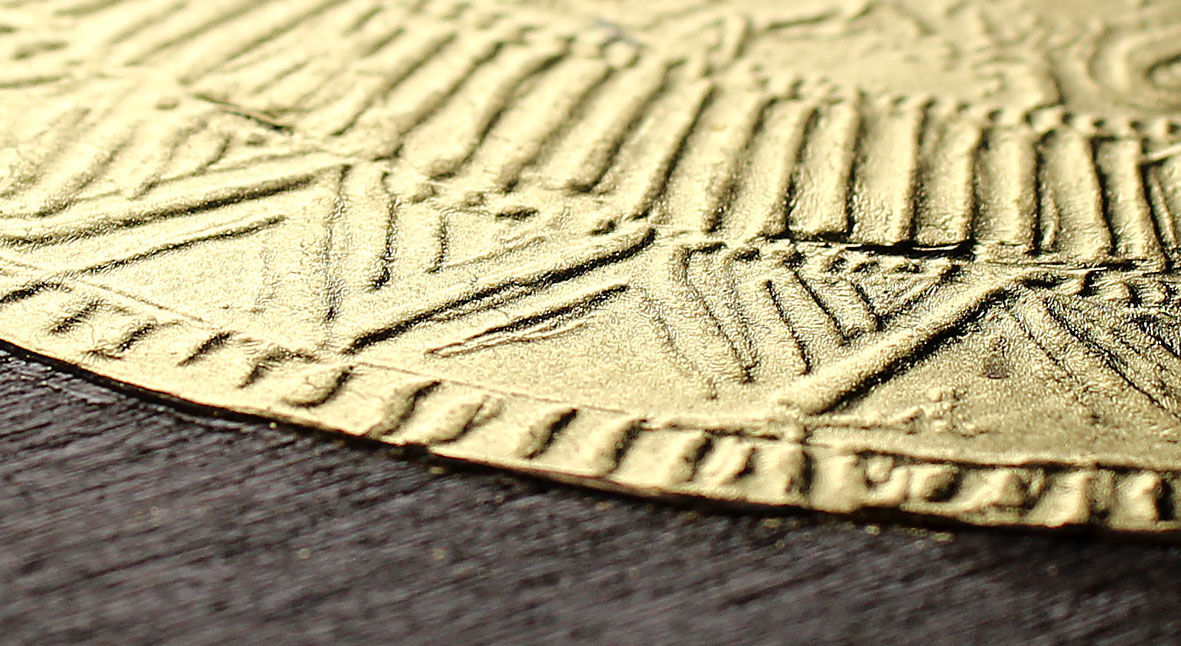
The disc is made from thin sheet gold, measures approximately 14.5 centimetres in diameter and is decorated with elaborate punched designs. Circular ornaments, radiating motifs and small bosses testify to exceptional craftsmanship and precision. Archaeologists date the object to between approximately 1500 and 1300 BC.
The significance of the gold disc has yet to be conclusively established. Owing to its design, it is often associated with Bronze Age sun worship. It was probably intended not as an item of jewellery but as a ritual or ceremonial object. Comparable depictions are known chiefly from Scandinavia and northern Germany, indicating close cultural connections during the Bronze Age.
The circumstances surrounding its discovery also remain a mystery. Research suggests that the disc was originally placed in a burial mound as a valuable grave offering. Its possible use as a votive offering has also been discussed.
Original: Lower Saxony State Museum Hanover.
Original DIETZ replica, produced in 40 coordinated screen-printing layers, printed onto an 8 mm thick wooden panel, hand-gilded with 22-carat real gold. The diameter of the gold disc is approx. 14.5 cm, as with the original. Framed in a golden solid wood frame. Size including frame 30 x 30 cm.
Producer: ars mundi Edition Max Büchner GmbH, Bödekerstraße 13, 30161 Hanover, Germany, [email protected]
A revolutionary process developed by Günter Dietz for the authentic reproduction of paintings, in which not the usual printing inks are used but the same original colours used by the artist. Depending on the artist's painting technique, up to 140 (!) different layers of paint my be required to achieve a perfect replica of the original that also tangibly reproduces the "relief" and texture of the paint.
An example is August Macke's "Couple at the Garden Table":
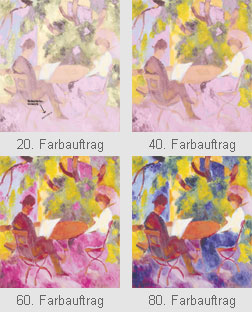
Furthermore, the material of the original carrier is always used, meaning the reproduction is made on canvas, paper, wood, copper, or parchment.
The result is a perfect, gridless reproduction that closely resembles the original in terms of expressiveness and effect. Even museum specialists often can not distinguish the original from the replica. Therefore, a special security note must be added, which is only visible under X-rays.
The edition of most Dietz replicas is limited, usually to 950 copies. Each canvas replica is stretched onto a stretcher frame, just like the original, so that it can be re-stretched in case of fluctuations in room temperature and humidity. A high-quality solid wood frame completes the appearance every Dietz replica.
Numerous masterpiece paintings of Rembrandt, Caspar David Friedrich, Claude Monet, Gustav Klimt, and others, have been recreated by the "Dietz Offizin". Famous modern artists such as Pablo Picasso, Salvador Dalí, Max Ernst, Friedensreich Hundertwasser, Joan Miró, and Marc Chagall have used this method developed by Günter Dietz in order to have replicas of their works produced.
Press Comments:
"The Dietz System provides images as good as the originals. What electronics achieved with the invention of Hi-Fi and stereo for music playback, this technology has now done for the visual arts." (Die Zeit, German newspaper)
"In theory, there is no difference between the original and the Dietz replica. They should be called facsimiles, not reproductions." (Newsweek, US-American news magazine)
"For art printers all over the world, what Dietz has achieved with the printing technique remains an unattainable goal: the perfect reproduction of painted works." (Der Spiegel, German news magazine)
A true-to-the-original reproduction of an artwork in the same size and with the best possible material and colour uniformity.
The mould is usually taken directly from the original so that the replication reproduces even the finest details. After casting the replication, using the most appropriate method, the surface is polished, patinated, gilded or painted according to the original.
A replication of ars mundi is a recognizable copy of the original.
A plastic work of sculptural art made of wood, stone, ivory, bronze or other metals.
While sculptures made of wood, ivory, or stone are carved directly from the material block, in bronze casting, a working model is prepared at first. Usually, it is made of clay or other easily mouldable materials.
The prime time of sculpture after the Greek and Roman antiquity was the Renaissance. Impressionism gave a new impulse to the sculptural arts. Contemporary artists such as Jorg Immendorf, Andora, and Markus Lupertz also enriched sculptures with outstanding works.