
Picture "Two Dancers on Stage" (around 1874), framed
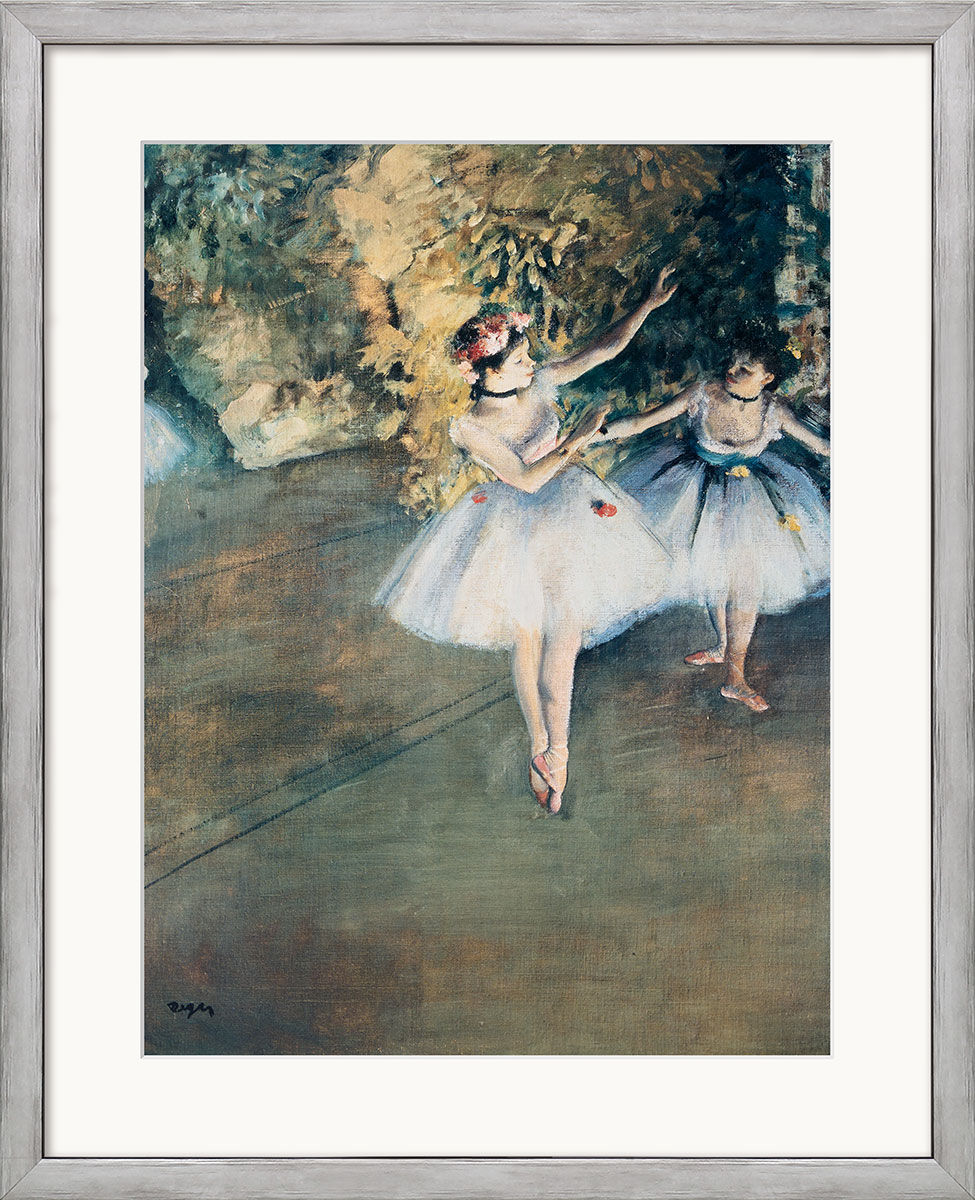


Picture "Two Dancers on Stage" (around 1874), framed
Quick info
reproduction on paper | framed | passe-partout | glazed | size 80 x 65 cm (h/w)
Detailed description
Picture "Two Dancers on Stage" (around 1874), framed
High-quality edition on paper. Framed in silver-coloured solid wood frame with passe-partout, glazed. Size 80 x 65 cm (h/w).
Producer: ars mundi Edition Max Büchner GmbH, Bödekerstraße 13, 30161 Hanover, Germany, [email protected]
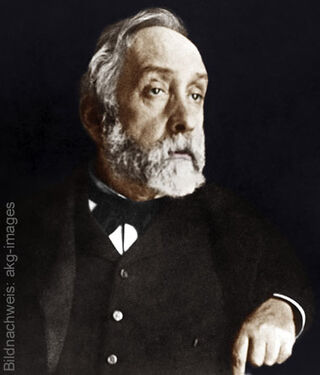
About Edgar Degas
1834-1917
Pictures of graceful dancers and colourful theatre scenes have been at the centre of Degas' work since the mid-1860s. They belong to everyday pictures depicting metropolitan life. In many of his paintings, Degas criticises the new modern world. He selected a rather unusual detail that had caught his attention and emphasised it through the isolation of the individual.
Born in 1834, the French painter, who according to the wishes of his wealthy family should actually have become a lawyer, had studied the art of old masters in the Louvre and the museums of Italy. Classicist history paintings and portraits were part of his repertoire of motifs and forms at that time. Only his encounter and regular exhibitions with the Impressionist Eduard Manet starting in 1874 changed his painting style. However, he never saw himself as a representative of Impressionism and insisted on his independence.
There are no landscapes in his oeuvre, nor did he work with the Impressionist dissection of colour and form. For Degas, the human being was always the dominant theme of his work. The link between his works and those of the Impressionists lay in the endeavour to capture the moment. He proved his skill in depicting movement in his dynamic paintings of horse races and ballet scenes. He also captured his subject through rapid brushwork of pastel colours and delicate contour lines. Degas' artistic basis was drawing, which was inspired by the Japanese woodcut. Equally important, he translated the subject matter into painting as well as graphic art.
As Degas' slowly lost his eyesight towards the end of his life, he switched from painting to sculpture. He modelled statuettes of horsemen and dancers, thus remaining true to his familiar motifs. Degas died in Paris in 1917.
The style of Impressionism, which emerged in French painting around 1870, owes its name to Claude Monet's landscape 'Impression, Soleil Levant'. After initial rejection, it began a veritable triumphal procession.
Painters such as Claude Monet, Edgar Degas, Edouard Manet, Auguste Renoir and others created motifs from everyday life, urban and landscape scenes in bright, natural light.
Impressionism can be seen as a reaction to academic painting. Rather than emphasizing content with a structured composition, it focused on the subject as it appears in the moment, often in a seemingly random snapshot. The reality was seen in all its variety of colours in natural lighting. Outdoor painting replaced studio painting.
Through the brightening of the palette and the dissolution of firm contours, a new approach to colour emerged. In many cases, the colours were no longer mixed on the palette but placed side by side on the canvas, so that the final impression emerged in the eye of the viewer with a certain distance. In "Pointillism", (with painters such as Georges Seurat or Paul Signac), this principle was taken to the extreme.
Outside France, Impressionism was taken up by painters such as Max Slevogt, Max Liebermann and Lovis Corinth in Germany, and by James A. M. Whistler in the United States.
However, Impressionism was only expressed to a limited extent in the art of sculpture. In the works of Auguste Rodin, who is considered one of the main representatives, a dissolution of surfaces is evident, in which the play of light and shadow is included in the artistic expression. Degas and Renoir created sculptures as well.