
Picture "The Barque" (1874), framed
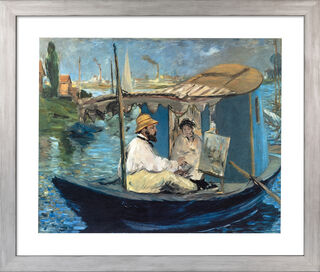


Picture "The Barque" (1874), framed
Quick info
reproduction on cardboard | framed | glazed | size 54 x 63.5 cm (h/w)
Detailed description
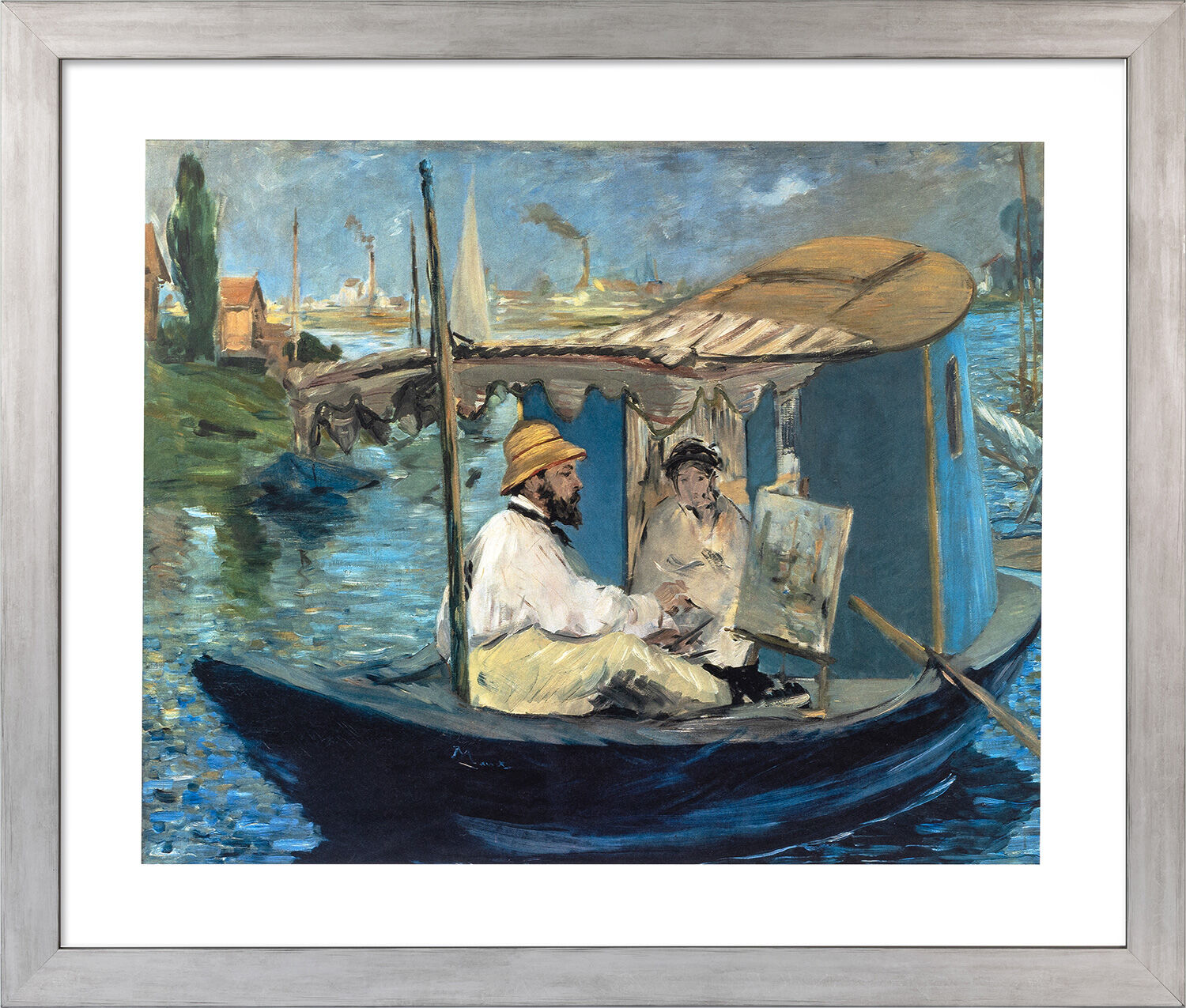
Picture "The Barque" (1874), framed
The classic studio painting was given a new interpretation in the style of the Impressionists: Manet painting his fellow artist Claude Monet in the plein air studio - here on a boat.
Original: 1874, oil on canvas, 82.7 x 105 cm, Neue Pinakothek, Munich.
High-quality edition on cardboard. Framed in a silver-coloured solid wood frame, glazed. Size 54 x 63.5 cm (h/w).
Producer: ars mundi Edition Max Büchner GmbH, Bödekerstraße 13, 30161 Hanover, Germany, [email protected]
About Edouard Manet
1832-1883
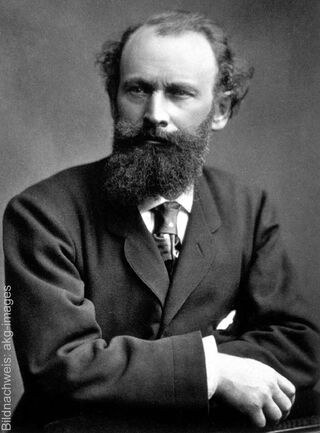
Manet is one of the most important French painters of the second half of the 19th-century. Although he was one of the pioneers of the Impressionists, his style remained independent. He frequently met with the founders of Impressionism, who regarded him as a role model. Because of his encounter with Claude Monet in 1871, he was inspired to paint in the open air. In the following years, his paintings are characterised by brighter, more luminous colours and a lighter, more sketchy brushstroke.
Depiction of typical scenes from daily life in painting, with distinctions between rural, bourgeois, and courtly genres.
The genre reached its peak and immense popularity in Dutch paintings of the 17th century. In the 18th century, especially in France, the courtly and gallant painting became prominent, while in Germany, a more bourgeois character developed.
The style of Impressionism, which emerged in French painting around 1870, owes its name to Claude Monet's landscape 'Impression, Soleil Levant'. After initial rejection, it began a veritable triumphal procession.
Painters such as Claude Monet, Edgar Degas, Edouard Manet, Auguste Renoir and others created motifs from everyday life, urban and landscape scenes in bright, natural light.
Impressionism can be seen as a reaction to academic painting. Rather than emphasizing content with a structured composition, it focused on the subject as it appears in the moment, often in a seemingly random snapshot. The reality was seen in all its variety of colours in natural lighting. Outdoor painting replaced studio painting.
Through the brightening of the palette and the dissolution of firm contours, a new approach to colour emerged. In many cases, the colours were no longer mixed on the palette but placed side by side on the canvas, so that the final impression emerged in the eye of the viewer with a certain distance. In "Pointillism", (with painters such as Georges Seurat or Paul Signac), this principle was taken to the extreme.
Outside France, Impressionism was taken up by painters such as Max Slevogt, Max Liebermann and Lovis Corinth in Germany, and by James A. M. Whistler in the United States.
However, Impressionism was only expressed to a limited extent in the art of sculpture. In the works of Auguste Rodin, who is considered one of the main representatives, a dissolution of surfaces is evident, in which the play of light and shadow is included in the artistic expression. Degas and Renoir created sculptures as well.