
Picture "Red-Yellow Sunflower and Summer Flowers" (around 1930), black and golden framed version




Picture "Red-Yellow Sunflower and Summer Flowers" (around 1930), black and golden framed version
Quick info
ars mundi Exclusive Edition | limited, 199 copies | numbered | certificate | reproduction, Giclée on Hahnemühle handmade watercolour paper | framed | passe-partout | glazed | size approx. 44 x 55 cm (h/w)
Video
Detailed description
Picture "Red-Yellow Sunflower and Summer Flowers" (around 1930), black and golden framed version
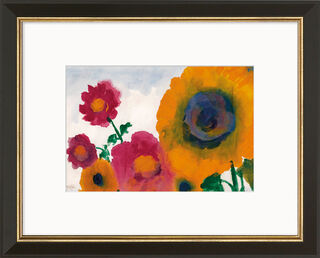
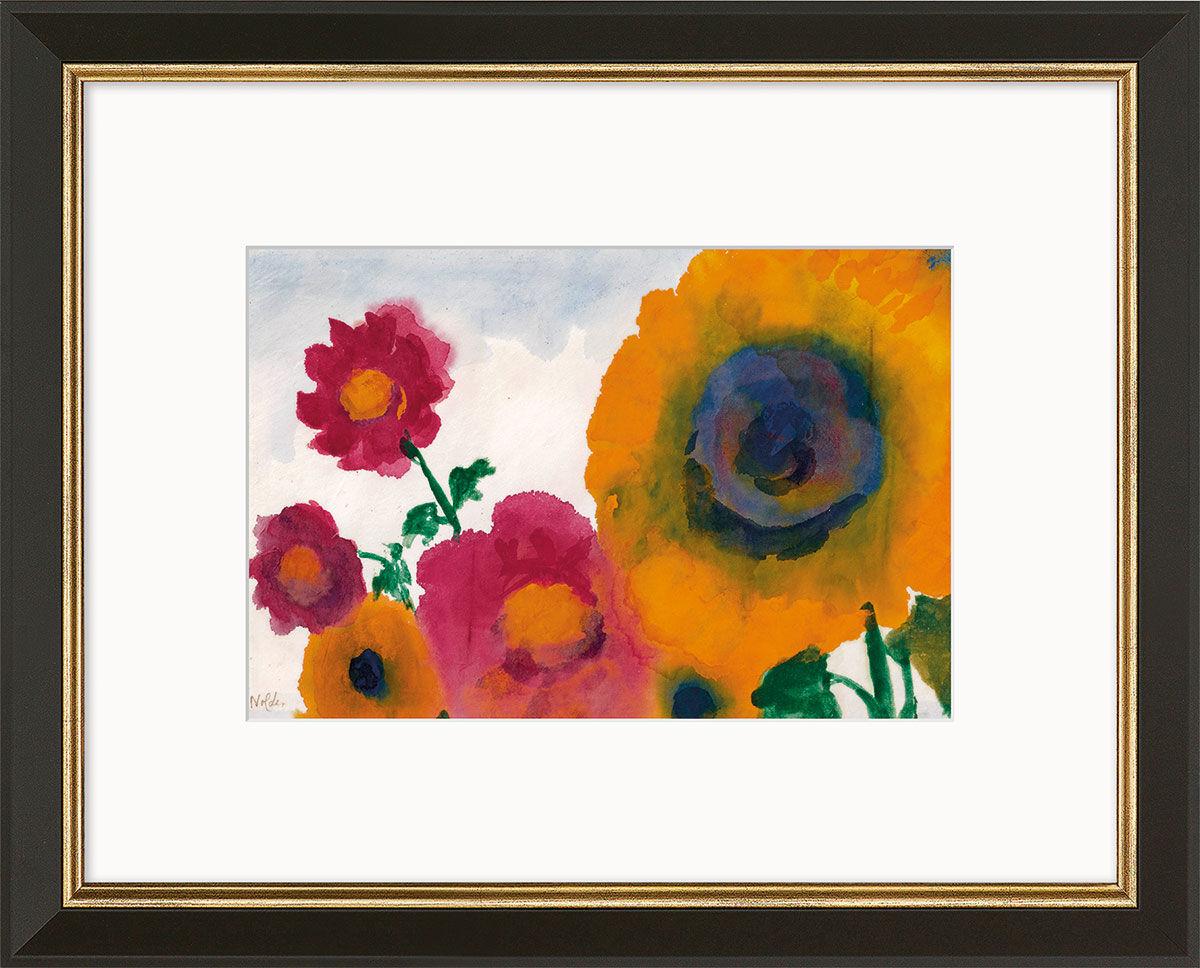
The watercolour "Red-Yellow Sunflower and Summer Flowers", which Emil Nolde painted around 1930, is exemplary of his perfection in handling the watercolour technique and his unique flair for colour composition. Using various methods, the artist achieved a striking vibrancy of colour.
Initially, he worked with a relatively small colour palette: He used yellow and red very prominently, adding just a touch of green for the stems and leaves and a very pale light blue in the background.
The intensity of the colours is further enhanced by the contrast between light and dark. The bright yellow sunflowers contrast with the red of the other summer flowers. Additionally, Nolde emphasised the yellow of the petals by contrasting them with the dark blue to black centre of the sunflower. He painted the blossoms in flat colours, omitting details such as petals or seeds. In this way, he gave the colours plenty of space to unfold.
Original: c. 1930, watercolour, 23 x 34.5 cm, privately owned.
High-quality Fine Art Giclée museum edition reproduced in original size, pigment colours on Hahnemühle genuine handmade watercolour paper. Limited edition of 199 copies, numbered, with certificate. Motif size approx. 23 x 34.5 cm (h/w). Sheet size approx. 38 x 48.5 cm (h/w). Dust-proof glazed and framed in a noble black and golden solid wood frame with passe-partout. Size approx. 44 x 55 cm (h/w). ars mundi Exclusive Edition, published in cooperation with the Nolde Foundation Seebüll. © 2026 Nolde Foundation Seebüll
Producer: ars mundi Edition Max Büchner GmbH, Bödekerstraße 13, 30161 Hanover, Germany, [email protected]
Frame configurator
Customised picture frame

Frame configurator
Customised picture frame


Customer reviews
Frame variant: Framing 2
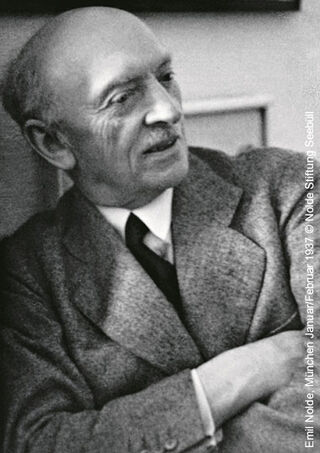
About Emil Nolde
1867-1956 - German Expressionist
Emil Nolde was born as Hans Emil Hansen and named himself after his birthplace in 1902. Nolde is considered one of the most important German Expressionists. When he was rejected by the Munich Academy of Fine Arts, he moved to Paris to study at the Académie Julien. Starting in 1905 he lived and worked on the Danish island of Alsen and in Berlin and was a member of the revolutionary expressionist group "Die Brücke" (The Bridge) for a short time and of the Berlin Secession.
Shortly after Nolde left the artists' association "Die Brücke" at the end of 1907, he met the Norwegian painter Edvard Munch in Berlin, whose work impressed him greatly. During the visit of his friend Hans Fehr in 1908, he began to discover the technique of watercolour painting and finally how to realise it with virtuosity.
Today, Nolde's oeuvre includes numerous watercolour works, oil paintings, graphic works and several sculptures. His intensive use of colour is characteristic. Although the artist always remained figurative in his motifs (e.g. landscapes, flowers, city scenes, religious motifs), he "composed" his pictures entirely from colour. When Nolde moved into his brick house "Seebüll" in Neukirchen in northern Germany in 1927, he surrounded it with a large garden that offered him motifs in abundance.
Research had long noted that Nolde's position on National Socialism was problematic. His exclusion from the Reich Chamber of Fine Arts was associated with a ban on exhibitions, sales and publications. Nolde repeatedly sought rehabilitation and recognition as a state artist. However, he was denied this right up until the end. His painting was simply not formally compatible with the ideas of the Nazis.
At the opening of the infamous exhibition "Degenerate Art", 48 of his works were shown, and more than 1000 works were confiscated. However, due to his contacts, Nolde was able to retrieve a large part of these works.
Despite his active adherence to the system, he was banned from working from 1941 on. However, his ban didn't include a general ban on painting, as was often reported later. During the war, he produced more than 1000 of the so-called "unpainted pictures" in the privacy of his home. The term originally referred to the function of these small-format watercolours as studies and preliminary sketches that were not turned into large paintings. After 1945, these undoubtedly artistically charming pieces and their naming contributed to the mystification of Nolde as a persecuted artist.
Despite the contradictory ideological positions of Nolde as a person, the artistic value of his work remains undisputed to this day. The way Nolde manages to let the colour of an oil painting or aquarelle glow from within is unrivalled.
Works by Emil Nolde can be found in the collections of high-ranking museums worldwide, including the Art Institute in Chicago, the Hermitage Museum in St. Petersburg, the Museum of Modern Art in New York City, the Brücke Museum in Berlin, the Albertina in Vienna and the Kunstmuseum in Basel, etc. Moreover, foundations have been established in his honour in Seebüll and Berlin.
Graphic or sculpture edition that was initiated by ars mundi and is available only at ars mundi or at distribution partners licensed by ars mundi.
> All ars mundi Exclusive Editions