
Picture "Portrait" (1949) (unique piece)
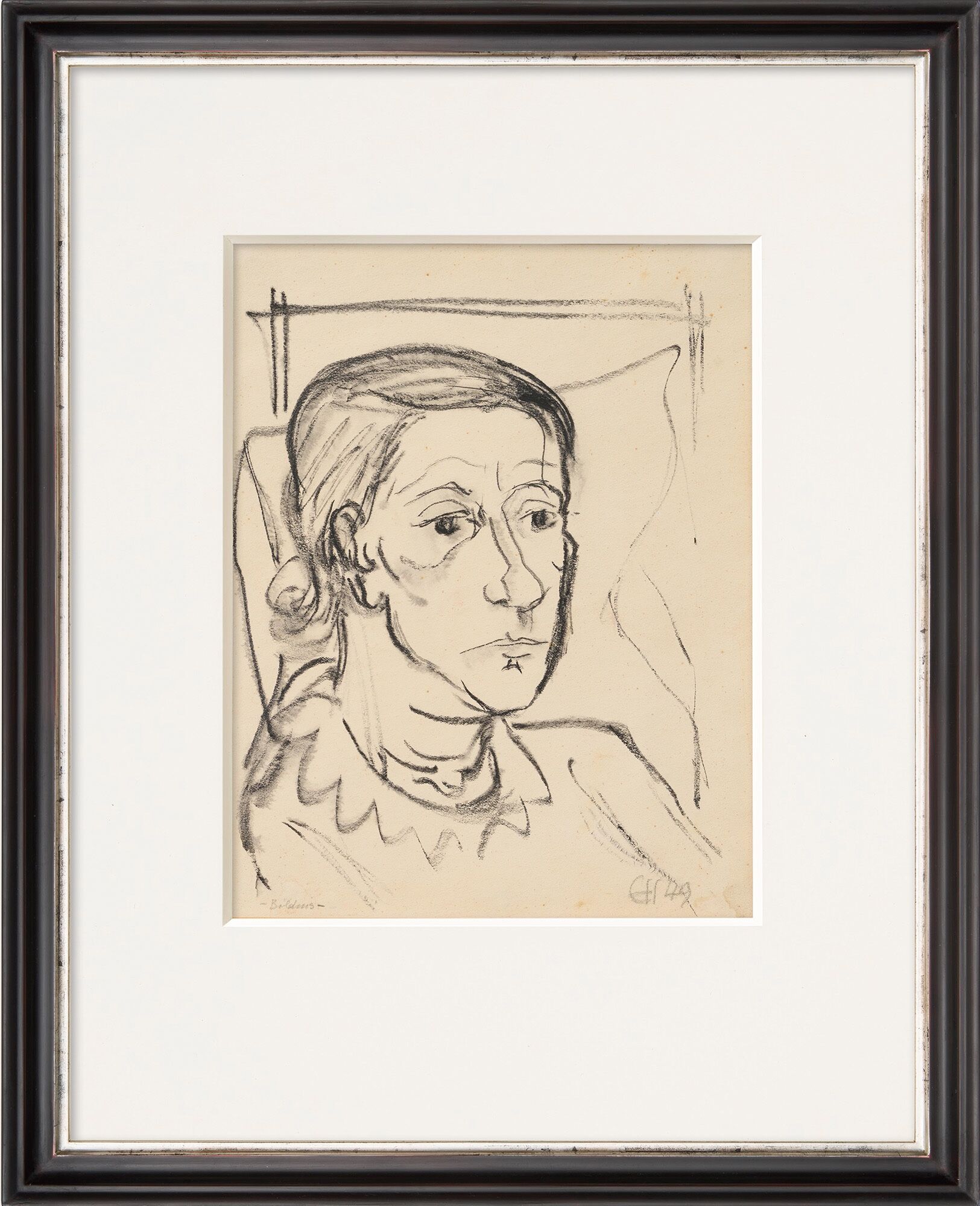


Picture "Portrait" (1949) (unique piece)
Quick info
unique piece | monogrammed | dated | titled | charcoal on paper | framed | size 51 x 44 cm
Detailed description
Picture "Portrait" (1949) (unique piece)
Charcoal on paper, 1949. Monogrammed, dated and titled. Watercolour painted over on the back. Motif size/sheet size 31 x 24 cm. Framed size 51 x 44 cm, as shown.
Producer: ars mundi Edition Max Büchner GmbH, Bödekerstraße 13, 30161 Hanover, Germany, [email protected]

About Erich Heckel
Erich Heckel (1883-1970) is one of the most important artists of German Expressionism. In 1905, together with Ernst Ludwig Kirchner, Karl Schmidt-Rottluff and Fritz Bleyl, he founded the legendary artists' group "Die Brücke" in Dresden, which later Max Pechstein, Emil Nolde and Otto Mueller joined.
After World War I Heckel developed a new, cosmopolitan classicism that was accompanied by a more naturalistic approach and a brightening of the palette. In the 1920s, he produced numerous landscape works, including the unusually large charcoal drawing of the 'Westerholz Mill', which is still a popular touristic destination in Schleswig-Holstein.
Erich Heckel's works are represented in the world's leading museums and collections.
A one-of-a-kind or unique piece is a work of art personally created by the artist. It exists only once due to the type of production (oil painting, watercolour, drawing, lost-wax sculpture etc.).
In addition to the classic unique pieces, there are also the so-called "serial unique pieces". They present a series of works with the same colour, motif and technique, manually prepared by the same artist. The serial unique pieces are rooted in "serial art", a genre of modern art that aims to create an aesthetic effect through series, repetitions, and variations of the same objects or themes or a system of constant and variable elements or principles.
The historical starting point is considered to be Claude Monet's "Les Meules" (1890/1891), where, for the first time, a series was created that went beyond a mere group of works. The other artists, who addressed to the serial art, include Claude Monet, Piet Mondrian and above all Gerhard Richter.