
Sculpture "The Book Reader" (1936), reduction in bronze

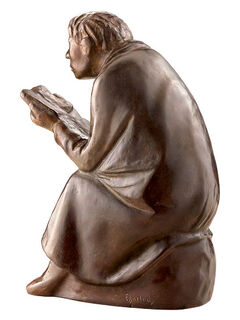
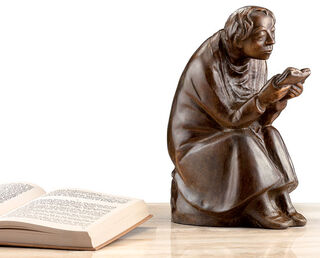


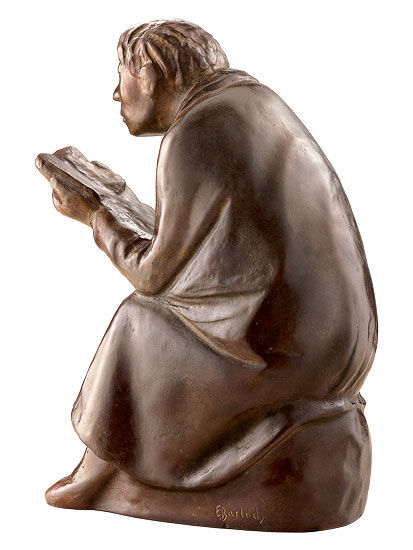
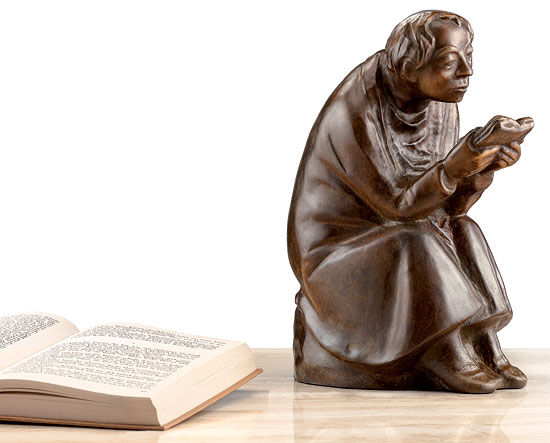
Sculpture "The Book Reader" (1936), reduction in bronze
Quick info
ars mundi Exclusive Edition | limited, 980 copies | numbered | signed | hallmarked | certificate | bronze | reduction | size 11 x 24 x 17.5 cm (w/h/d)
Detailed description
Sculpture "The Book Reader" (1936), reduction in bronze
Ernst Barlach's Book Reader - a Milestone of Modernism
The motif of the reader is a key motif in Barlach's work, which he already addressed in the lithograph from 1916, "To whom time is like eternity and eternity is like time, he is freed from all suffering" and in charcoal drawing from 1922. In the spring of 1936, he gave the motif a special density with the sculpture "The Book Reader".
"The Book Reader" is completely absorbed in his reading, radiating concentration and meditative harmony. He lives in his world: "His back, resembling a spherical shell, protects him like a shield from anything distracting, guards the intimacy and solitude of the reader - the prerequisites of all intellectual endeavour".
Bertolt Brecht described Ernst Barlach's masterly depiction of the reading man with enthusiasm: "A seated man, bent over, holding a book in heavy hands. He reads curiously, confidently, and critically. He is clearly looking for solutions to urgent problems in the book [...] I like "The Book Reader" better than Rodin's famous "Thinker", which only shows the difficulty of thinking. Barlach's sculpture is more realistic, more concrete..."
Sculpture directly moulded from the original and reduced in size (reduction). Fine bronze, cast by hand using the Lost-Wax-Process. Size 11 x 24 x 17,5 cm (w/h/d). Limited edition of 980 copies, individually numbered and with the signature "E. Barlach" taken from the original as well as the foundry hallmark. ars mundi Exclusive Edition, published in cooperation with the Ernst Barlach Society. With numbered certificate of authenticity and limitation.
Producer: ars mundi Edition Max Büchner GmbH, Bödekerstraße 13, 30161 Hanover, Germany, [email protected]
Customer reviews
Sehr schön. Danke.
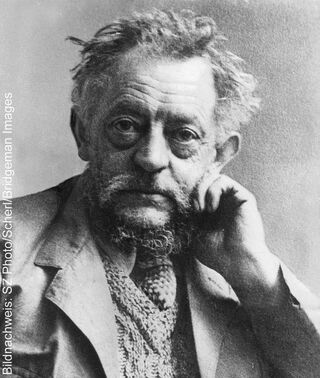
About Ernst Barlach
1870-1938, sculptor, writer, and draughtsman
Ernst Barlach was born on January 2, 1870, in Wedel, Germany, and died on October 24, 1938, in Rostock, Germany. He holds an outstandingly special position within German Expressionism. As a graphic artist, draughtsman, writer, and above all, as a sculptor, Barlach created milestones in art history. Barlach's sculptural works of art have a special effect because they seek extreme experience of limits and their representation. They are works of multi-layered meaning with which he foregrounded the essence of the human being and that what stands above the self and the world.
Barlach's intention is rooted deeply, in the inner self. Shaped by war and challenging living conditions, he experiences both suffering and happiness. And always, at the centre of his work, stands the human being: Ecce homo.
"I desire nothing more than to be an artist, as best I can. I believe that what cannot be expressed through the work can pass into the possession of another through forms. My pleasure and creative impulse continually revolve around the problems of the meaning of life and the other great mountains in the spiritual realm." (Ernst Barlach)
In 1925, Ernst Barlach was made an honorary member of the Academy of Fine Arts in Munich. In 1933, he was appointed Knight of the Peace Class of the Order "Pour le Mérite". In 1937, the National Socialists removed his works from public collections and spaces, branding them as "degenerate art." On October 24, 1938, Ernst Barlach died in Rostock.
Today, Ernst Barlach's works are an integral part of leading museums and collections, and - if available - fetch record prices at auction.
"The Singing Man" became Ernst Barlach's best-known sculpture, an icon of Modernism. It adorns illustrated books and posters worldwide, and the original edition is a permanent part of the collections of the world's major museums, including the Museum of Modern Art (MoMA) in New York.


An alloy of copper with other metals (especially with tin) used since ancient times. It is an ideal metal for high-quality artistic castings, capable of enduring for millennia.
When casting bronze, the artist usually applies the lost-wax technique which is dating back more than 5000 years. This is the best, but also the most complex method of producing sculptures.
First, the artist forms a model of their work. This model is embedded in a liquid silicone rubber mass. Once the material has solidified, the model is cut out, leaving a negative mould. Liquid wax is then poured into the negative mould. After cooling down, the wax cast is removed from the mould, provided with sprues and dipped into ceramic mass. The ceramic mass is hardened in a kiln, where the wax melts away (lost mould).
Finally, the negative mould is ready, into which the 1400° C hot molten bronze is poured. After the bronze had cooled down, the ceramic shell is broken apart, reavoling the sculpture.
Next, the sprues are removed, the surfaces are polished, patinated and numbered by the artist or by a specialist, following their instructions. Thus, each casting is an original work.
For lower-quality bronze castings, the sand casting method is often used, which, however, does not achieve the results of a more elaborate lost-wax technique in terms of surface characteristics and quality.
Graphic or sculpture edition that was initiated by ars mundi and is available only at ars mundi or at distribution partners licensed by ars mundi.
> All ars mundi Exclusive Editions
Artistic movement that replaced Impressionism in the early 20th century.
Expressionism is the German form of the art revolution in painting, graphic art and sculpture, with its precursors found in the works of Paul Cézanne, Vincent van Gogh, and Paul Gauguin at the end of the 19th century. The expressionists sought to reach the fundamental elements of painting. Using vibrant, unbroken colours in large areas, emphasising lines, and aiming for suggestive expressiveness, they fought against the artistic taste established by the bourgeoisie.
The most important representatives of Expressionism were the founders of "Die Brücke": Ernst Ludwig Kirchner, Erich Heckel, Karl Schmidt-Rottluff, Max Pechstein, Otto Mueller and Franz Marc, August Macke and others.
Masters of Viennese Expressionism are Egon Schiele and Oskar Kokoschka. Among sculptors, Ernst Barlach is the most famous.
Fauvism is the French form of Expressionism.
Term for an art object (sculpture, installation) that, according to the artist’s intention, is produced in multiple copies within a limited and numbered edition.
Multiples enable the "democratization" of art by making the work accessible and affordable for a wider audience.
A plastic work of sculptural art made of wood, stone, ivory, bronze or other metals.
While sculptures made of wood, ivory, or stone are carved directly from the material block, in bronze casting, a working model is prepared at first. Usually, it is made of clay or other easily mouldable materials.
The prime time of sculpture after the Greek and Roman antiquity was the Renaissance. Impressionism gave a new impulse to the sculptural arts. Contemporary artists such as Jorg Immendorf, Andora, and Markus Lupertz also enriched sculptures with outstanding works.