
Picture "El semáforo" (2020) (Original / Unique piece), framed

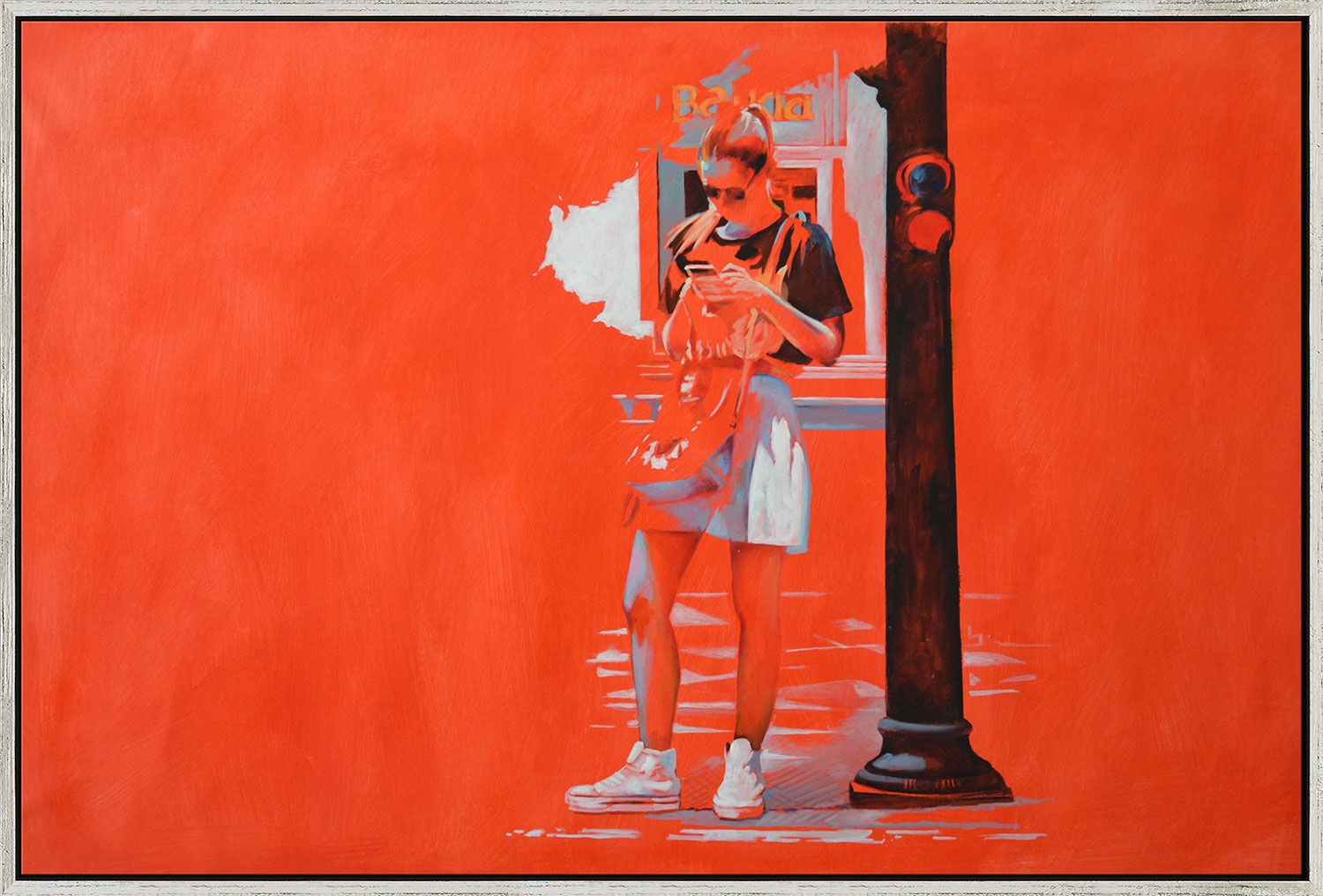


Picture "El semáforo" (2020) (Original / Unique piece), framed
Quick info
original painting | signed | oil on canvas | on stretcher frame | framed | size 105 x 155 cm (h/w)
Detailed description
Picture "El semáforo" (2020) (Original / Unique piece), framed
Original painting 2020, signed by hand. Oil on canvas, stretched on stretcher frame. Stretcher frame size 100 x 150 cm (h/w). Framed in silver-coloured solid wood shadow gap frame. Size 105 x 155 cm (h/w).
Producer: ars mundi Edition Max Büchner GmbH, Bödekerstraße 13, 30161 Hanover, Germany, [email protected]

About Esther Miranda
Esther Miranda Garrido (Esther Miranda), born in 1976 in Vitoria in the Basque Country, Spain, is an artist whose works captivate viewers through its intense engagement with light, colour and everyday moments. After completing a degree in philosophy at the University of Granada, she turned to visual arts and has been working as a freelance painter since 2012. She lives and works in Andalusia and occasionally in Germany, including Wuppertal and Heidelberg.
Miranda's artistic style is characterised by bright colours and a special focus on light, which she considers the central element of her works. Her paintings often depict everyday scenes in which space often merges into the indefinite and blends with the canvas, blurring the boundaries between reality and painting. This technique emphasises the transience of the moment and invites the viewer to discover the hidden beauty in everyday life.
Esther Miranda has exhibited her work at numerous international art fairs and in renowned galleries, including Art Karlsruhe, the Discovery Art Fair in Cologne and Frankfurt, as well as in exhibitions in Berlin, Essen, and Heidelberg. Her works are represented in private and public collections.


Depiction of typical scenes from daily life in painting, with distinctions between rural, bourgeois, and courtly genres.
The genre reached its peak and immense popularity in Dutch paintings of the 17th century. In the 18th century, especially in France, the courtly and gallant painting became prominent, while in Germany, a more bourgeois character developed.
A one-of-a-kind or unique piece is a work of art personally created by the artist. It exists only once due to the type of production (oil painting, watercolour, drawing, lost-wax sculpture etc.).
In addition to the classic unique pieces, there are also the so-called "serial unique pieces". They present a series of works with the same colour, motif and technique, manually prepared by the same artist. The serial unique pieces are rooted in "serial art", a genre of modern art that aims to create an aesthetic effect through series, repetitions, and variations of the same objects or themes or a system of constant and variable elements or principles.
The historical starting point is considered to be Claude Monet's "Les Meules" (1890/1891), where, for the first time, a series was created that went beyond a mere group of works. The other artists, who addressed to the serial art, include Claude Monet, Piet Mondrian and above all Gerhard Richter.