
Picture "Jumping Cat" (Unique piece)
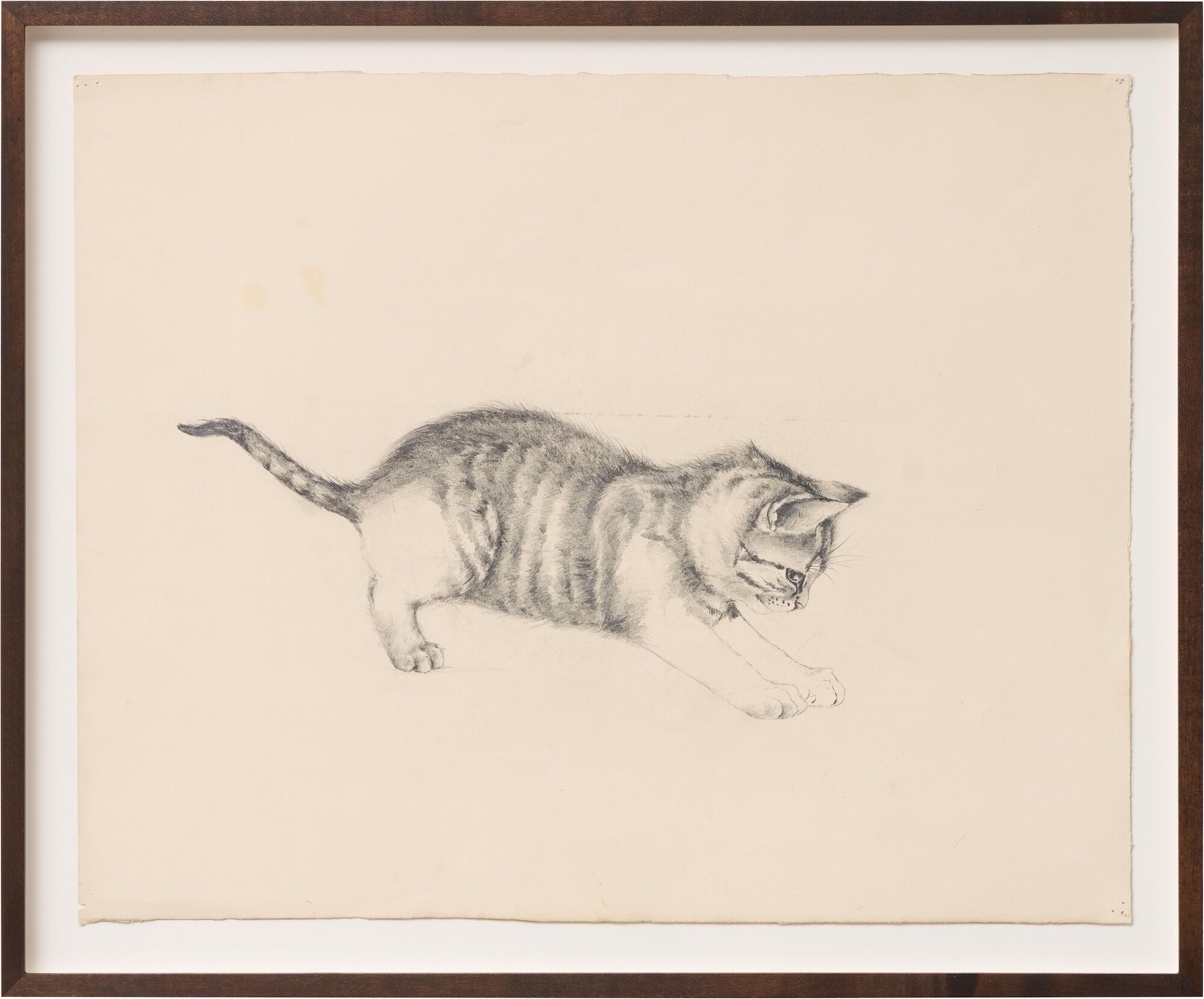


Picture "Jumping Cat" (Unique piece)
Quick info
unique piece | graphite | framed | size 39 x 47 cm
Detailed description
Picture "Jumping Cat" (Unique piece)
Graphite. With certificate of provenance. Motif size/sheet size 33.2 x 41.4 cm. Framed size 39 x 47 cm.
Producer: ars mundi Edition Max Büchner GmbH, Bödekerstraße 13, 30161 Hanover, Germany, [email protected]
About Etha Richter
Etha Richter was born in Dresden in 1883 and died there in 1977. She was a sculptor, draughtswoman and painter. She became best known for her animal sculptures.
As women were not permitted to study at the Dresden Academy of Fine Arts at that time, Richter spent three years as the first female auditor at the Dresden University of Veterinary Medicine. There, she studied anatomy and observed animals. She also took private sculpture lessons with Robert Diez.
From 1903 onwards, her works were purchased by the Saxon state. Richter primarily created sculptures of animals such as monkeys, dogs, cats and predators. In the 1920s, she taught drawing at the ‘Der Weg’ art school in Dresden.
In 1927, she married the veterinary surgeon and animal anatomist Hans Richter. From 1934 to 1940, she lived with him in Ankara, where she taught animal drawing. After her return to Dresden, she continued to work as an artist and teacher. During the destruction of Dresden in 1945, she lost around 500 works.
Etha Richter died in Dresden in 1977. She is regarded as one of the most significant German animal sculptors of the 20th century.
A one-of-a-kind or unique piece is a work of art personally created by the artist. It exists only once due to the type of production (oil painting, watercolour, drawing, lost-wax sculpture etc.).
In addition to the classic unique pieces, there are also the so-called "serial unique pieces". They present a series of works with the same colour, motif and technique, manually prepared by the same artist. The serial unique pieces are rooted in "serial art", a genre of modern art that aims to create an aesthetic effect through series, repetitions, and variations of the same objects or themes or a system of constant and variable elements or principles.
The historical starting point is considered to be Claude Monet's "Les Meules" (1890/1891), where, for the first time, a series was created that went beyond a mere group of works. The other artists, who addressed to the serial art, include Claude Monet, Piet Mondrian and above all Gerhard Richter.