
Picture "Hara Kiri Miki" (2021) (Unique piece)

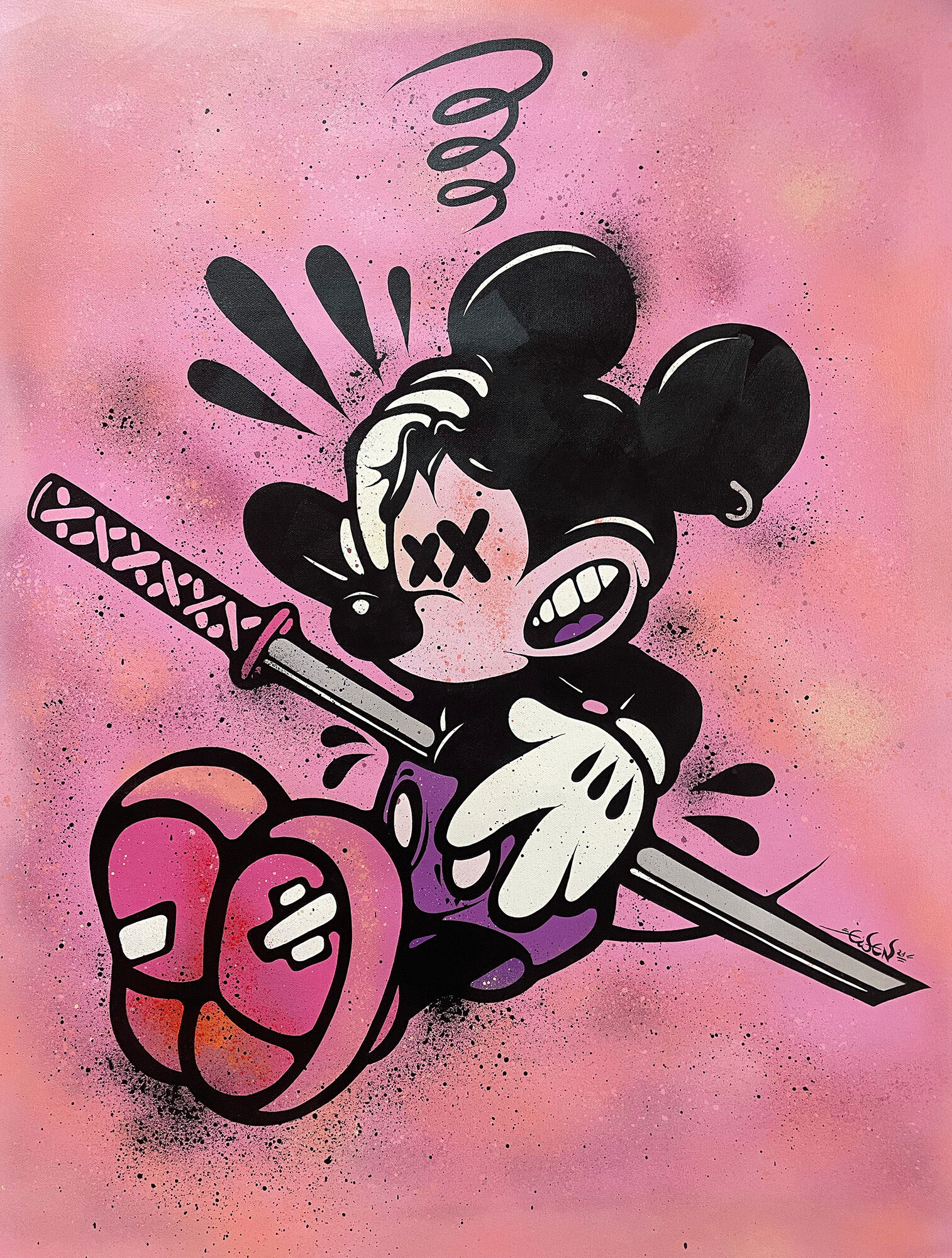


Picture "Hara Kiri Miki" (2021) (Unique piece)
Quick info
unique piece | signed | dated | acrylic and ink on canvas | unframed | size 80 x 60 cm
Detailed description
Picture "Hara Kiri Miki" (2021) (Unique piece)
Acrylic and ink on canvas, 2021, signed and dated. Unframed. Size stretched on stretcher frame 80 x 60 cm.
Producer: ars mundi Edition Max Büchner GmbH, Bödekerstraße 13, 30161 Hanover, Germany, [email protected]

About Ewen Gur
Ewen Gur is a French artist with German roots who grew up near Tours (Indre-et-Loire, France), a region known for its castles and its ‘art de vivre’.
Gur began drawing at a very early age, inspired mainly by video games and French comics such as ‘Francis le Blaireau’ (Claire & Jake), ‘La Rubrique-à-brac’ (Marcel Gotlib) and ‘Gaston Lagaffe’ (Franquin). As far back as he can remember, he has always been fascinated by drawings and stories.
Ewen Gur's style is clearly that of comic book art. The black lines and strong, clear areas of colour strike just the right balance between figuration and abstract elements, which inspire Gur. The message is very clear: life should be taken with a sense of humour and wit.
Ewen Gur's main themes focus on the diversity of human, urban existence with strong references to music, which plays an important role in the artist's life. Consumption and excess are stylised into absurdity. The tragic is conveyed playfully through the comedic.


Graphic artwork in the making of which the artist combines at least two graphic production techniques.
A one-of-a-kind or unique piece is a work of art personally created by the artist. It exists only once due to the type of production (oil painting, watercolour, drawing, lost-wax sculpture etc.).
In addition to the classic unique pieces, there are also the so-called "serial unique pieces". They present a series of works with the same colour, motif and technique, manually prepared by the same artist. The serial unique pieces are rooted in "serial art", a genre of modern art that aims to create an aesthetic effect through series, repetitions, and variations of the same objects or themes or a system of constant and variable elements or principles.
The historical starting point is considered to be Claude Monet's "Les Meules" (1890/1891), where, for the first time, a series was created that went beyond a mere group of works. The other artists, who addressed to the serial art, include Claude Monet, Piet Mondrian and above all Gerhard Richter.