
Picture "Avenue in the Sunshine", framed


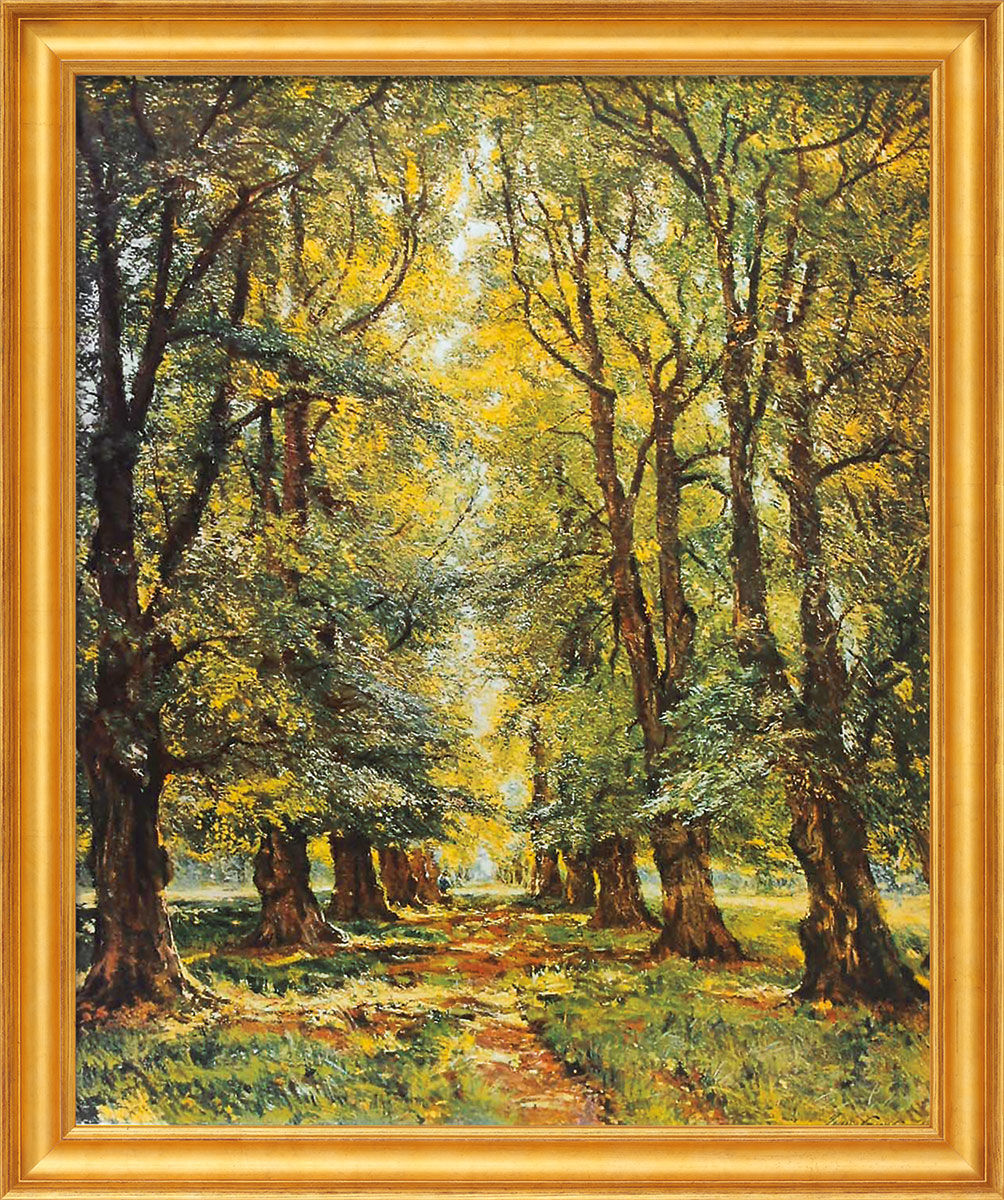


Picture "Avenue in the Sunshine", framed
Quick info
limited, 499 copies | numbered certificate | reproduction, Giclée print on canvas | on stretcher frame | framed | size 74 x 63 cm (h/w)
Detailed description
Picture "Avenue in the Sunshine", framed
The Flemish painter Franz Courtens (1854-1943) was one of the most influential Impressionists outside France. He painted his romantic landscapes in the tradition of the Barbizon school around Jean-François Millet.
Fine Art Giclée on 100% cotton artist canvas. Stretched like an original painting on a wooden stretcher frame (adjustable with wedges for re-stretching). Framed in a handmade fine solid wood museum frame, gilded with metal leaf. Limited edition of 499 copies, with a numbered certificate on the back. Size 74 x 63 cm (h/w).
Producer: ars mundi Edition Max Büchner GmbH, Bödekerstraße 13, 30161 Hanover, Germany, [email protected]
Customer reviews
Giclée = derived from the French verb gicler "to squirt, to spray".
The Giclée method is a digital printing process. It is a high-resolution, large-format print produced with an inkjet printer using special different-coloured dye- or pigment-based inks (usually six to twelve). The inks are lightfast, meaning they are resistant to harmful UV light. They provide a high level of nuance, contrast, and saturation.
The Giclée process is suitable for art canvases, handmade paper and watercolour paper as well as silk.
The style of Impressionism, which emerged in French painting around 1870, owes its name to Claude Monet's landscape 'Impression, Soleil Levant'. After initial rejection, it began a veritable triumphal procession.
Painters such as Claude Monet, Edgar Degas, Edouard Manet, Auguste Renoir and others created motifs from everyday life, urban and landscape scenes in bright, natural light.
Impressionism can be seen as a reaction to academic painting. Rather than emphasizing content with a structured composition, it focused on the subject as it appears in the moment, often in a seemingly random snapshot. The reality was seen in all its variety of colours in natural lighting. Outdoor painting replaced studio painting.
Through the brightening of the palette and the dissolution of firm contours, a new approach to colour emerged. In many cases, the colours were no longer mixed on the palette but placed side by side on the canvas, so that the final impression emerged in the eye of the viewer with a certain distance. In "Pointillism", (with painters such as Georges Seurat or Paul Signac), this principle was taken to the extreme.
Outside France, Impressionism was taken up by painters such as Max Slevogt, Max Liebermann and Lovis Corinth in Germany, and by James A. M. Whistler in the United States.
However, Impressionism was only expressed to a limited extent in the art of sculpture. In the works of Auguste Rodin, who is considered one of the main representatives, a dissolution of surfaces is evident, in which the play of light and shadow is included in the artistic expression. Degas and Renoir created sculptures as well.