
Picture "Ophelia" (around 1900), black and golden framed version
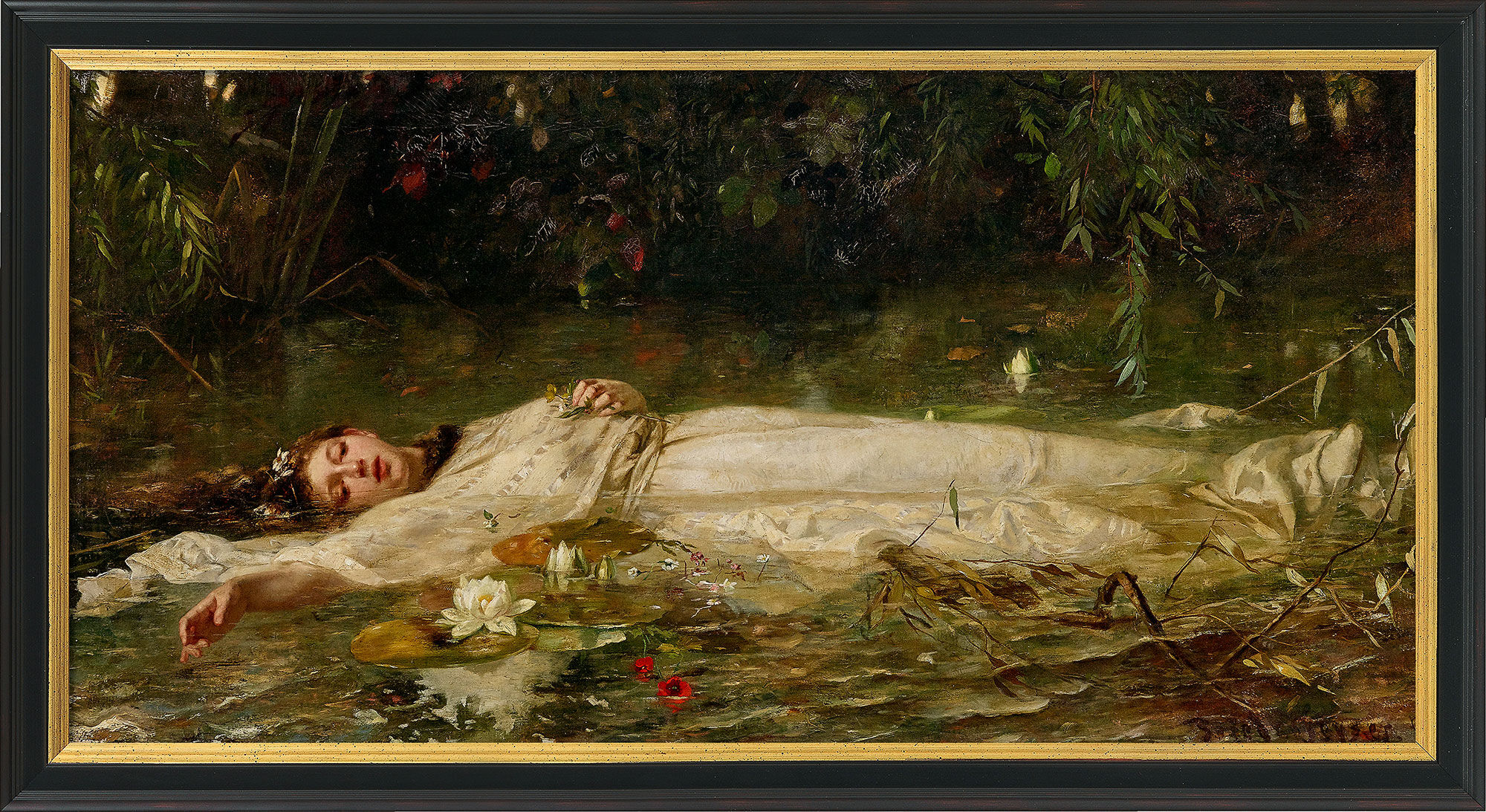


Picture "Ophelia" (around 1900), black and golden framed version
Quick info
ars mundi Exclusive Edition | limited, 980 copies | numbered | certificate | reproduction, Giclée print on canvas | on stretcher frame | framed | size approx. 36 x 66 cm (h/w)
Detailed description
Picture "Ophelia" (around 1900), black and golden framed version
Friedrich Heyser (1857-1921) was not previously regarded as one of the best-known artists of German Art Nouveau and Symbolism. This changed in October 2025, when Taylor Swift recreated a scene from his Ophelia picture as a "living picture" in her music video "The Fate of Ophelia". Thanks to the donation by F. W. Neess, Museum Wiesbaden owns this impressive depiction of Ophelia floating on the water by Friedrich Heyser. The motif is inspired by William Shakespeare's Hamlet.
Original: c. 1900, oil on canvas, 90.5 x 181.5 cm, Museum Wiesbaden.
Edition transferred directly onto artist's canvas using the Fine Art Giclée process and stretched on stretcher frame. Limited edition of 980 copies, numbered, with certificate. Framed in a handmade, black and golden solid wood frame. Size approx. 36 x 66 cm (h/w). ars mundi Exclusive Edition.
Producer: ars mundi Edition Max Büchner GmbH, Bödekerstraße 13, 30161 Hanover, Germany, [email protected]
About Friedrich Heyser
1857–1921
Friedrich Heyser was not previously regarded as one of the best-known artists of German Art Nouveau and Symbolism. This changed in October 2025, when Taylor Swift recreated a scene from his Ophelia painting as a "living picture" in her music video "The Fate of Ophelia".
From 1880 to 1883, Heyser studied at the Royal Academy of Fine Arts in Dresden, Germany, under Leon Pohle and Paul Mohn. This was followed by further studies from 1883 to 1885 under Ferdinand Keller in Karlsruhe. In 1890, Heyser undertook a short period of study at the Académie Julian in Paris. He was also a member of the professional association Allgemeine Deutsche Kunstgenossenschaft as well as the artist group Grün-Weiß, which was founded in Dresden around 1910.
Graphic or sculpture edition that was initiated by ars mundi and is available only at ars mundi or at distribution partners licensed by ars mundi.
> All ars mundi Exclusive Editions
Giclée = derived from the French verb gicler "to squirt, to spray".
The Giclée method is a digital printing process. It is a high-resolution, large-format print produced with an inkjet printer using special different-coloured dye- or pigment-based inks (usually six to twelve). The inks are lightfast, meaning they are resistant to harmful UV light. They provide a high level of nuance, contrast, and saturation.
The Giclée process is suitable for art canvases, handmade paper and watercolour paper as well as silk.
The term Art Nouveau, or the German term Jugendstil (lit.: "Youth Style"), is the art epoch between 1890-1910. The name originates from the Munich-based magazine "Jugend" (Youth), founded in 1896. It was the German counterpart of Art Nouveau (France), internationally known as Modern Style (England) or Secession (Austria).
Art Nouveau spread across Europe, resulting in innumerable works, ranging from painting and applied arts to architecture. One of the requirements of Art Nouveau was the artistic design of everyday objects, aiming to merge beauty with practicality. The desired unity of the artistic ability could only be achieved through individually influenced design, making Art Nouveau a precursor of modernism. The defining characteristic of Art Nouveau is its linear, often asymmetrical ornamentation. The models are particularly taken from nature and flora.
Major Art Nouveau centres were formed in Munich, Darmstadt, Brussels, Paris and Nancy (Glass Art by Emile Gallé). The Viennese architecture of that time was determined by Otto Wagner and J. Hoffmann. Gustav Klimt created paintings that gave sensual shape to the spirit of Art Nouveau.