


Quick info
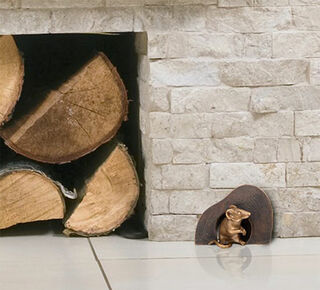
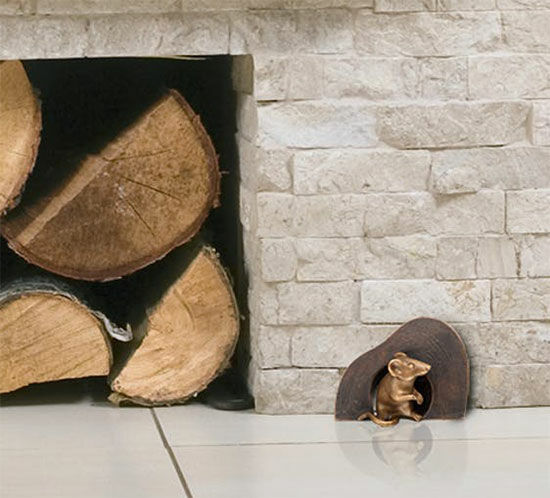
bronze | hand-chased and hand-patinated | size 8 x 10.5 x 4 cm (h/w/d) | weight approx. 0.5 kg | incl. mounting hardware
Detailed description
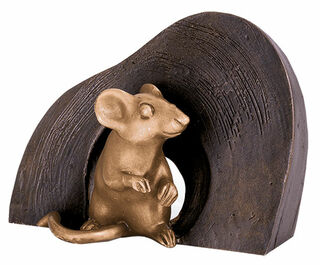
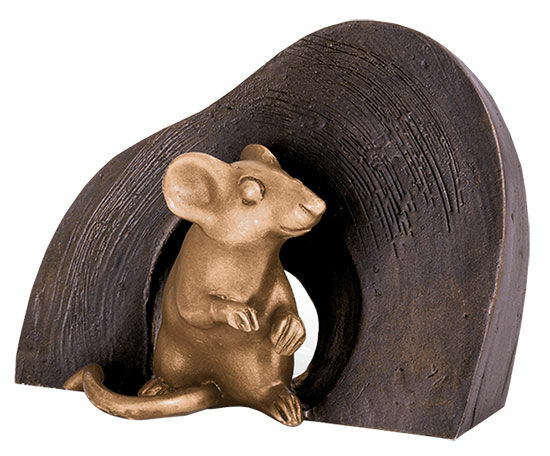
Garden sculpture "Mouse, Sitting", bronze
The mouse is not only found in forests and meadows - it is a synanthropic animal that likes to live close to humans - the Aesopian fable already tells of the encounter between the mus rusticus (the country mouse) and the mus urbanus (the city mouse). As a fine bronze figure, you can confidently invite them into your house and garden as guests: Your cheese stocks will remain untouched, nothing will be gnawed on and even at night, they will be quiet. This rodent provides its own house - i.e. the mouse hole.
Bronze sculpture, cast using the Lost-Wax-Process, chiselled and patinated by hand. Size 8 x 10.5 x 4 cm (h/w/d). Weight approx. 0.5 kg. Can be fastened using the threaded pin supplied.
Customer reviews
-
An alloy of copper with other metals (especially with tin) used since ancient times. It is an ideal metal for high-quality artistic castings, capable of enduring for millennia.
When casting bronze, the artist usually applies the lost-wax technique which is dating back more than 5000 years. This is the best, but also the most complex method of producing sculptures.
First, the artist forms a model of their work. This model is embedded in a liquid silicone rubber mass. Once the material has solidified, the model is cut out, leaving a negative mould. Liquid wax is then poured into the negative mould. After cooling down, the wax cast is removed from the mould, provided with sprues and dipped into ceramic mass. The ceramic mass is hardened in a kiln, where the wax melts away (lost mould).
Finally, the negative mould is ready, into which the 1400° C hot molten bronze is poured. After the bronze had cooled down, the ceramic shell is broken apart, reavoling the sculpture.
Next, the sprues are removed, the surfaces are polished, patinated and numbered by the artist or by a specialist, following their instructions. Thus, each casting is an original work.
For lower-quality bronze castings, the sand casting method is often used, which, however, does not achieve the results of a more elaborate lost-wax technique in terms of surface characteristics and quality.