
Picture "Teyde Landscape" (1971)
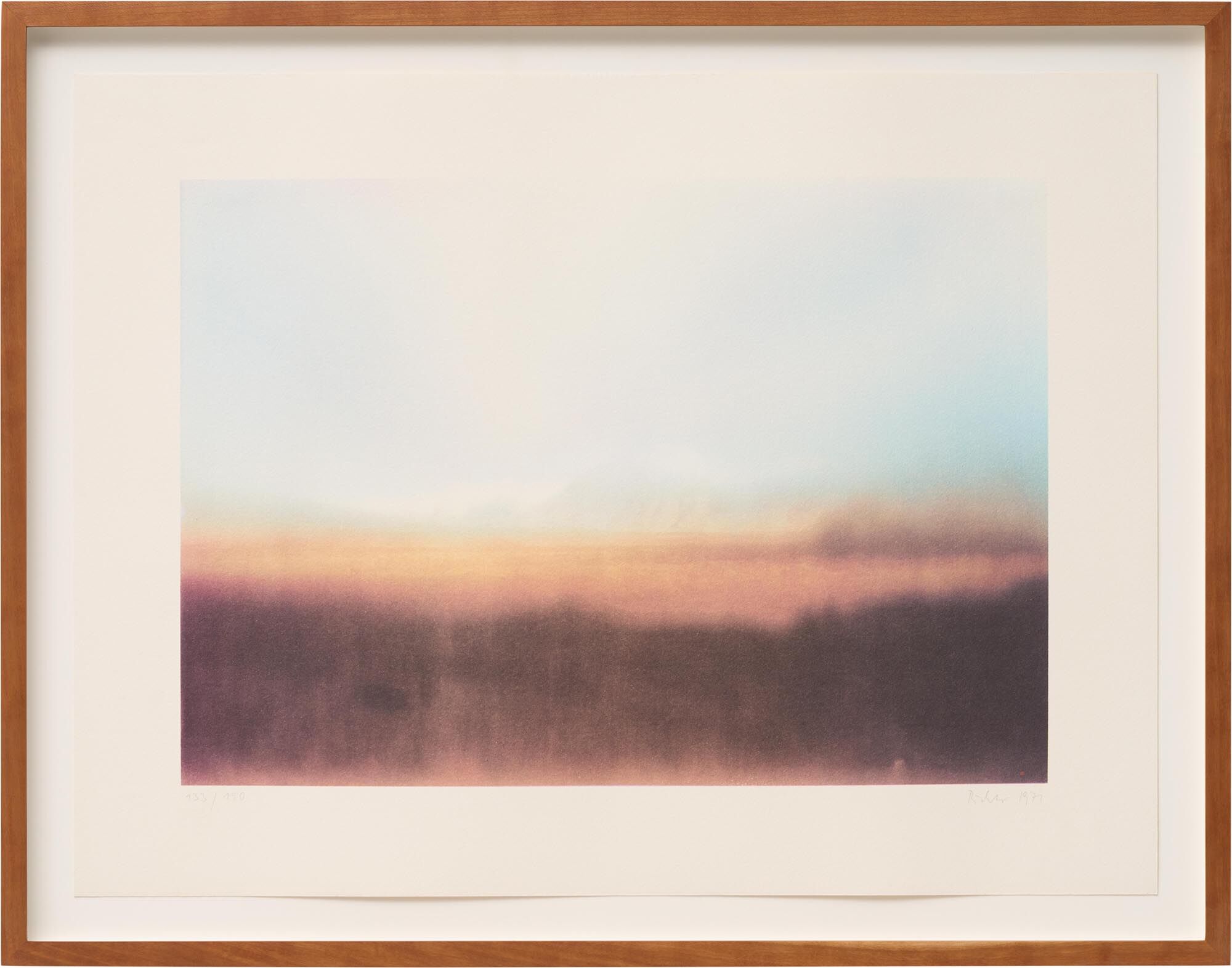


Picture "Teyde Landscape" (1971)
Quick info
limited, 150 copies | numbered | signed | offset print on paper | framed | size 53 x 67.5 cm
Detailed description
Picture "Teyde Landscape" (1971)
With an almost poetic restraint, the picture of "Teyde Landscape" unfolds: a remote crater on Tenerife is not read as geological topography, but as an atmospheric mood. The print does not reduce the photographic motif to documentary clarity, instead, it transforms it into a spherical drawing of colour, in which the luminous tones of the yellow, red, blue, and black series arch across the surface and open up an almost meditative space for the viewer - a landscape that is less seen than felt.
Gerhard Richter, who has maintained his own photographic "encyclopaedia", the Atlas, since the late 1960s, again chooses to translate only a selected fragment here - a gesture that elevates the fragment to the origin of a new way of seeing, a picture that does not depict but resonates. The work is exemplary of Richter's quiet struggle with the medium of photography and the question of how a photographic source can relinquish its generic identity in order to enter the autonomous realm of painting. In this way, an offset print becomes not merely a reproduction, but a poetic reflection - a gift to the viewer, allowing them to perceive the expanse of a silence that fulfils itself only in consciousness.
Colour offset print, 1971. Edition: 150 copies marked with Arabic numerals (offered here) and 20 copies numbered in Roman numerals, signed. Based on a photograph of the Teyde crater on Tenerife. Catalogue raisonné Butin 41. Motif size: 45.2 x 57.5 cm. Sheet size: 45.4 x 59.9 cm. Size in frame 53 x 67.5 cm as shown.
Producer: ars mundi Edition Max Büchner GmbH, Bödekerstraße 13, 30161 Hanover, Germany, [email protected]
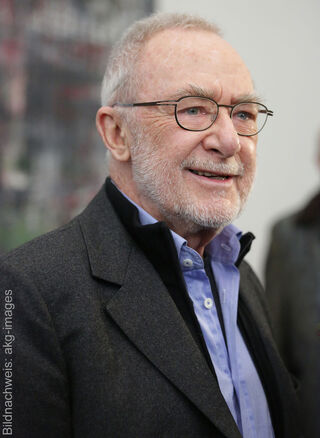
About Gerhard Richter
"I pursue no intentions, no system, no direction; I have no programme, no style, no mission." With these words, one of the most successful and versatile artists of our time describes himself - Gerhard Richter.
Born in 1932 in Dresden, Germany, Richter left his hometown two months before the building of the Berlin Wall in 1961 and went to West Germany to continue his studies at the Düsseldorf Art Academy. The young artist attracted attention with his photo-realistic paintings of motifs straight out of the family album. In a time and environment in which experimental, abstract art was predominant, Richter's paintings caused a sensation.
Richter's characteristic seems to be to look for new modes of expression whenever a method he explored has successfully established itself in the art market. His figurative painting in grey was followed by monochrome grey paintings and the coloured "Vermalung" (Inpainting) that made the pictorial motif unrecognisable. In the mid-1970s, he got involved in abstraction, no less successfully than with his previous works.
Versatility extends through Gerhard Richter's entire oeuvre. He is not "only" a painter, but also a sculptor and photographer, he draws, paints in watercolours, does performances and installations. His photographs and prints are now just as sought-after as his paintings, with high prices included. His paintings take up the room and are created with full physical effort.
His fame and the high prices are sometimes scary for the artist himself, as he freely admitted in an interview with Die Zeit in 2015. However, this does not detract from the popularity of his works. Richter is an artist who, despite his outstanding status, has remained true to himself and prefers to let his art speak instead of stage-managing himself.
In 2011, his oil painting "Kerze" (Candle) from 1982 sold for almost 12 million euros at Christie's London. The painting belongs to a series that Richter painted in the early 1980s in his slightly blurred, photorealistic style. It is considered a symbol of East Germany (GDR) citizens' silent protest against the socialist regime and became one of Richter's most famous motifs.
The most important private collector of Gerhard Richter is the British musician Eric Clapton, who owns more than 50 works. And this is even though Richter's works are the most expensive of any living artist on the art market. The canvas "Abstraktes Bild" (Abstract Picture) from 1986 was sold at Sotheby's for 41 million euros. And even some of Richter's graphic works are already being traded in the six-figure range.
Gerhard Richter was awarded the Praemium Imperiale, the Nobel Prize for the arts, in 1997 and, as special recognition, a comprehensive retrospective at the New York Museum of Modern Art in 2002. With 188 works, it was the largest ever dedicated to a living artist.
The field of graphic arts, that includes artistic representations, which are reproduced by various printing techniques.
Printmaking techniques include woodcuts, copperplate engraving, etching, lithography, serigraphy, among others.