
Picture "Portrait of Elisabeth Lederer" (1914-16), black and golden framed version
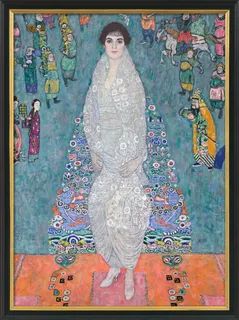


Picture "Portrait of Elisabeth Lederer" (1914-16), black and golden framed version
Quick info
ars mundi Exclusive Edition | limited, 980 copies | numbered | certificate | reproduction, Giclée print on canvas | on stretcher frame | framed | size approx. 71 x 53 cm (h/w)
Video
Detailed description
Picture "Portrait of Elisabeth Lederer" (1914-16), black and golden framed version
The previous auction record for a work by Gustav Klimt stood at 108.8 million dollars and was achieved in London in 2023. Now, on 18 November 2025, the work "Portrait of Elisabeth Lederer" has been auctioned in New York for 236.4 million dollars. The work "Portrait of Elisabeth Lederer" was previously part of the collection of the late billionaire Leonard A. Lauder. It depicts the daughter of the Austrian industrial couple Lederer, who repeatedly supported Gustav Klimt and commissioned him in 1914 to portray Elisabeth.
The work "Portrait of Elisabeth Lederer" is now ranked second among the most expensive works in art history, directly behind Leonardo da Vinci’s "Salvator Mundi", which achieved 450.3 million dollars in 2017.
Original: 1914-1916, oil on canvas, 180.4 x 130.5 cm, privately owned.
Edition transferred directly onto artist's canvas using the fine art giclée process and stretched on stretcher frame. Limited edition of 980 copies, numbered, with certificate. Framed in a handmade, black and golden solid wood frame. Size approx. 71 x 53 cm (h/w). ars mundi Exclusive Edition.
Producer: ars mundi Edition Max Büchner GmbH, Bödekerstraße 13, 30161 Hanover, Germany, [email protected]
Frame configurator
Customised picture frame

Frame configurator
Customised picture frame


Customer reviews
Frame variant: Framing 1
wunderschön. Der Druck sieht aus wie ein Gemälde und der Rahmen passt perfekt dazu
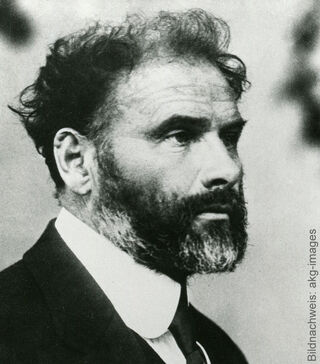
About Gustav Klimt
1862-1918, Austrian painter, a famous representative of Viennese Art Nouveau
Gustav Klimt (1862-1918) was already a renowned artist, influencing the Art Nouveau style of Vienna's famous Ringstrasse with his murals and co-founding the Vienna Secession, when he created his "Golden Style". Inspired by the Byzantine mosaics, he inserted ornamental colour surfaces into a golden bed just like encased gemstones. In his pictorial programs, Klimt describes the human life path, where, negatively influenced by instincts, the person finds redemption in the kiss. The depictions of the body convey a subtle eroticism, although their figures dissolve into ornamental and geometric colour surfaces. He utilized this method not only for his depictions of couples but also for his portraits of rich women and landscape paintings. This two-dimensional style is today the epitome of Klimt's intensely coloured art, which, however, only characterises his work from 1905 onwards.
Klimt was not only adept at gold and opulence but was also a brilliant draughtsman. Throughout his life, he produced numerous drawings, mostly as preliminary studies for larger works.
As a son of an engraver, Klimt learned his craft at Vienna‘s School of Applied Arts. While still seeking to find his own artistic style, his early work is based on historicism especially influenced by Hans Makart, the artist Prince of the Habsburg monarchy in the late 19th century. Together with his brother Ernst and Franz Matsch, the three young painters formed an artistic community and received numerous commissions to design new buildings on Vienna's Ringstrasse. The staircases of Vienna's Burgtheater or the Museum of Fine Arts bear witness to the historicist style of this collaborative team.
In the late 1890s, like so many young and open-minded artists of the fin de siècle, Gustav Klimt abandoned the academic tradition. In 1897, together with other artists, he founded the "Vienna Secession", which he presided over as president until his resignation in 1905. To this day, the Secession's exhibition building remains a place and temple for new young art.
Graphic or sculpture edition that was initiated by ars mundi and is available only at ars mundi or at distribution partners licensed by ars mundi.
> All ars mundi Exclusive Editions
Giclée = derived from the French verb gicler "to squirt, to spray".
The Giclée method is a digital printing process. It is a high-resolution, large-format print produced with an inkjet printer using special different-coloured dye- or pigment-based inks (usually six to twelve). The inks are lightfast, meaning they are resistant to harmful UV light. They provide a high level of nuance, contrast, and saturation.
The Giclée process is suitable for art canvases, handmade paper and watercolour paper as well as silk.
The term Art Nouveau, or the German term Jugendstil (lit.: "Youth Style"), is the art epoch between 1890-1910. The name originates from the Munich-based magazine "Jugend" (Youth), founded in 1896. It was the German counterpart of Art Nouveau (France), internationally known as Modern Style (England) or Secession (Austria).
Art Nouveau spread across Europe, resulting in innumerable works, ranging from painting and applied arts to architecture. One of the requirements of Art Nouveau was the artistic design of everyday objects, aiming to merge beauty with practicality. The desired unity of the artistic ability could only be achieved through individually influenced design, making Art Nouveau a precursor of modernism. The defining characteristic of Art Nouveau is its linear, often asymmetrical ornamentation. The models are particularly taken from nature and flora.
Major Art Nouveau centres were formed in Munich, Darmstadt, Brussels, Paris and Nancy (Glass Art by Emile Gallé). The Viennese architecture of that time was determined by Otto Wagner and J. Hoffmann. Gustav Klimt created paintings that gave sensual shape to the spirit of Art Nouveau.