
Picture "Roses dans une coupe - Roses in the Bowl" (1882), framed
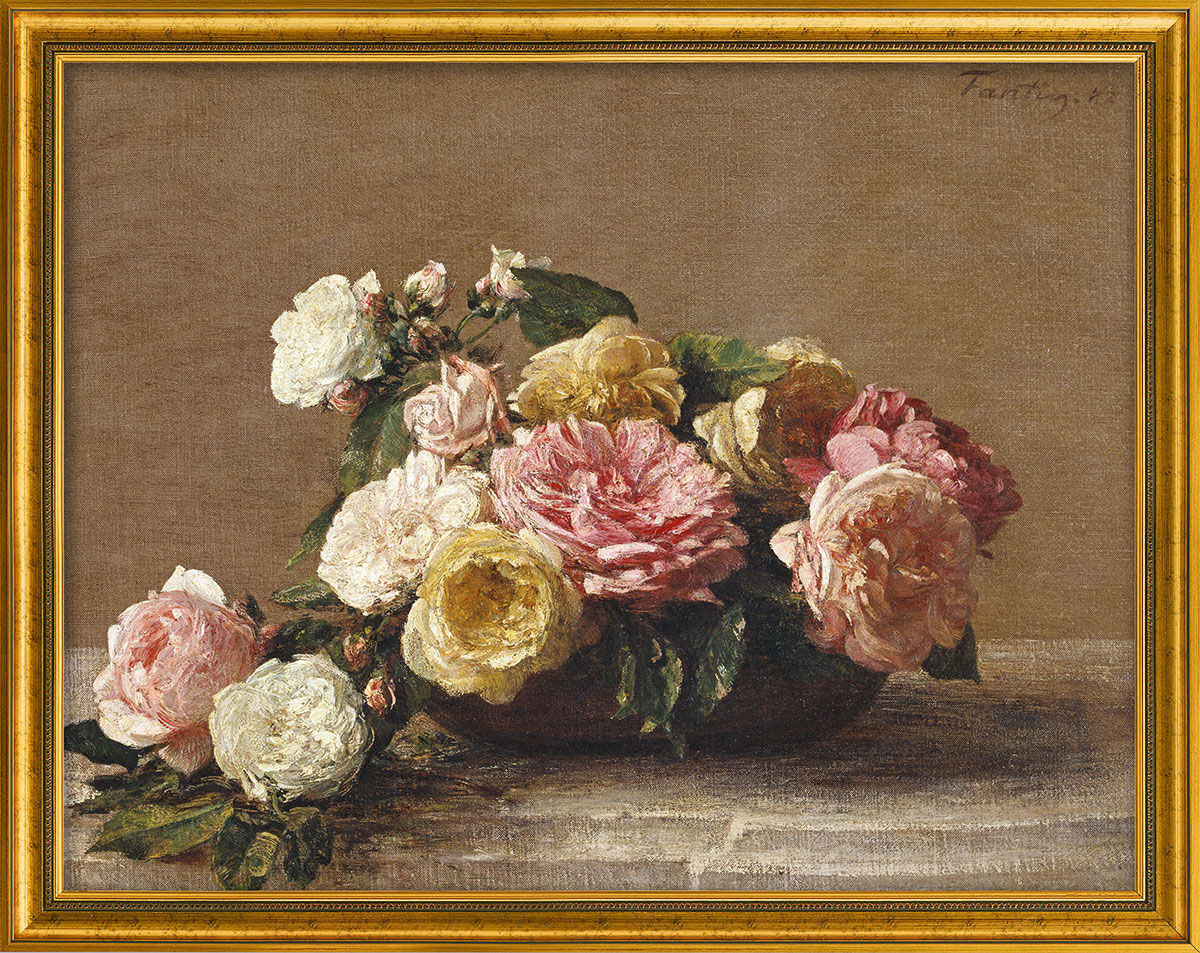


Picture "Roses dans une coupe - Roses in the Bowl" (1882), framed
Quick info
limited, 980 copies | numbered certificate | reproduction, Giclée print on canvas | on stretcher frame | framed | size approx. 54 x 68 cm (h/w)
Detailed description
Picture "Roses dans une coupe - Roses in the Bowl" (1882), framed
Original: 1882, oil on canvas. Musée d'Orsay, Paris.
Edition transferred directly onto artist's canvas using the Fine Art Giclée process and stretched on stretcher frame. Limited edition of 980 copies. With numbered limitation certificate on the back. Framed in a golden solid wood frame. Size approx. 54 x 68 cm (h/w).
Producer: ars mundi Edition Max Büchner GmbH, Bödekerstraße 13, 30161 Hanover, Germany, [email protected]
About Henri Fantin-Latour
1836-1904
When modernism emerged Henri Fantin-Latour lived in the epicentre – Paris. He was friends with many of the writers and painters who were to revolutionise art. But although he had regular contact with the Impressionists such as Manet, Degas and Whistler, he stuck to his painting style, which was trained by Gustave Courbet and committed to realism.
He became famous for his still lifes, which he produced with almost photographic precision. Those still lifes were also highly appreciated by his fellow painters who pursued completely different ideas and approaches. In addition, there is a series of group portraits in which he depicted his illustrious circle of friends – above all the "Homage to Delacroix" from 1865 (which shows the late painter surrounded by Whistler, Manet, Baudelaire and Fantin-Latour himself, among others) and the "A Studio at Les Batignolles" from 1870, which portrays Manet and his companions (including Zola, Monet and Renoir).
His lithographs, which were inspired by the music of his time, were also highly influential. In art history today, they are regarded as bridging the gap between realism and later symbolism.
Giclée = derived from the French verb gicler "to squirt, to spray".
The Giclée method is a digital printing process. It is a high-resolution, large-format print produced with an inkjet printer using special different-coloured dye- or pigment-based inks (usually six to twelve). The inks are lightfast, meaning they are resistant to harmful UV light. They provide a high level of nuance, contrast, and saturation.
The Giclée process is suitable for art canvases, handmade paper and watercolour paper as well as silk.
A 19th-century trend of painting originated in France. Gustave Courbet was regarded as the initiator of the realist movement.
In Germany, Wilhelm Leibl and Hans Thoma, among others, were very enthusiastic about this style, which dealt with reality in a realistic way. In the 20th century, therewere recurring realist tendencies, such as Nouveau Réalisme, with artists like Arman and Jean Tinguely and the movement New Objectivity. In the 1960s, new forms of Realism emerged.
American Realism was founded by a group of eight painters of the Ashcan School. They were later joined by Edward Hopper, who became famous for his typically American motifs, depictions of people in architectural or landscape settings in static, actionless situations.