
Picture "Zügenschlucht Near Davos" (1925) (Unique piece)
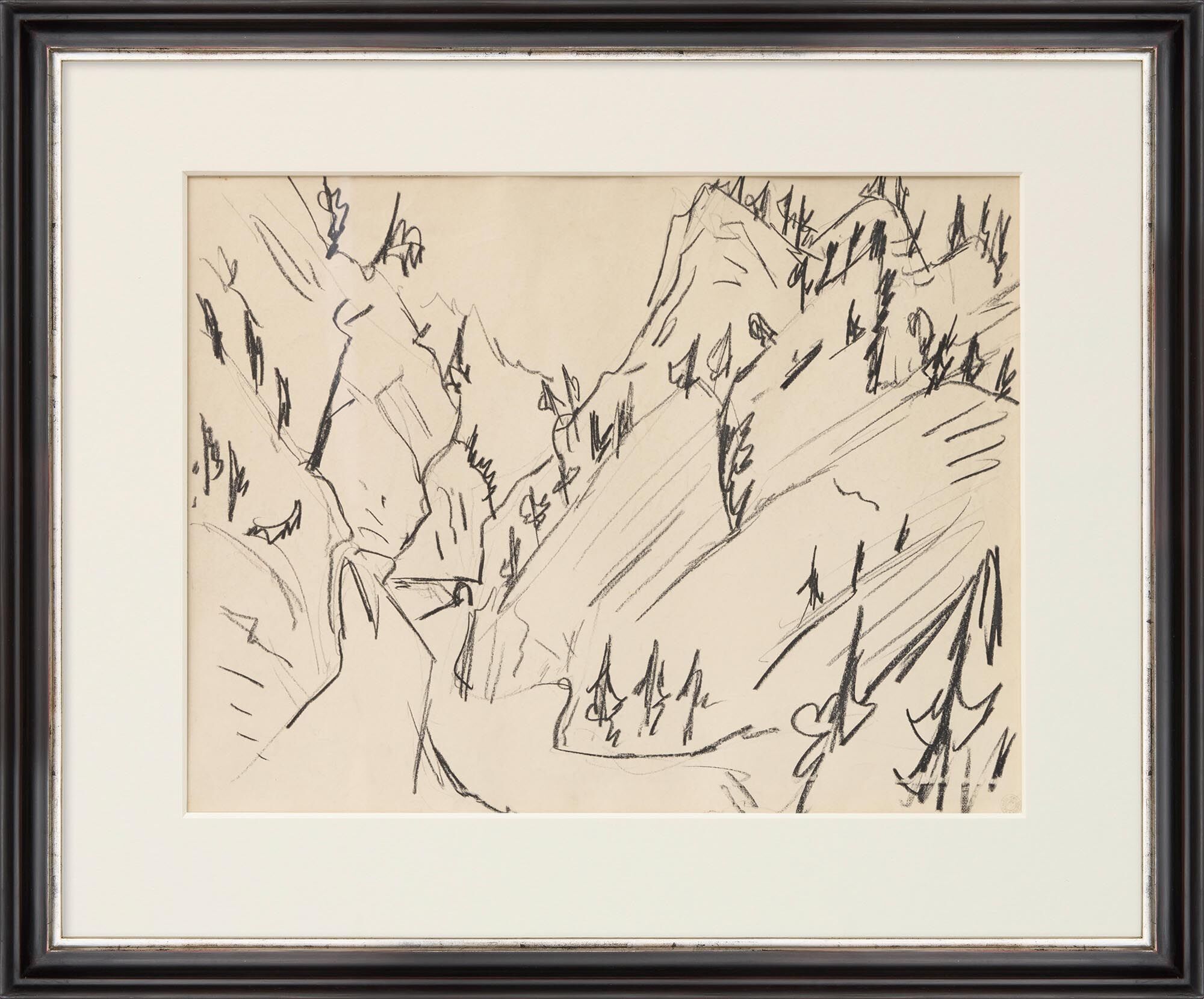


Picture "Zügenschlucht Near Davos" (1925) (Unique piece)
Quick info
unique piece | stamped | charcoal on paper | framed | size 63 x 76 cm
Detailed description
Picture "Zügenschlucht Near Davos" (1925) (Unique piece)
Charcoal on paper, 1925. Estate stamp in the bottom right-hand corner. Motif size/sheet size 43 x 56 cm. Framed size 63 x 76 cm, as shown.
Producer: ars mundi Edition Max Büchner GmbH, Bödekerstraße 13, 30161 Hanover, Germany, [email protected]
About Hermann Scherer
Hermann Scherer (1893-1927) was a leading Swiss painter, sculptor and printmaker of the Expressionist movement. As a member of the Rot-Blau artists’ group, he shaped modern Swiss art of the 1920s with a powerful, expressive visual language. His works are characterised by striking forms, intense colours and dynamic woodcuts. Despite his early death at the age of just 34, Scherer left behind a diverse and influential body of work that is still valued today for its emotional expressiveness and artistic originality.
A one-of-a-kind or unique piece is a work of art personally created by the artist. It exists only once due to the type of production (oil painting, watercolour, drawing, lost-wax sculpture etc.).
In addition to the classic unique pieces, there are also the so-called "serial unique pieces". They present a series of works with the same colour, motif and technique, manually prepared by the same artist. The serial unique pieces are rooted in "serial art", a genre of modern art that aims to create an aesthetic effect through series, repetitions, and variations of the same objects or themes or a system of constant and variable elements or principles.
The historical starting point is considered to be Claude Monet's "Les Meules" (1890/1891), where, for the first time, a series was created that went beyond a mere group of works. The other artists, who addressed to the serial art, include Claude Monet, Piet Mondrian and above all Gerhard Richter.