
Tote bag "Crown Black"
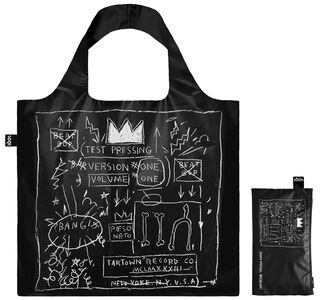
Tote bag "Crown Black"
Quick info
recycled material | coated | size 50 x 42 cm (h/w) | handle length 27 cm | incl. additional pocket | waterproof | max. load 20 kg | hand wash
Detailed description
Tote bag "Crown Black"
A symbol of power, creative strength and self-made nobility. This reusable tote bag made from recycled material features Basquiat's iconic crown motif, originally designed as a record cover and exhibited at the Museum of Modern Art (MoMA).
Bag made from recycled materials with an additional metallic coating. Size 50 x 42 cm (h/w). Handle length 27 cm. Comes in an additional zip-fastened pouch (13 x 23 cm). Waterproof. Carries up to 20 kg. Hand wash recommended. © Estate of Jean-Michel Basquiat. Licensed by Artestar, New York.
Producer: ars mundi Edition Max Büchner GmbH, Bödekerstraße 13, 30161 Hanover, Germany, [email protected]
About Jean-Michel Basquiat
1960-1988
Jean Michel Basquiat was an American artist who gained international attention in the 1980s with his expressive, often raw paintings. Born in 1960 in Brooklyn, New York, he began as a graffiti artist under the pseudonym "SAMO". He quickly became a central figure in the New York art scene.
His works combine text elements, symbols, and strong colours with socially critical themes such as racism, power structures, and identity. Despite his early death in 1988 at the age of just 27, Basquiat left behind a significant artistic legacy and is now considered an icon of modern art.
In the early 1950s, a movement took over the cultural scene. Young artists from the U.S. and the UK independently broke with all traditions of artistic creativity, giving rise to a new art movement in modern art.
In the U.S., Roy Lichtenstein, Andy Warhol, Tom Wesselmann, and James Rosenquist who were seeking their themes in the world of advertising and comics, in star cult and anonymous urban culture. With bright colours, over dimensioning and manipulating depth perspective, they created new provocative works. Richard Hamilton and Eduardo Paolozzi became pioneers of Pop Art in England through the famous "This is Tomorrow" at London's Whitechapel Art Gallery. In the 1960s, they were followed by David Hockney, Allan Jones, Peter Phillips and Derek Boshier.