
Garden sculpture "Nymph", bronze


Garden sculpture "Nymph", bronze
Quick info
limited, 24 copies | numbered | signed | bronze | chased | patinated | size 73 x 135 x 70 cm (h/w/d) | weight approx. 52 kg
Detailed description
Garden sculpture "Nymph", bronze
With skilful hands she frees herself from the fishing line - she will keep her freedom and her independence.
Edition in bronze, cast using the Lost-Wax-Process, chiselled and patinated by hand. Limited edition of 24 copies, numbered and signed. Size 73 x 135 x 70 cm (h/w/d). Weight approx. 52 kg.
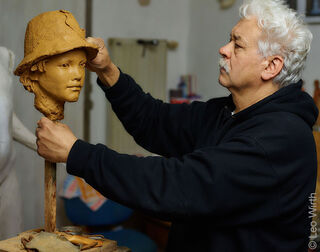
About Leo Wirth
"It's the details that count" is the motto of sculptor Leo Wirth, and in each of his works, it is obvious how seriously he means it.
Leo Wirth works figuratively. With great dedication to detail, his works (portraits of people, fountain sculptures, religious and mythological motifs such as St. Francis or the Roman fertility goddess Ceres) come alive.
The same applies to his depiction of everyday people, which he is particularly interested in; people that any of us might run into on the street. His sculptures deal with human strengths and weaknesses and the challenges of life. It is easy to recognise oneself in those small, often humorous everyday life scenes. In their skilful execution, the realistic but also expressive sculptures are inviting to contemplate and reflect.
Leo Wirth, born in 1956, graduated from the technical school for wood and stone sculpture in Elbigenalp/Tyrol in 1989 as the best graduate of his year. Afterwards, he decided to start his own business as a freelance sculptor. His success proved him right. Today his large sculptures can be found in public places in Dorum by the North Sea ("Deicharbeiter") to Isny in the Allgäu ("Neidhammelbrunnen").
An alloy of copper with other metals (especially with tin) used since ancient times. It is an ideal metal for high-quality artistic castings, capable of enduring for millennia.
When casting bronze, the artist usually applies the lost-wax technique which is dating back more than 5000 years. This is the best, but also the most complex method of producing sculptures.
First, the artist forms a model of their work. This model is embedded in a liquid silicone rubber mass. Once the material has solidified, the model is cut out, leaving a negative mould. Liquid wax is then poured into the negative mould. After cooling down, the wax cast is removed from the mould, provided with sprues and dipped into ceramic mass. The ceramic mass is hardened in a kiln, where the wax melts away (lost mould).
Finally, the negative mould is ready, into which the 1400° C hot molten bronze is poured. After the bronze had cooled down, the ceramic shell is broken apart, reavoling the sculpture.
Next, the sprues are removed, the surfaces are polished, patinated and numbered by the artist or by a specialist, following their instructions. Thus, each casting is an original work.
For lower-quality bronze castings, the sand casting method is often used, which, however, does not achieve the results of a more elaborate lost-wax technique in terms of surface characteristics and quality.
Term for an art object (sculpture, installation) that, according to the artist’s intention, is produced in multiple copies within a limited and numbered edition.
Multiples enable the "democratization" of art by making the work accessible and affordable for a wider audience.