
Picture "Echo" (2026) (Original / Unique piece), framed New


Picture "Echo" (2026) (Original / Unique piece), framed New
Quick info
original painting | signed | acrylic on canvas | on stretcher frame | framed | size 144 x 104 cm (h/w)
Detailed description
Picture "Echo" (2026) (Original / Unique piece), framed
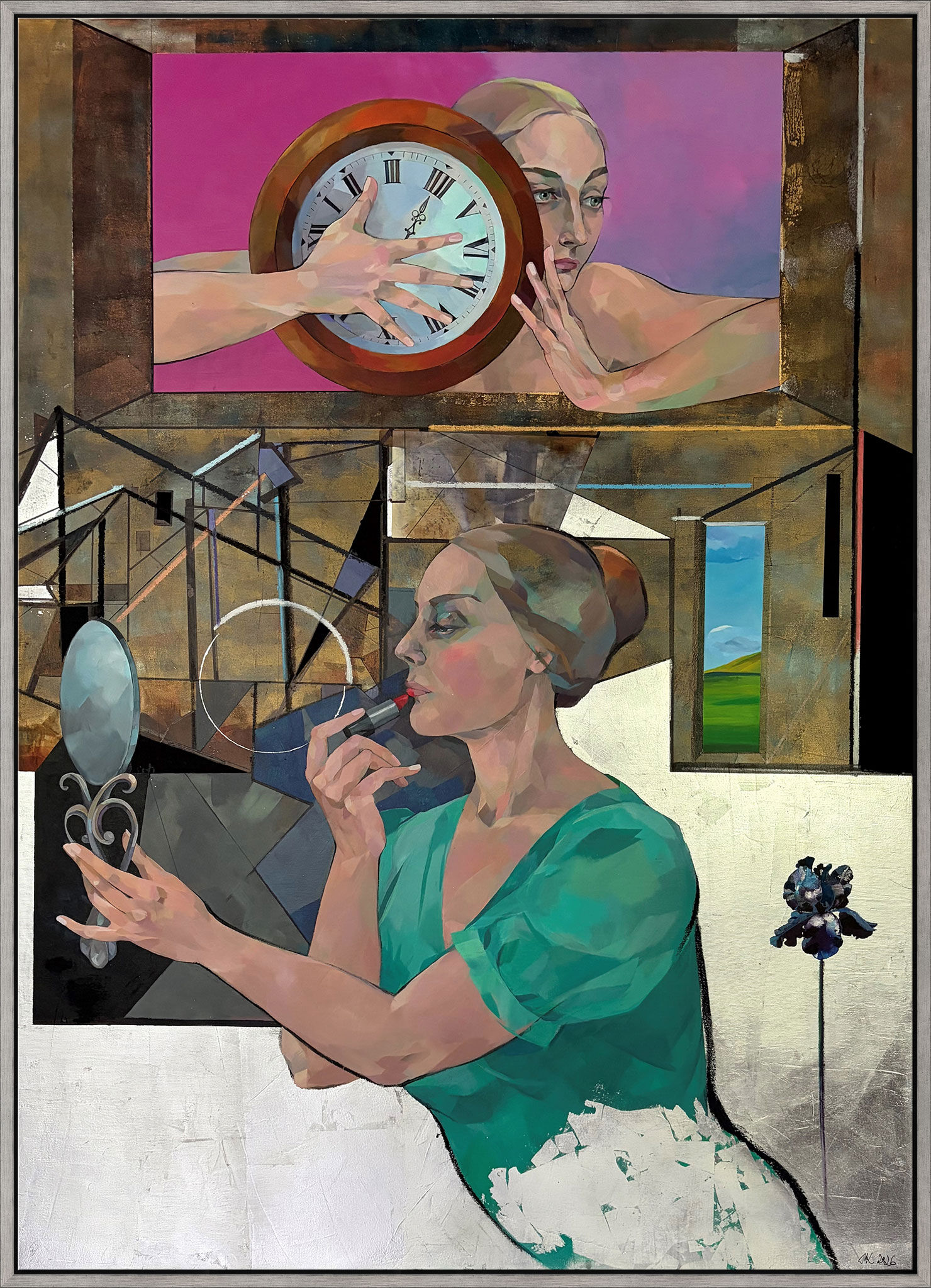
Echo: A Reflection on Time and Permanence
"The painting 'Echo' is a profound exploration of the fragility of our existence and the unstoppable passage of time. It serves as a visual bridge between two states: the desire to hold on to moments and the reality of a constantly changing, often fragmented life.
In the upper part of the work, I visualise the desire to halt the relentless flow of time - an almost desperate, yet deeply human attempt to bring order to chaos. In contrast, the lower part of the composition transforms reality into a complex labyrinth of shapes, structures and random pictures. This geometric rigour contrasts with the intimacy of the scenes depicted.
The view through the window onto an expansive landscape is intended as a 'window to clarity' - a reminder of a time of peace and stability. In direct contrast is the intimate, almost ritualistic act of applying lipstick in front of a mirror. This gesture is far more than a purely cosmetic act: it is a symbolic act of self-assertion, a heroic attempt to preserve the connection to one's own identity and to normality amid an irrational world that is falling apart.
Ultimately, 'Echo' is a dialogue between generations. It raises the question of what remains of us when external structures begin to crumble. In my work, love is the only constant - the only enduring sound that echoes through the silence, even when everything else threatens to fade. Through the deliberate combination of figurative representation and abstract elements, I invite the viewer to reflect on their own transience and the preserving power of emotions." (Marina Krasnitskaya)
Original painting 2026, signed by the artist. Acrylic on canvas, stretched on a stretcher frame. Stretcher frame size 140 x 100 cm (h/w). Framed in a silver-coloured solid wood shadow gap frame. Size 144 x 104 cm (h/w).
Producer: ars mundi Edition Max Büchner GmbH, Bödekerstraße 13, 30161 Hanover, Germany, [email protected]
About Marina Krasnitskaya
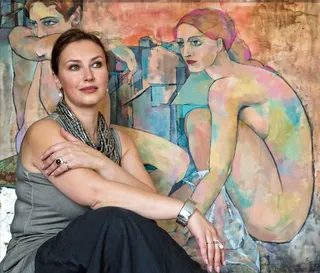
"Painting is not a hobby, a profession or a passion. It is my doppelganger, my conscience, my second self," says painter Marina Krasnitskaya about the daily confrontation with her ideas and artistic visions.
Love, longing, hope: Marina Krasnitskaya makes great emotions the subject of her pictures. The Russian-born painter, who has lived in Germany since 1994, usually lets the emotions take shape in female figures or in abstract images. In her depictions, she combines elements of the folk art of her homeland with her own formal language.
"Picasso said that the work you paint is a way of journaling. That's exactly how I feel: each of my works is like capturing moments full of emotions and feelings. Each painting is deeply personal, each piece is 'me' – in very different forms and colours."
In addition to her work as a graphic designer and web designer, Marina Krasnitskaya maintains and develops the clear, Russian visual language and folk culture in her paintings. Because of their colourfulness, the motifs, which range from cubist to fantastic, are reminiscent of other famous Russian artists such as Malevich or Chagall. Krasnitskaya's paintings are surrounded by a dreamlike aura and set a contemporary monument to Russian fairytale culture and symbolism.
A one-of-a-kind or unique piece is a work of art personally created by the artist. It exists only once due to the type of production (oil painting, watercolour, drawing, lost-wax sculpture etc.).
In addition to the classic unique pieces, there are also the so-called "serial unique pieces". They present a series of works with the same colour, motif and technique, manually prepared by the same artist. The serial unique pieces are rooted in "serial art", a genre of modern art that aims to create an aesthetic effect through series, repetitions, and variations of the same objects or themes or a system of constant and variable elements or principles.
The historical starting point is considered to be Claude Monet's "Les Meules" (1890/1891), where, for the first time, a series was created that went beyond a mere group of works. The other artists, who addressed to the serial art, include Claude Monet, Piet Mondrian and above all Gerhard Richter.