
Picture "Untitled (Bridging Variant)" (1950) (Unique piece)
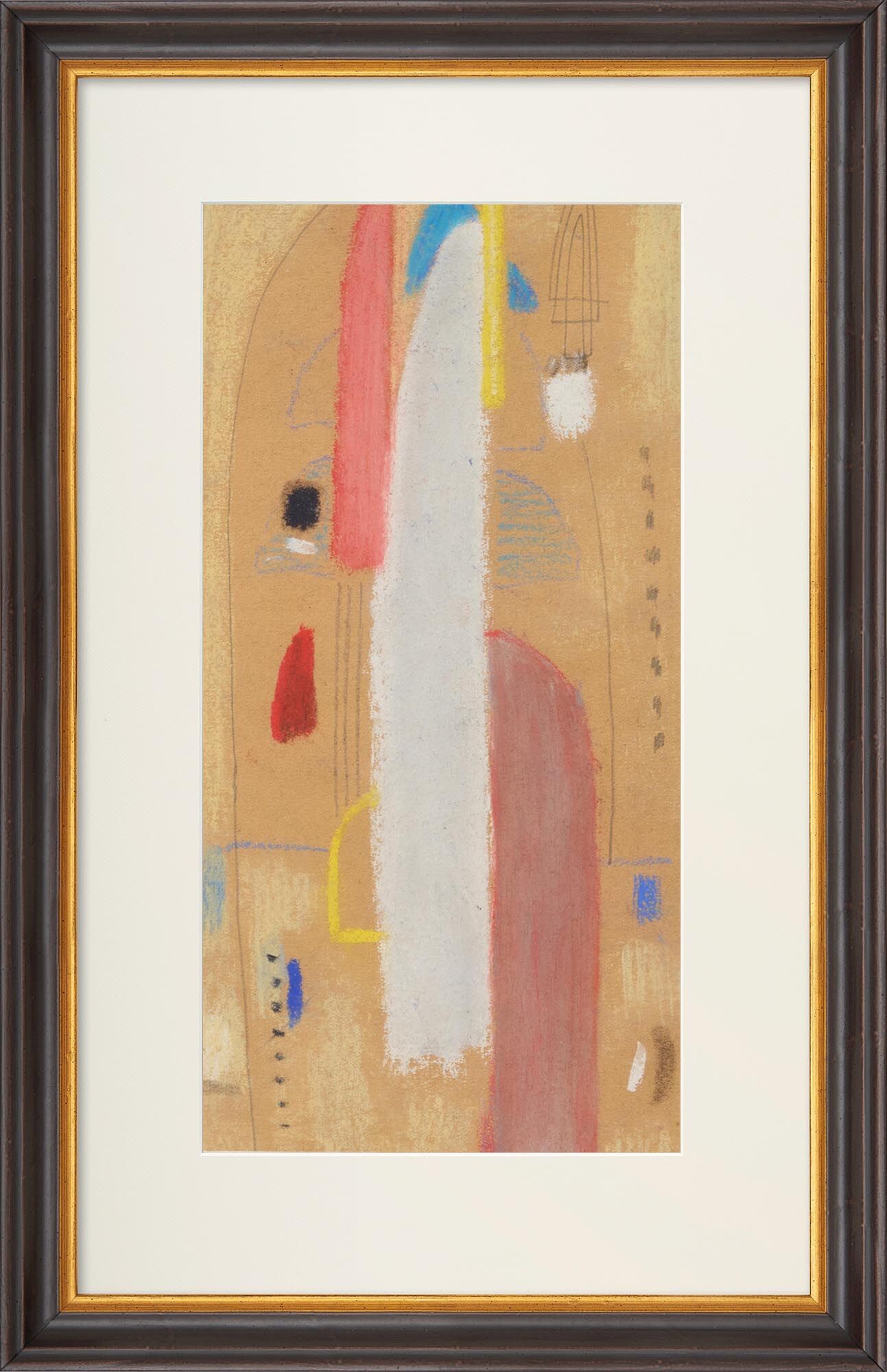


Picture "Untitled (Bridging Variant)" (1950) (Unique piece)
Quick info
unique piece | signed | dated | pastel and graphite on paper | framed | size 45 x 32 cm
Detailed description
Picture "Untitled (Bridging Variant)" (1950) (Unique piece)
Pastel and graphite on brownish paper, 1950. Signed and dated. Motif size/sheet size 25.6 x 12.9 cm. Size in frame 45 x 32 cm as shown.
Producer: ars mundi Edition Max Büchner GmbH, Bödekerstraße 13, 30161 Hanover, Germany, [email protected]
About Max Ackermann
1887–1975
Max Ackermann was one of the artists who laid the foundations for the development of modern abstract art in Germany.
He initially studied at the art school in Weimar under Henry van de Velde, then in Dresden and Munich under Franz von Stuck. In 1912, he moved to Stuttgart, where he became a student of Adolf Hölzel at the Royal Academy of Fine Arts and later founded a seminar on ‘absolute painting’. From 1936 onwards, his works were considered ‘degenerate’ and he moved to Hornstaad on Lake Constance. After the Second World War, his works gained great significance.
The state of Baden-Württemberg awarded him a professorship and in 1964 Ackermann was a guest of honour at the Villa Massimo in Rome.
Term for paintings and sculptures that are detached from representational depiction, which spread across the entire western world and parts of the eastern world from around 1910 onwards in ever new stylistic variations. The Russian painter Wassily Kandinsky, born in 1866, is considered the founder of abstract art. Other important artists of abstract art are K.S. Malewitsch, Piet Mondrian, and others.
Works of abstract art
> Abstract pictures
> Abstract sculptures
A one-of-a-kind or unique piece is a work of art personally created by the artist. It exists only once due to the type of production (oil painting, watercolour, drawing, lost-wax sculpture etc.).
In addition to the classic unique pieces, there are also the so-called "serial unique pieces". They present a series of works with the same colour, motif and technique, manually prepared by the same artist. The serial unique pieces are rooted in "serial art", a genre of modern art that aims to create an aesthetic effect through series, repetitions, and variations of the same objects or themes or a system of constant and variable elements or principles.
The historical starting point is considered to be Claude Monet's "Les Meules" (1890/1891), where, for the first time, a series was created that went beyond a mere group of works. The other artists, who addressed to the serial art, include Claude Monet, Piet Mondrian and above all Gerhard Richter.