
Picture "Flock of Sheep Under Trees (Motif Near Kösen)" (1893)

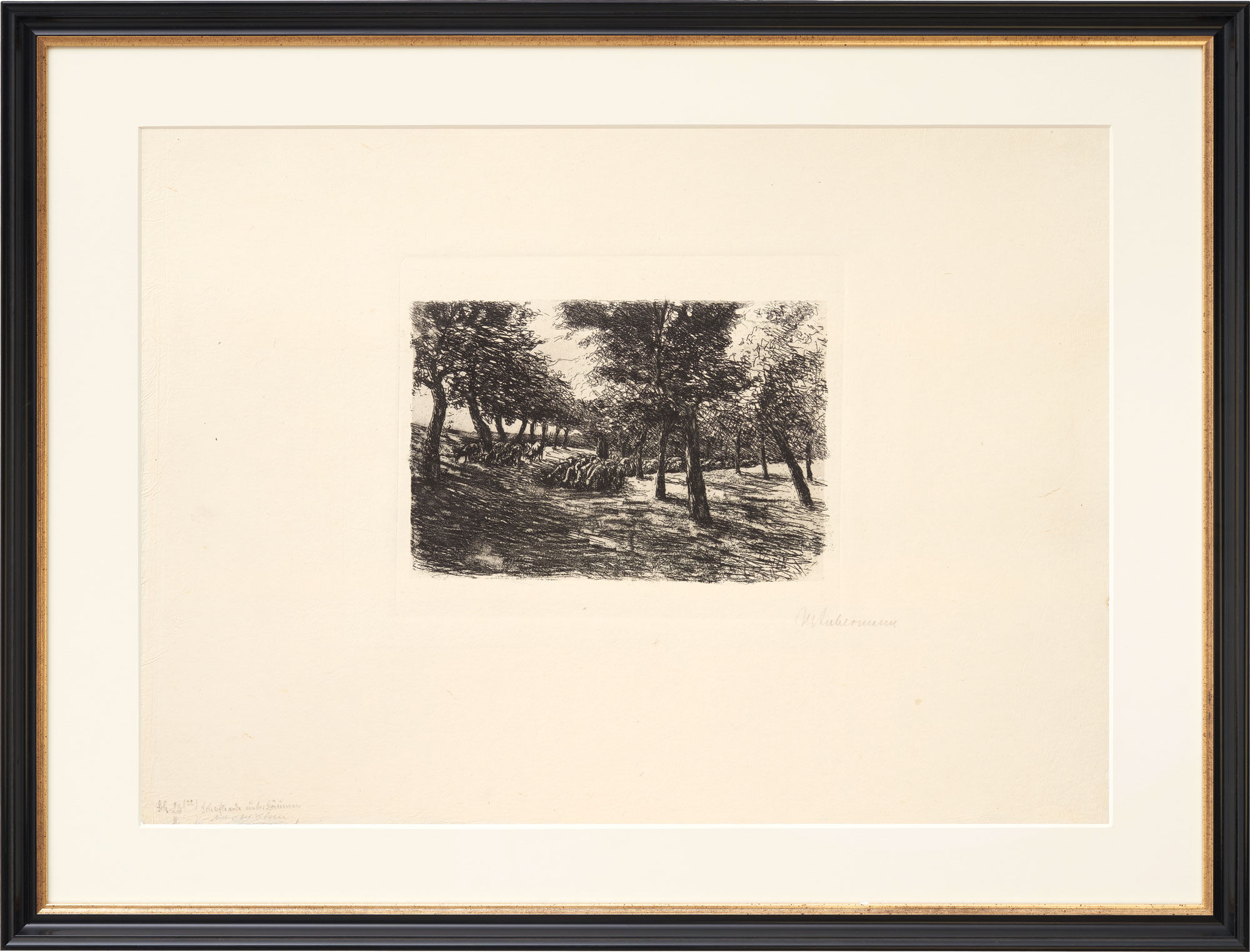


Picture "Flock of Sheep Under Trees (Motif Near Kösen)" (1893)
Quick info
limited, 100 copies | signed | inscribed | etching on Japanese paper | framed | size 46 x 58 cm
Detailed description
Picture "Flock of Sheep Under Trees (Motif Near Kösen)" (1893)
Etching, 1893. Edition: a few prints and proofs as well as 100 copies from the Photographische Gesellschaft (offered here) on Japanese paper, signed and inscribed "Motiv bei Kösen". Catalogue raisonné Schiefler 23 II b. Motif size 19.6 x 24 cm. Sheet size 38 x 52.2 cm. Size in frame 46 x 58 cm as shown.
Producer: ars mundi Edition Max Büchner GmbH, Bödekerstraße 13, 30161 Hanover, Germany, [email protected]
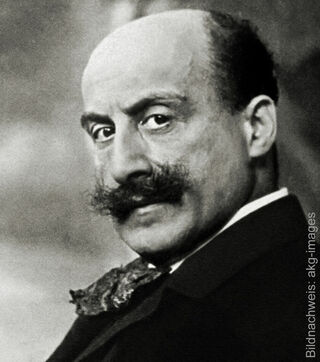
About Max Liebermann
1847-1935
Together with Lovis Corinth and Max Slevogt, Max Liebermann formed the triumvirate of German Impressionism and received numerous honours throughout his life. Through his commitment to elevating the life and work of ordinary people to art in unpretentious simplicity meant that Liebermann initially had to fight for recognition.
Liebermann only became a celebrated painter at the turn of the century when he increasingly devoted himself to motifs and scenes from the life of the upper-middle classes. He was an appointed professor at the Royal Academy and a member of the jury at the Academy exhibitions in 1897. In 1899 he founded the Berlin Secession and made it the most important German art institution. In 1920 Liebermann became president of the Prussian Academy and in 1932 its honorary president.
Because of his Jewish ancestry, he was ostracised by the Nazis and forced to resign from all offices. While watching the Nazis celebrate their victory by marching through the Brandenburg Gate from the window of his flat Liebermann supposedly said: "I can't eat as much as I want to vomit." In 1935 he died at the age of 87 after a long illness.
For Max Liebermann, nature was always a man-made (and man-inhabited) paradise. He found his motifs in gardens, parks and in bourgeois places of amusement. Liebermann is a master of staged light, which he lets fall on his scenes, often filtered through a canopy. The individual beams of light that penetrate to the ground are striking and have gone down in art history as "Liebermann's sunspots".


The field of graphic arts, that includes artistic representations, which are reproduced by various printing techniques.
Printmaking techniques include woodcuts, copperplate engraving, etching, lithography, serigraphy, among others.