


Quick info
reproduction, Giclée print on canvas | on stretcher frame | framed | size approx. 45 x 45 cm
Detailed description
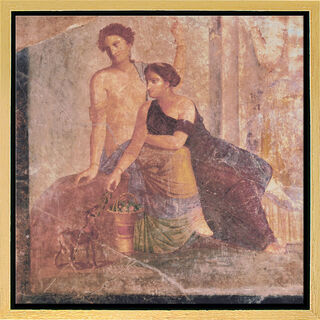
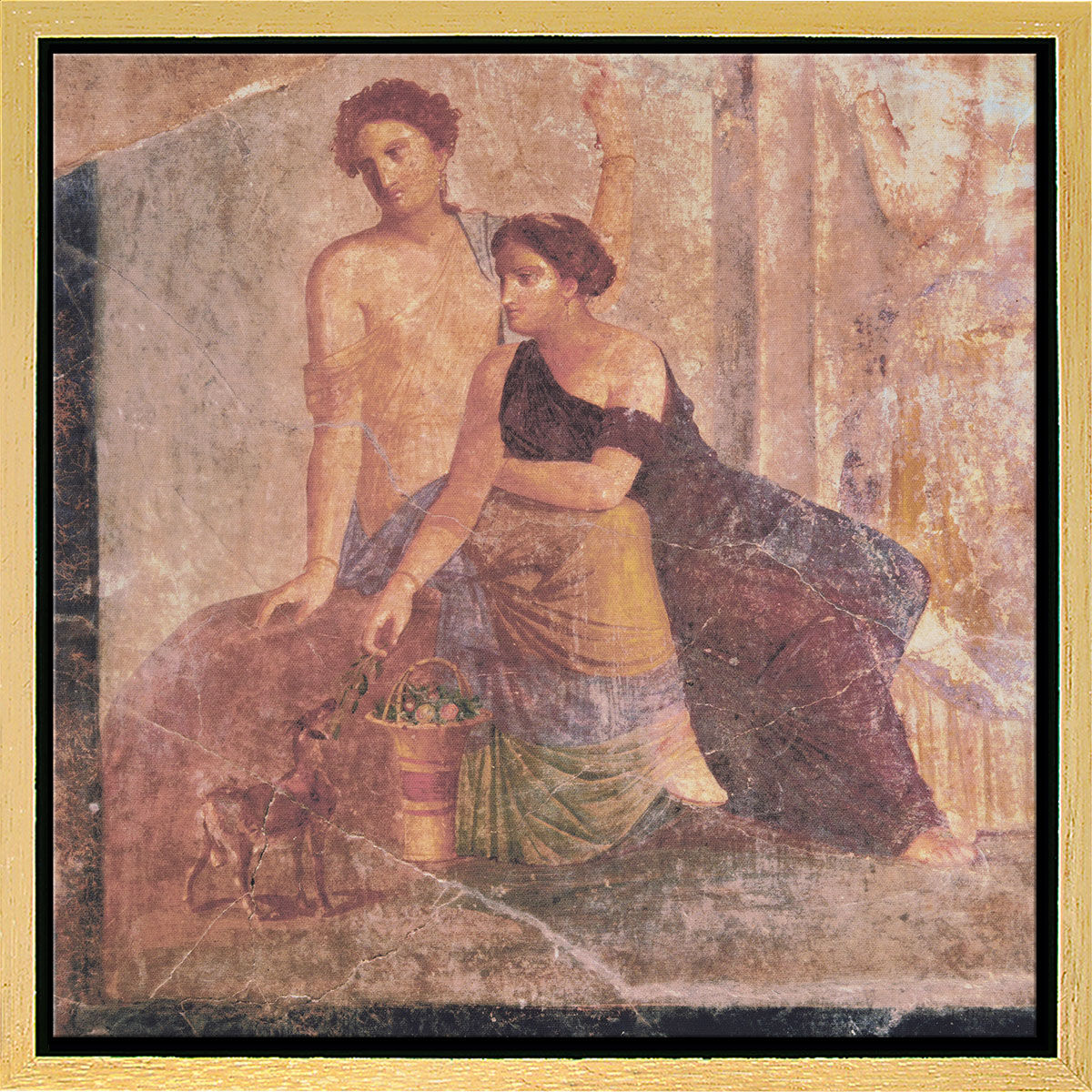
Mural from Pompeii: Picture "Two Women", framed
Pompeii was considered one of the most beautiful cities of the Roman Empire until the eruption of Mount Vesuvius in AD 79, burying the city within minutes under a thick layer of ash and pumice. Today, this terrible natural disaster is a stroke of luck for art history because there is no other place where frescoes and art objects of this time have been preserved in such a complete state.
Two women, 1st century AD: The replica presented here was made true to detail after the original from the National Archaeological Museum, Naples. Edition transferred directly onto artist's canvas using the Fine Art Giclée process and stretched on stretcher frame. Limited edition of 980 copies. With numbered certificate on the back. Framed in a golden solid wood frame. Size approx. 45 x 45 cm.
Producer: ars mundi Edition Max Büchner GmbH, Bödekerstraße 13, 30161 Hanover, Germany, [email protected]
Giclée = derived from the French verb gicler "to squirt, to spray".
The Giclée method is a digital printing process. It is a high-resolution, large-format print produced with an inkjet printer using special different-coloured dye- or pigment-based inks (usually six to twelve). The inks are lightfast, meaning they are resistant to harmful UV light. They provide a high level of nuance, contrast, and saturation.
The Giclée process is suitable for art canvases, handmade paper and watercolour paper as well as silk.
Roman art is primarily determined by the fusion of native Italic and Greek Hellenistic elements.
In architecture, pragmatic and political considerations played a major role in the expansion of the empire.
In the sacral sphere, the early temples of Rome copied the Etrurian-Italic style. The Roman secular buildings, such as bridges, ports, aqueducts, walls, gates, etc., played a far more important role.
With the remodelling of the Forum Romanum by Augustus and the redesign of the Forum of Augustus, the importance of old city centres changed. They became large enclosed outdoor space complexes. Axial symmetry, aligned toward a podium temple, became a defining feature of this period. During the reign of Augustus, temples and theatres were built in the "Eternal City" with increasingly rounded and dynamic forms, departing from the linearity of Greek models.
In sculpture, early Roman works were initially dominated by copies and redesigns of Greek models. However, Roman sculptors made independent contributions in the field of portraiture, where the bust form was particularly favoured. In relief art, there was a strong inclination toward ornamentation while maintaining narrative content.
In painting, triumphal processional paintings honouring victorious generals were a distinctive feature. For mural painting, the cities buried by Mount Vesuvius - Pompeii, Herculaneum, Stabiae, and Oplontis - offer the most extensive evidence.
Mosaic art ran parallel to painting and was primarily used for decorative floor and wall designs.
Some areas of minor arts flourished exceedingly in Roman times. Toreutics, the art of metal embossing, produced precious silver vessels. The art of glassblowing is documented by numerous excellent finds. Glyptic (engraving on gemstones) produced magnificent reliefs carved from semi-precious stones, engraved gems and cameos depicting official themes.
The extensive coinage in Roman times contributed to spreading the portraits of rulers across the entire territory of the Roman Empire.