
Quick info
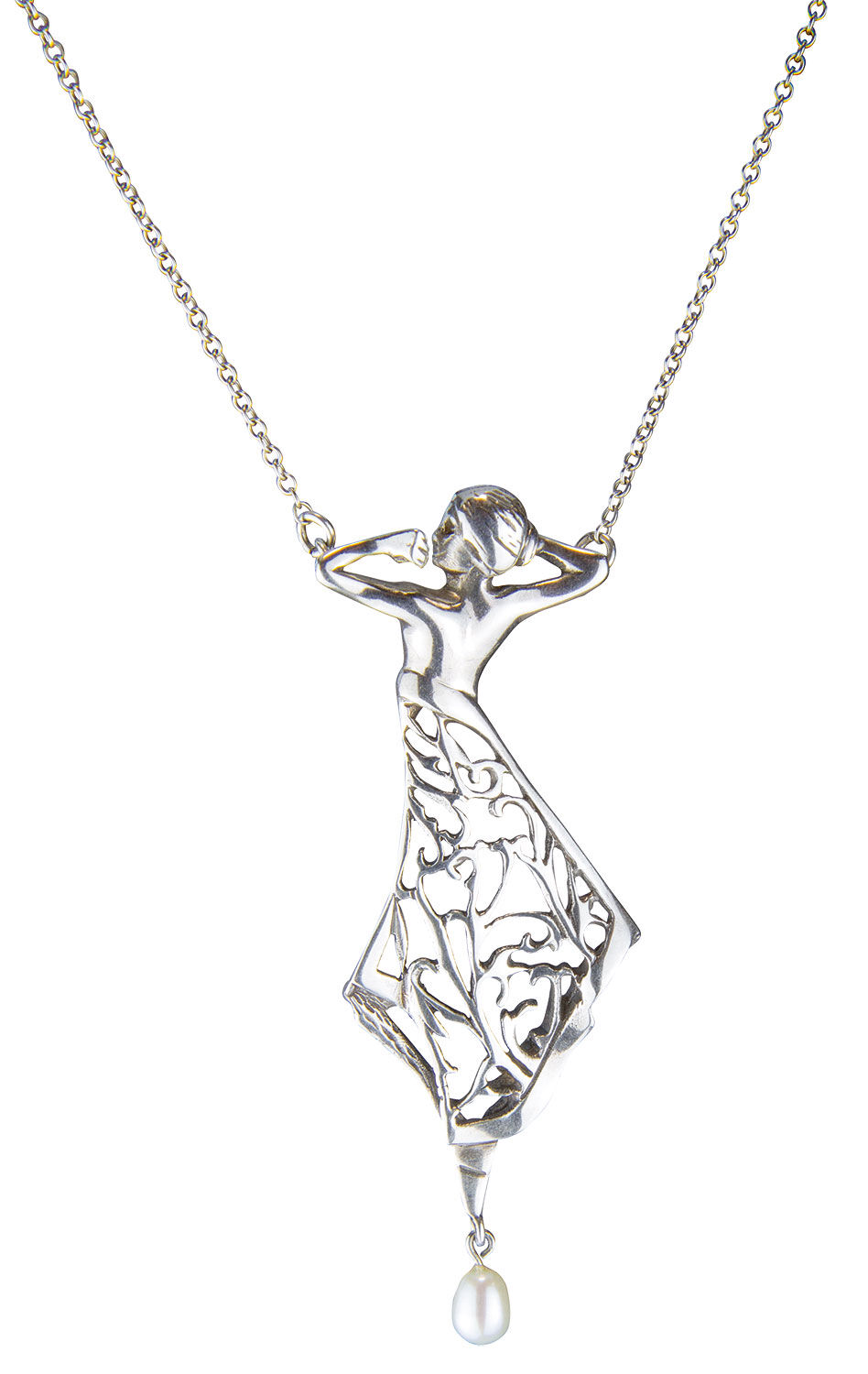
925 sterling silver | freshwater pearl | length 42-45 cm | pendant 7.5 x 2.5 cm (h/w)
Detailed description
Necklace "Femme" with pearl
In Art Nouveau art, the woman is one of the most important motifs. Made of lightly patinated 925 sterling silver and decorated with an oval freshwater pearl. Spring ring clasp. Adjustable length from 42-45 cm. Pendant 7.5 x 2.5 cm (h/w).
Producer: ars mundi Edition Max Büchner GmbH, Bödekerstraße 13, 30161 Hanover, Germany, [email protected]
The term Art Nouveau, or the German term Jugendstil (lit.: "Youth Style"), is the art epoch between 1890-1910. The name originates from the Munich-based magazine "Jugend" (Youth), founded in 1896. It was the German counterpart of Art Nouveau (France), internationally known as Modern Style (England) or Secession (Austria).
Art Nouveau spread across Europe, resulting in innumerable works, ranging from painting and applied arts to architecture. One of the requirements of Art Nouveau was the artistic design of everyday objects, aiming to merge beauty with practicality. The desired unity of the artistic ability could only be achieved through individually influenced design, making Art Nouveau a precursor of modernism. The defining characteristic of Art Nouveau is its linear, often asymmetrical ornamentation. The models are particularly taken from nature and flora.
Major Art Nouveau centres were formed in Munich, Darmstadt, Brussels, Paris and Nancy (Glass Art by Emile Gallé). The Viennese architecture of that time was determined by Otto Wagner and J. Hoffmann. Gustav Klimt created paintings that gave sensual shape to the spirit of Art Nouveau.