
Picture "La Salute (Venise)" (1906), white and golden framed version


Picture "La Salute (Venise)" (1906), white and golden framed version
Quick info
ars mundi Exclusive Edition | limited, 980 copies | numbered | certificate | reproduction, Giclée print on canvas | on stretcher frame | framed | size approx. 68 x 84 cm (h/w)
Detailed description
Picture "La Salute (Venise)" (1906), white and golden framed version
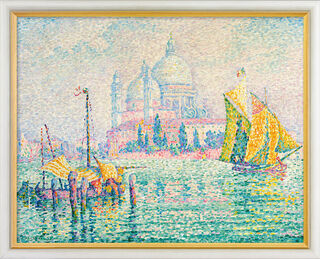
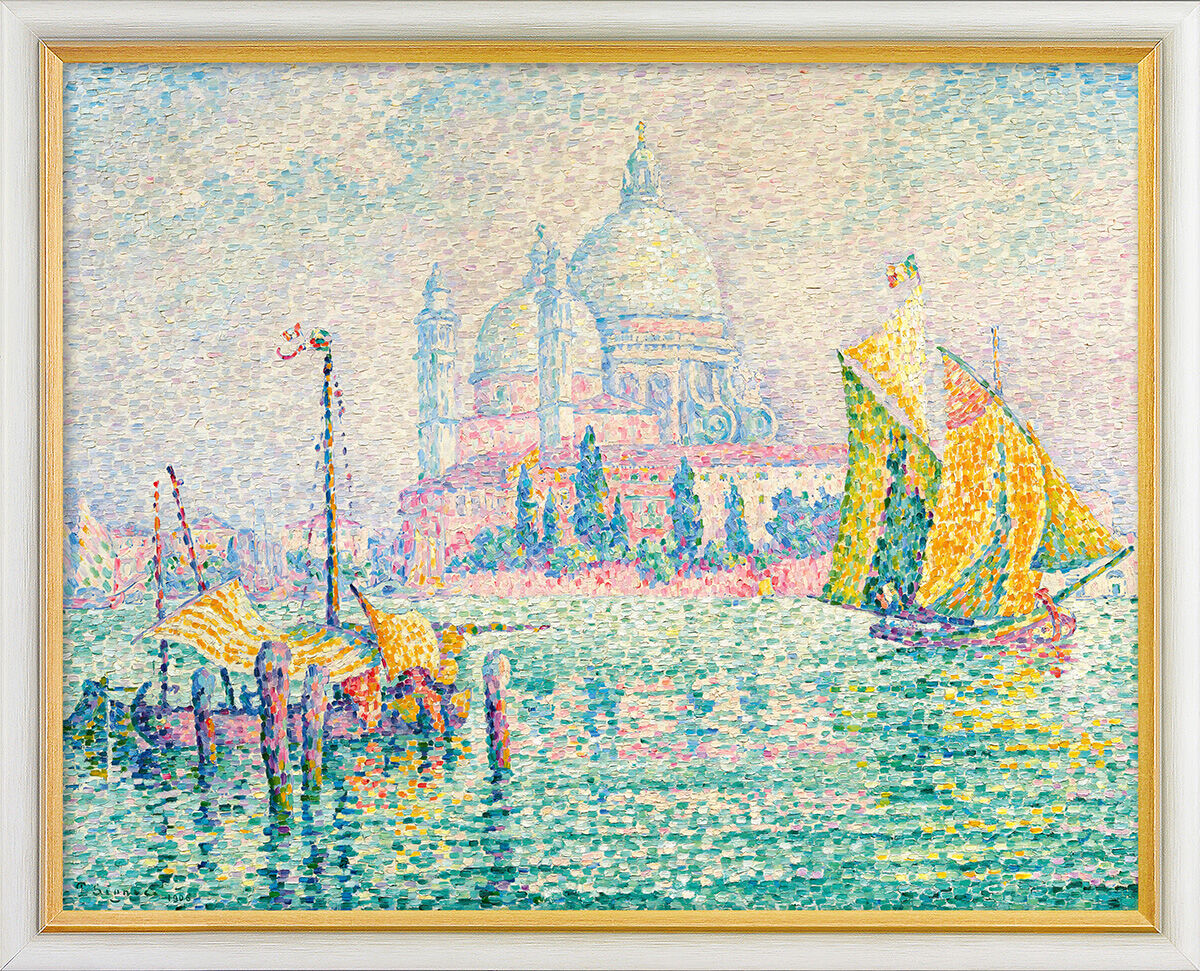
In vibrant colours and shimmering light, Paul Signac captures the unmistakable atmosphere of Venice. At the centre of the composition rises the famous Basilica of Santa Maria della Salute, its silhouette seeming to emerge from the haze of the lagoon. Yellow sailing boats structure the scene and add lively accents to the shimmering surface of the water.
As a leading representative of Neo-Impressionism, Signac developed a painting technique in which pure colours are placed side by side and only come together in the viewer’s eye to form a radiant overall image. This creates an extraordinary luminosity that transforms water, light and architecture into a harmonious play of colour.
La Salute (Venise) is among the artist's most impressive depictions of Venice. The work masterfully combines the poetic beauty of the lagoon city with Signac's pioneering theory of colour, making the modern pictorial vision of Neo-Impressionism uniquely tangible.
The original work was last exhibited in public in 1913 and was sold at auction by Koller on 26 June 2026 for CHF 4,164,500.
Original: 1906, oil on canvas, 73 x 92 cm, private collection.
Edition based on the original, produced using the Fine Art Giclée process, transferred directly onto artist's canvas and stretched on a stretcher frame. Limited edition of 980 copies, numbered, with certificate. Framed in a handcrafted, white and golden solid wood frame. Size approx. 68 x 84 cm (h/w). ars mundi Exclusive Edition.
Producer: ars mundi Edition Max Büchner GmbH, Bödekerstraße 13, 30161 Hanover, Germany, [email protected]
Frame configurator
Customised picture frame

Frame configurator
Customised picture frame


Customer reviews
Frame variant: Framing 1
Ein großartiges Bild, welches wir jeden Morgen beim Aufwachen betrachten können. Ganz tolle Farben und die Punkte sind so gut erkennbar.
Übrigens kam die Lieferung umgehend.
Vielen Dank.
About Paul Signac
1863-1935
Paul Signac is one of the most important representatives of Neo-Impressionism. Together with Georges Seurat, he developed the technique of Pointillism, in which countless small dots of colour merge to form luminous compositions. Through the carefully considered use of contrasting and corresponding primary colours, and a profound knowledge of optics and the physiology of perception, he created masterpieces whose radiance is scarcely surpassed.
Signac's paintings are characterised by an extraordinary abundance of light and a harmonious use of colour, transforming landscapes, harbours and coastal scenes into poetic pictorial worlds. His work combines scientific colour theory with artistic sensitivity and opens up to the viewer a vision of calm, clarity and Mediterranean joie de vivre.
Graphic or sculpture edition that was initiated by ars mundi and is available only at ars mundi or at distribution partners licensed by ars mundi.
> All ars mundi Exclusive Editions
Giclée = derived from the French verb gicler "to squirt, to spray".
The Giclée method is a digital printing process. It is a high-resolution, large-format print produced with an inkjet printer using special different-coloured dye- or pigment-based inks (usually six to twelve). The inks are lightfast, meaning they are resistant to harmful UV light. They provide a high level of nuance, contrast, and saturation.
The Giclée process is suitable for art canvases, handmade paper and watercolour paper as well as silk.
The style of Impressionism, which emerged in French painting around 1870, owes its name to Claude Monet's landscape 'Impression, Soleil Levant'. After initial rejection, it began a veritable triumphal procession.
Painters such as Claude Monet, Edgar Degas, Edouard Manet, Auguste Renoir and others created motifs from everyday life, urban and landscape scenes in bright, natural light.
Impressionism can be seen as a reaction to academic painting. Rather than emphasizing content with a structured composition, it focused on the subject as it appears in the moment, often in a seemingly random snapshot. The reality was seen in all its variety of colours in natural lighting. Outdoor painting replaced studio painting.
Through the brightening of the palette and the dissolution of firm contours, a new approach to colour emerged. In many cases, the colours were no longer mixed on the palette but placed side by side on the canvas, so that the final impression emerged in the eye of the viewer with a certain distance. In "Pointillism", (with painters such as Georges Seurat or Paul Signac), this principle was taken to the extreme.
Outside France, Impressionism was taken up by painters such as Max Slevogt, Max Liebermann and Lovis Corinth in Germany, and by James A. M. Whistler in the United States.
However, Impressionism was only expressed to a limited extent in the art of sculpture. In the works of Auguste Rodin, who is considered one of the main representatives, a dissolution of surfaces is evident, in which the play of light and shadow is included in the artistic expression. Degas and Renoir created sculptures as well.