
Sculptural group "A Deux", cast stone version

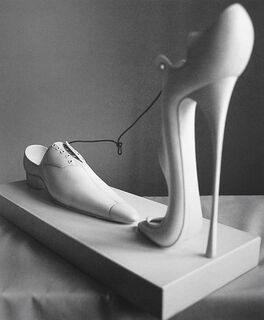
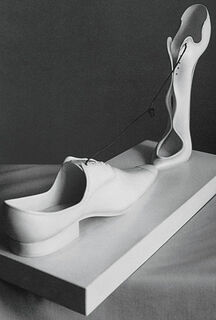


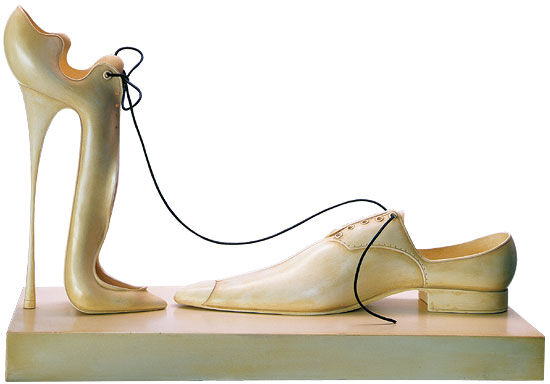
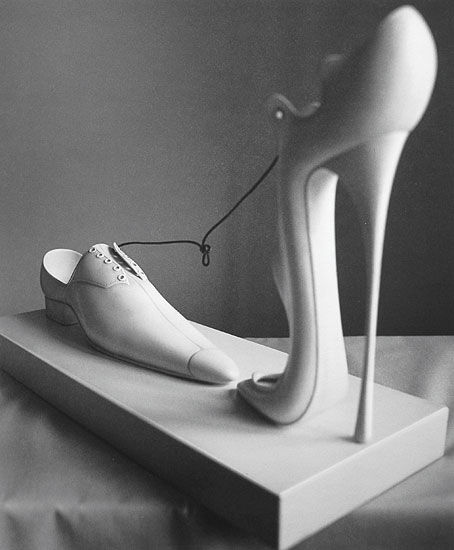
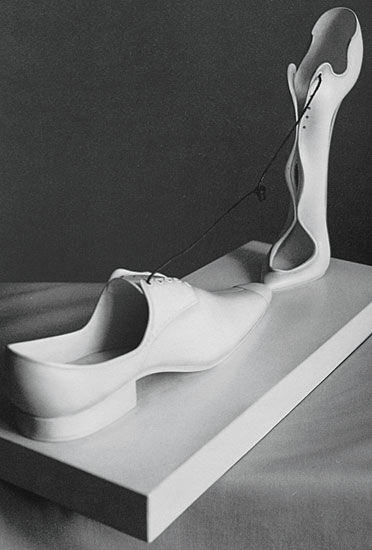
Sculptural group "A Deux", cast stone version
Quick info
limited, total 499 copies | numbered | signed | cast stone | patinated | polished | overall size: height 31 cm, length 43.5 cm, depth 18 cm | weight 6 kg
Detailed description
Sculptural group "A Deux", cast stone version
In Wunderlich's sculptural group "A Deux", everyday objects undergo a metamorphosis under the sign of Eros. The manneristically exaggerated shoes become symbols of the male and female elements. Knotted together by a leather strap, they grow together into a new shared reality: The pair of shoes is at once a symbol of togetherness and erotic fetish.
Sculpture in a limited total edition of 499 copies, divided into two editions. Edition in ivory-coloured cast stone, cast by hand. Patinated and polished by hand. Catalogue raisonné no. 101a. Size including plinth: Height 31 cm, length 43,5 cm, depth 18 cm. Weight 6 kg. The sculptures are numbered and signed on a porcelain plaque embedded in the plinth.
Producer: ars mundi Edition Max Büchner GmbH, Bödekerstraße 13, 30161 Hanover, Germany, [email protected]
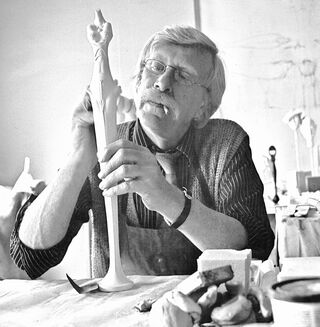
About Paul Wunderlich
1927-2010
Like no other artist of our time, Paul Wunderlich was one of the most influential style-forming artists of the modern age. Only in 1960, the Hamburg prosecutor seized his works for "indecent". Three years later, the relativley young Paul Wunderlich was hired as a professor at the University of Fine Arts. Numerous awards such as the Edwin Scharff Prize honours at the biennial arts exhibition in Ireland, Taiwan and Bulgaria made Wunderlich internationally famous. He was the only German artist to be admitted to the Paris "Académie des Beaux-Arts". Paul Wunderlich lived and worked both in Hamburg and France until his death in June 2010.
Born in 1927 in Eberswalde near Berlin, the painter and sculptor learned to draw at the Palace School of Art in the Orangery of Eutin Castle. Immediately after World War II, he visited the Hamburg Academy of Fine Arts to study graphic arts. After completing his studies, he remained there working as a drawing teacher and in 1963 became a professor.
In the early 1950s, he met Emil Nolde and Oskar Kokoschka. Under their guidance he printed reproductions of their works. He developed a very idiosyncratic style in which manneristic and surrealistic, as well as elements of Art Nouveau and Art Deco, meet. He initially drew his themes inspired by German history, for example the cycle of lithographs "20 July 1944". Later, erotic and sexual motifs became more significant which he treated with delicacy and also a hint of morbidity. In 1960, one such cycle of lithographs was seized by the Hamburg prosecutor for indecent depictions.
In the 1960s he began to work based on photographs by Karin Székessy. After he resigned from his professorship in 1968, he made several study trips to New York and Switzerland. From then on, he also worked on sculpturally aestheticised everyday objects that were parallel with the subtly crafted imagery of his lithographs.
"His works are recognised, appreciated and also bought by a broad public all over the world," writes Paul Wunderlich's biographer Jens Christian Jensen. "Art connoisseurs agree: Paul Wunderlich is the leading master of fantastic realism and one of the very few style-forming artists of our time."
"Out of all the truisms that are spread about his life's work, only one fact is for sure: the realisation that Paul Wunderlich became the unsurpassed master of lithography after Picasso." (Prof. Heinz Spielmann)
"If one searches for the greatest master in the art of lithography in all its possibilities, there is no doubt that Paul Wunderlich deserves all credits." (Carl Vogel)
Collective term for all casting processes that ars mundi carries out with the help of specialised art foundries.
Stone Casting
Similar to artificial marble, with the difference that instead of marble powder, the stone to be replicated is used in powder form.
Bonded Bronze (Cold-Cast-Bronze)
Bronze powder is polymer-bonded. Through special polishing and patination techniques, the surface of the cast takes on an appearance similar to that of bronze.
Imitation Wood
In order to guarantee absolute fidelity to the original, an artificially manufactured imitation wood is used as a base material that features typical wood characteristics: density, workability, colour, and surface structure.
Ceramic Mould Casting
Ceramic mould casting usually requires the use of casting clay, which is then fired and optionally glazed. Instead of the usual rubber moulds, plaster moulds are often used in ceramic casting and porcelain production.
Cast Bronze (Lost-Wax-Casting)
For the cast bronze, the thousand-year-old lost-wax technique is used. It's the best, but also the most complex method of producing sculptures.
Term for an art object (sculpture, installation) that, according to the artist’s intention, is produced in multiple copies within a limited and numbered edition.
Multiples enable the "democratization" of art by making the work accessible and affordable for a wider audience.
Contemporary art created from objects that are not normally considered materials from which art is made.
Object art was a means of expression of Cubism, Dadaism and Surrealism, and over time, it has developed various representational techniques up to the present day.
A plastic work of sculptural art made of wood, stone, ivory, bronze or other metals.
While sculptures made of wood, ivory, or stone are carved directly from the material block, in bronze casting, a working model is prepared at first. Usually, it is made of clay or other easily mouldable materials.
The prime time of sculpture after the Greek and Roman antiquity was the Renaissance. Impressionism gave a new impulse to the sculptural arts. Contemporary artists such as Jorg Immendorf, Andora, and Markus Lupertz also enriched sculptures with outstanding works.