
Picture "Mountain Landscape" (c. 1920) (Unique piece) New
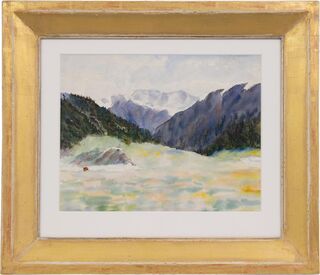
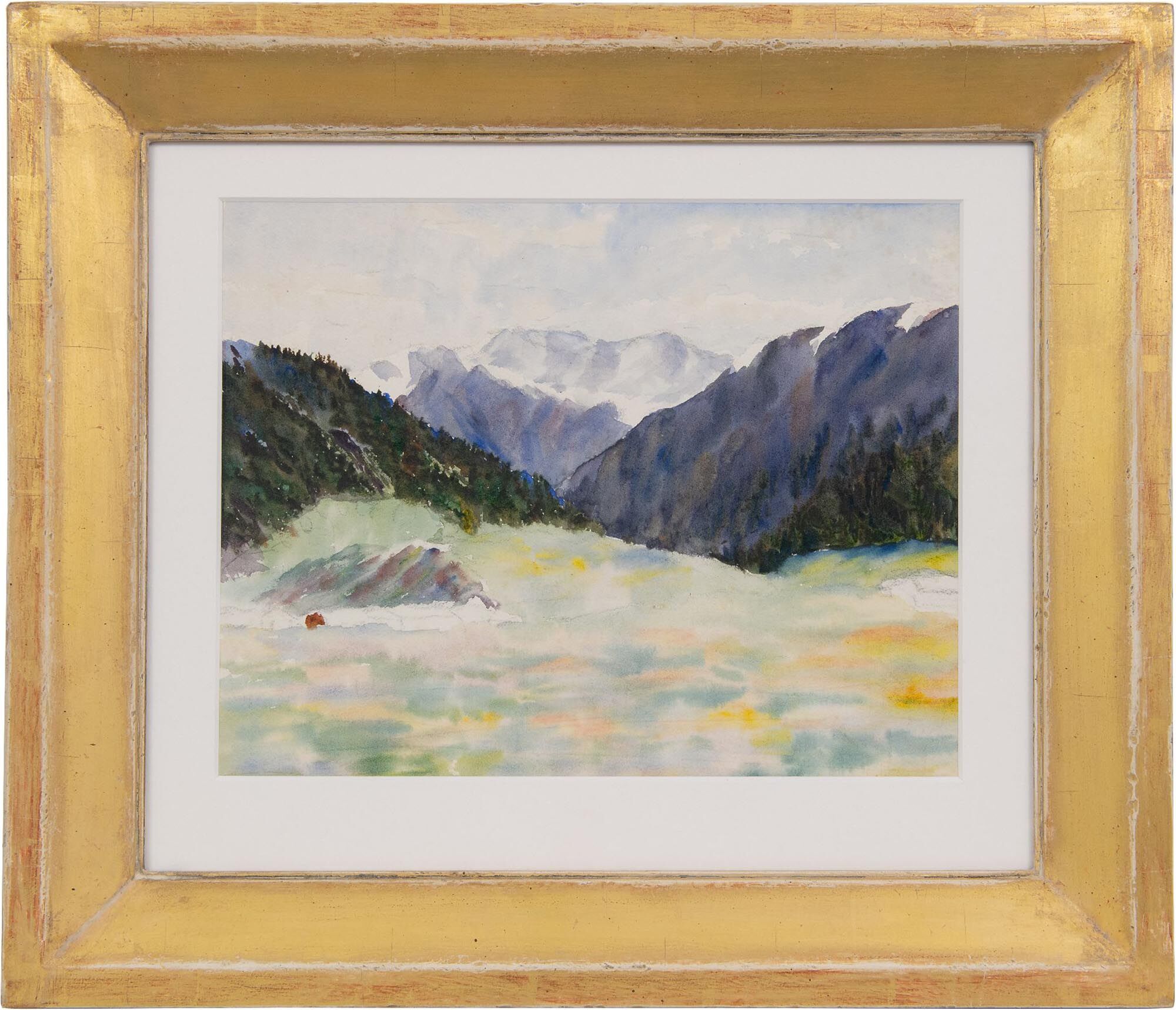


Picture "Mountain Landscape" (c. 1920) (Unique piece) New
Quick info
unique piece | signed | chalk and watercolour on paper | framed | size 41.5 x 48 cm
Detailed description
Picture "Mountain Landscape" (c. 1920) (Unique piece)
Black chalk and watercolour on paper, c. 1920. Signed. Motif size/sheet size 24.7 x 31 cm. Size framed 41.5 x 48 cm, as shown.
Producer: ars mundi Edition Max Büchner GmbH, Bödekerstraße 13, 30161 Hanover, Germany, [email protected]
About Philipp Bauknecht
Philipp Bauknecht (1884–1933) is regarded as one of the most distinctive figures of German Expressionism. After training at the School of Applied Arts in Stuttgart, he settled in Davos around 1910 for health reasons. Bauknecht’s unique position stems from the combination of his technical training, the Alpine way of life and his expressive use of colour.
Unlike many artists of his generation, he developed his visual language largely away from the major art centres. The Alpine landscape and the lives of the mountain people became the central themes of his work in Davos. Using bold colours, simplified forms and expressive lines, Bauknecht developed an unmistakable visual language that stands on its own alongside the art of his contemporary Ernst Ludwig Kirchner.
On 26 February 1933, Bauknecht died during an operation in Davos. Despite his untimely death, he left behind a significant body of work comprising paintings, watercolours and woodcuts. Today, Bauknecht is being rediscovered in particular as a key figure in Alpine Expressionism, and his works are held in major public and private collections.
A particularly significant re-evaluation of his work took place with the exhibition "Philipp Bauknecht – Davos Mountain Worlds in Expressionism", which was shown at the Museum Würth in Künzelsau in 2014 and subsequently at the Kirchner Museum Davos in 2014–15. The exhibition highlighted Bauknecht’s unique significance within Alpine Expressionism. Philipp Bauknecht has also gained considerably in prominence on the international art market in recent years. The highest publicly documented auction result to date is CHF 165,000 for “Old Peasant Woman with Chickens”, achieved at Koller in Zurich in 2021.
Painting with glazing watercolours, that are characterised by their transparency, which let deeper layers and painting surfaces shine through.
Often the paper surface is omitted. This contributes significantly to the effect of the work. The aquarelle or watercolour painting requires skilful use of colour, as it dries quickly and corrections are almost impossible.
A one-of-a-kind or unique piece is a work of art personally created by the artist. It exists only once due to the type of production (oil painting, watercolour, drawing, lost-wax sculpture etc.).
In addition to the classic unique pieces, there are also the so-called "serial unique pieces". They present a series of works with the same colour, motif and technique, manually prepared by the same artist. The serial unique pieces are rooted in "serial art", a genre of modern art that aims to create an aesthetic effect through series, repetitions, and variations of the same objects or themes or a system of constant and variable elements or principles.
The historical starting point is considered to be Claude Monet's "Les Meules" (1890/1891), where, for the first time, a series was created that went beyond a mere group of works. The other artists, who addressed to the serial art, include Claude Monet, Piet Mondrian and above all Gerhard Richter.