
Sculpture "Reflection I", cast metallic look


Sculpture "Reflection I", cast metallic look
Quick info
ars mundi Exclusive Edition | limited, 99 copies | numbered | signed | hallmarked | certificate | cast | metallic look | lacquered | total size 58.5 x 14 x 9.5 cm (h/w/d) | weight approx. 4 kg
Video
Detailed description
Sculpture "Reflection I", cast metallic look
When designing his sculptures, Richard Senoner follows and focuses strongly on the real shapes of the human body: "My works are characterised by a detailed and precise elaboration,", states the artist. And yet, his nudes are by no means idealising. Senoner does not depict the ideal-typical woman, but rather the "real" woman, whose unadulterated beauty appears very natural and, thus, very lively.
Sculpture made of cast, metallic look, high-gloss lacquered. Limited edition of 99 copies, numbered, signed and hallmarked with the ars mundi stamp. With numbered certificate of authenticity and limitation. Size including pedestal 58.5 x 14 x 9.5 cm (h/w/d). Weight approx. 4 kg. ars mundi Exclusive Edition.
Producer: ars mundi Edition Max Büchner GmbH, Bödekerstraße 13, 30161 Hanover, Germany, [email protected]
Customer reviews
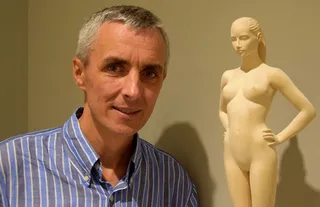
About Richard Senoner
The South Tyrolean sculptor Richard Senoner has made nudes the focus of his work and perfected the depiction of female bodies in over 15 years. His wooden sculptures show women in various sensual poses. "The nude - the classic motif in art par excellence - gives me the greatest possible scope in my work as a sculptor to translate expressiveness, aesthetics and harmony. My primary concern is to depict the human being in various thematic aspects," he says.
Senoner bases the design of his figures on the real forms of the human physique: "A detailed and precise elaboration characterises my works," says the artist. In addition to female nudes, Senoner's portfolio includes other motifs, especially sacred art.
Senoner mainly uses the wood of the linden tree for his nude sculptures. The sculptures can be up to 70 cm in size. In order to show off the fine grain of the wood and so that the sculptures do not lose their natural appearance, he does not use any colours or glazes. The perfect shaping in combination with the natural material is what makes Senoner's works so impressive.
Richard Senoner was born in 1967 and grew up in Ortisei in Val Gardena. His father, and later teacher, was also a sculptor, so he was born into the art of working with wood. In 1989, he completed his master's degree. Senoner has been a freelance artist since 1990 and has been working with the Meisel Gallery in New York since 2014.
Graphic or sculpture edition that was initiated by ars mundi and is available only at ars mundi or at distribution partners licensed by ars mundi.
> All ars mundi Exclusive Editions
Collective term for all casting processes that ars mundi carries out with the help of specialised art foundries.
Stone Casting
Similar to artificial marble, with the difference that instead of marble powder, the stone to be replicated is used in powder form.
Bonded Bronze (Cold-Cast-Bronze)
Bronze powder is polymer-bonded. Through special polishing and patination techniques, the surface of the cast takes on an appearance similar to that of bronze.
Imitation Wood
In order to guarantee absolute fidelity to the original, an artificially manufactured imitation wood is used as a base material that features typical wood characteristics: density, workability, colour, and surface structure.
Ceramic Mould Casting
Ceramic mould casting usually requires the use of casting clay, which is then fired and optionally glazed. Instead of the usual rubber moulds, plaster moulds are often used in ceramic casting and porcelain production.
Cast Bronze (Lost-Wax-Casting)
For the cast bronze, the thousand-year-old lost-wax technique is used. It's the best, but also the most complex method of producing sculptures.
Term for an art object (sculpture, installation) that, according to the artist’s intention, is produced in multiple copies within a limited and numbered edition.
Multiples enable the "democratization" of art by making the work accessible and affordable for a wider audience.
A plastic work of sculptural art made of wood, stone, ivory, bronze or other metals.
While sculptures made of wood, ivory, or stone are carved directly from the material block, in bronze casting, a working model is prepared at first. Usually, it is made of clay or other easily mouldable materials.
The prime time of sculpture after the Greek and Roman antiquity was the Renaissance. Impressionism gave a new impulse to the sculptural arts. Contemporary artists such as Jorg Immendorf, Andora, and Markus Lupertz also enriched sculptures with outstanding works.