
Picture "Hommage à Blériot" (1914), framed

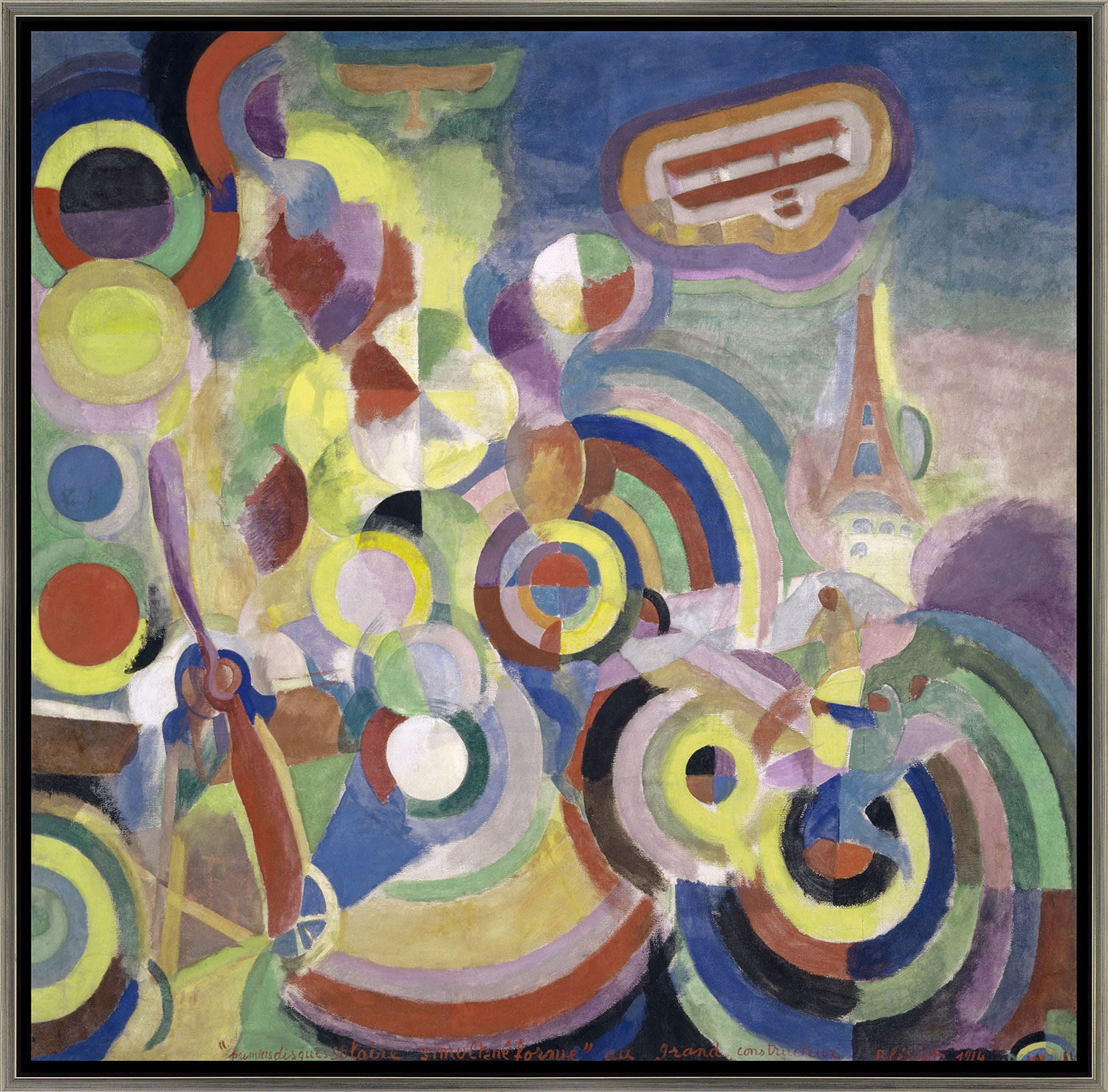


Picture "Hommage à Blériot" (1914), framed
Quick info
ars mundi Exclusive Edition | limited, 980 copies | numbered | certificate | reproduction, Giclée print on canvas | on stretcher frame | framed | size 70 x 71 cm (h/w)
Detailed description
Picture "Hommage à Blériot" (1914), framed
Colour poetry and abstract composition: The foundation of his pictures are colours and light. His window paintings, the "Fenêtres", vividly vibrating colour surfaces, led him to what Apollinaire later called his "Orphism". In his homage to Louis Blériot - an aviation pioneer who accomplished the first flight across the English Channel in 1909 - he still leaves room for the figurative: Clearly recognisable are an aircraft propeller, the Eiffel Tower and, high in the sky, Blériot's biplane.
Original: 1914, glue tempera on canvas, 250 x 251 cm, Kunstmuseum Basel, Switzerland.
Edition transferred directly onto artist's canvas using the Fine Art Giclée process and stretched on stretcher frame. Limited edition of 980 copies, numbered, with certificate. Framed in a handcrafted, silver-coloured solid wood frame. Size 70 x 71 cm (h/w). ars mundi Exclusive Edition.
Producer: ars mundi Edition Max Büchner GmbH, Bödekerstraße 13, 30161 Hanover, Germany, [email protected]
About Robert Delaunay
1885-1941
Inspired early on by the Neo-Impressionism of Georges Seurat, the Frenchman Robert Delaunay (1885-1941) started to paint together with the group "Der Blaue Reiter" in 1911. At the first exhibition of the artists' group from Munich, he even sold the most paintings of all.
In contrast to Kandinsky, Delaunay focused on light. His window paintings, the "Fenêtre", led him to what Guillaume Apollinaire later named "Orphism": vibrating areas of colour are shaping the form to be depicted. It was during this period that Delaunay finally rejected Abstract Cubism.
In 1912, the "Formes circulaires" which were a further development of his "Fenêtre" series, marked the beginning of abstract painting in France.
Term for paintings and sculptures that are detached from representational depiction, which spread across the entire western world and parts of the eastern world from around 1910 onwards in ever new stylistic variations. The Russian painter Wassily Kandinsky, born in 1866, is considered the founder of abstract art. Other important artists of abstract art are K.S. Malewitsch, Piet Mondrian, and others.
Works of abstract art
> Abstract pictures
> Abstract sculptures
Graphic or sculpture edition that was initiated by ars mundi and is available only at ars mundi or at distribution partners licensed by ars mundi.
> All ars mundi Exclusive Editions
Giclée = derived from the French verb gicler "to squirt, to spray".
The Giclée method is a digital printing process. It is a high-resolution, large-format print produced with an inkjet printer using special different-coloured dye- or pigment-based inks (usually six to twelve). The inks are lightfast, meaning they are resistant to harmful UV light. They provide a high level of nuance, contrast, and saturation.
The Giclée process is suitable for art canvases, handmade paper and watercolour paper as well as silk.