
Picture "Love", silver-coloured framed version

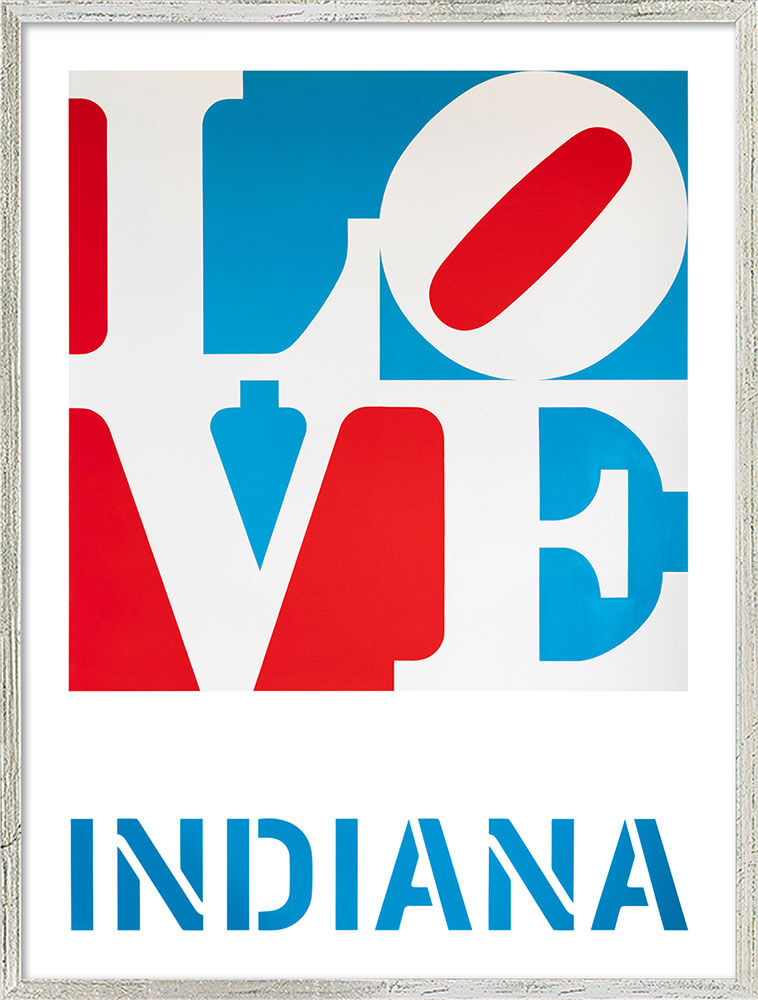


Picture "Love", silver-coloured framed version
Quick info
reproduction on cardboard | framed | glazed | size 82.5 x 62.5 cm (h/w)
Detailed description
Picture "Love", silver-coloured framed version
Edition on cardboard. © Morgan Art Foundation. Licensed by Artestar, New York. Framed in silver-coloured solid wood frame, glazed. Size 82.5 x 62.5 cm (h/w).
Producer: ars mundi Edition Max Büchner GmbH, Bödekerstraße 13, 30161 Hanover, Germany, [email protected]
About Robert Indiana
1928-2018
The Pop Art legend Robert Indiana was born in New Castle/Indiana. Since 1945, he lived in New York. He worked together with Andy Warhol, Jasper Johns, and Roy Lichtenstein. His sculpture LOVE made him world famous.
With simple stencils intended for labelling transport crates, Robert Indiana began his striking drawing images, which became characteristic of the artist's work through expressive words and bright colours.
LOVE became Indiana's artistic theme in 1966 - sculptures in marble, steel, and aluminium, screenprints, posters, tapestries, and even a LOVE stamp commissioned by the US government in 1973 followed. The typography of the work, with its tilted O, is one of the most reproduced works of post-war art and was even placed in red paint on the Berlin Wall by Indiana in 1991, in conjunction with the word "WALL".
His signature design devices were emblems, letters, and numbers - signs with a bold symbolic feel. Indiana's works are sold for $ 400,000 and more. They are central components of major modernist collections worldwide, from the Museum of Modern Art in New York to the Ludwig Museum in Cologne and many others. In Indianapolis, an entire museum is dedicated to his works.
In the early 1950s, a movement took over the cultural scene. Young artists from the U.S. and the UK independently broke with all traditions of artistic creativity, giving rise to a new art movement in modern art.
In the U.S., Roy Lichtenstein, Andy Warhol, Tom Wesselmann, and James Rosenquist who were seeking their themes in the world of advertising and comics, in star cult and anonymous urban culture. With bright colours, over dimensioning and manipulating depth perspective, they created new provocative works. Richard Hamilton and Eduardo Paolozzi became pioneers of Pop Art in England through the famous "This is Tomorrow" at London's Whitechapel Art Gallery. In the 1960s, they were followed by David Hockney, Allan Jones, Peter Phillips and Derek Boshier.