

Quick info
bonded bronze + stone | total height 23 cm | weight 3 kg
Detailed description
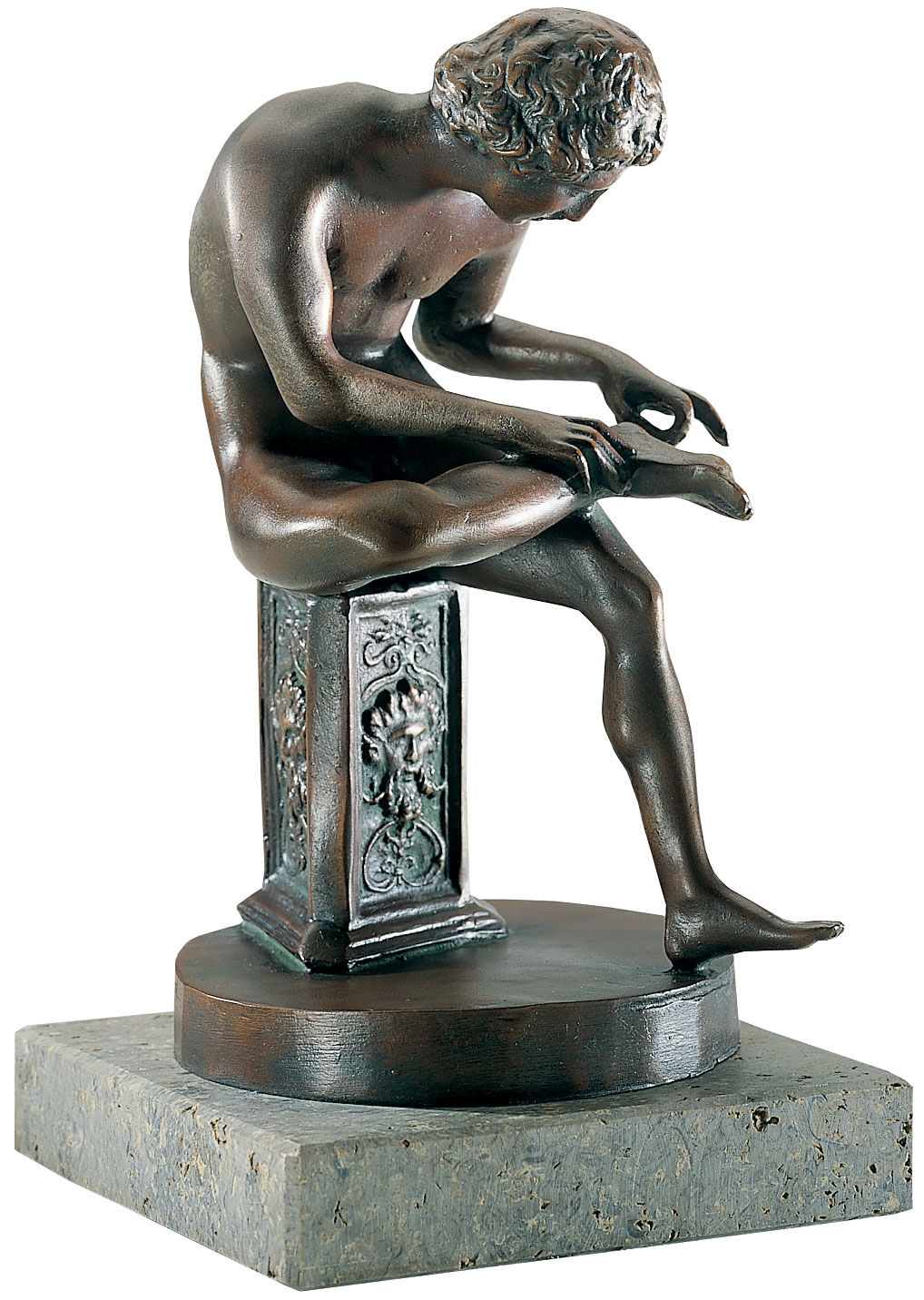
Sculpture "Boy with Thorn"
The Renaissance sculptors satisfied the predilection of Italian courts for antiquity with subtle replicas, such as this "Spinaro" dating back to the 3rd century BC. The rebirth of antique ideals took place in Florence in the 15th century and subsequently determined artistic creation in Italy, Germany, and the rest of Western Europe for almost 200 years. The Medicean age was characterised by a great sensitivity to artistic messages and a passion for collecting works of art, with sculpture setting the tone among all art forms.
Original: Staatliche Museen zu Berlin - Preußischer Kulturbesitz. Dating back to the 3rd century BC. Paduan, early 16th century, bronze.
Polymer cast, cast by hand, with bronzed surface. Height with stone pedestal 23 cm. Weight 3 kg.
Producer: ars mundi Edition Max Büchner GmbH, Bödekerstraße 13, 30161 Hanover, Germany, [email protected]
Customer reviews
Perfekte Qualität
Bronze powder is polymer-bonded. Special polishing and patination techniques give the surface of the casting an appearance similar to the authentic bronze.
(Rebirth). Term used to describe art from around 1350 until the 16th century.
Beginning in Florence, by the late 14th century, a mindset developed that, in retrospect, was classified as the rebirth of the classical ideals of ancient Greece and Rome. During the 15th and 16th centuries, the Renaissance spread first through Italy and then across Western Europe, influencing the entire artistic creation. Brilliant artists such as Donatello, Leonardo da Vinci, Michelangelo, Raphael, Dürer, Holbein, Cranach and Fouquet created their immortal works by following the humanistic premises and placing the human being in the centre of all thinking.
In literature, the Renaissance reached its pinnacle through the dramatic works of William Shakespeare.
By the end of the 16th century, the Renaissance had to give way to the opulence of the Baroque, before its ideas experienced a rebirth in the Classicism of the 18th century.
A true-to-the-original reproduction of an artwork in the same size and with the best possible material and colour uniformity.
The mould is usually taken directly from the original so that the replication reproduces even the finest details. After casting the replication, using the most appropriate method, the surface is polished, patinated, gilded or painted according to the original.
A replication of ars mundi is a recognizable copy of the original.
A plastic work of sculptural art made of wood, stone, ivory, bronze or other metals.
While sculptures made of wood, ivory, or stone are carved directly from the material block, in bronze casting, a working model is prepared at first. Usually, it is made of clay or other easily mouldable materials.
The prime time of sculpture after the Greek and Roman antiquity was the Renaissance. Impressionism gave a new impulse to the sculptural arts. Contemporary artists such as Jorg Immendorf, Andora, and Markus Lupertz also enriched sculptures with outstanding works.