
Decorative object "Ice Cream", red version

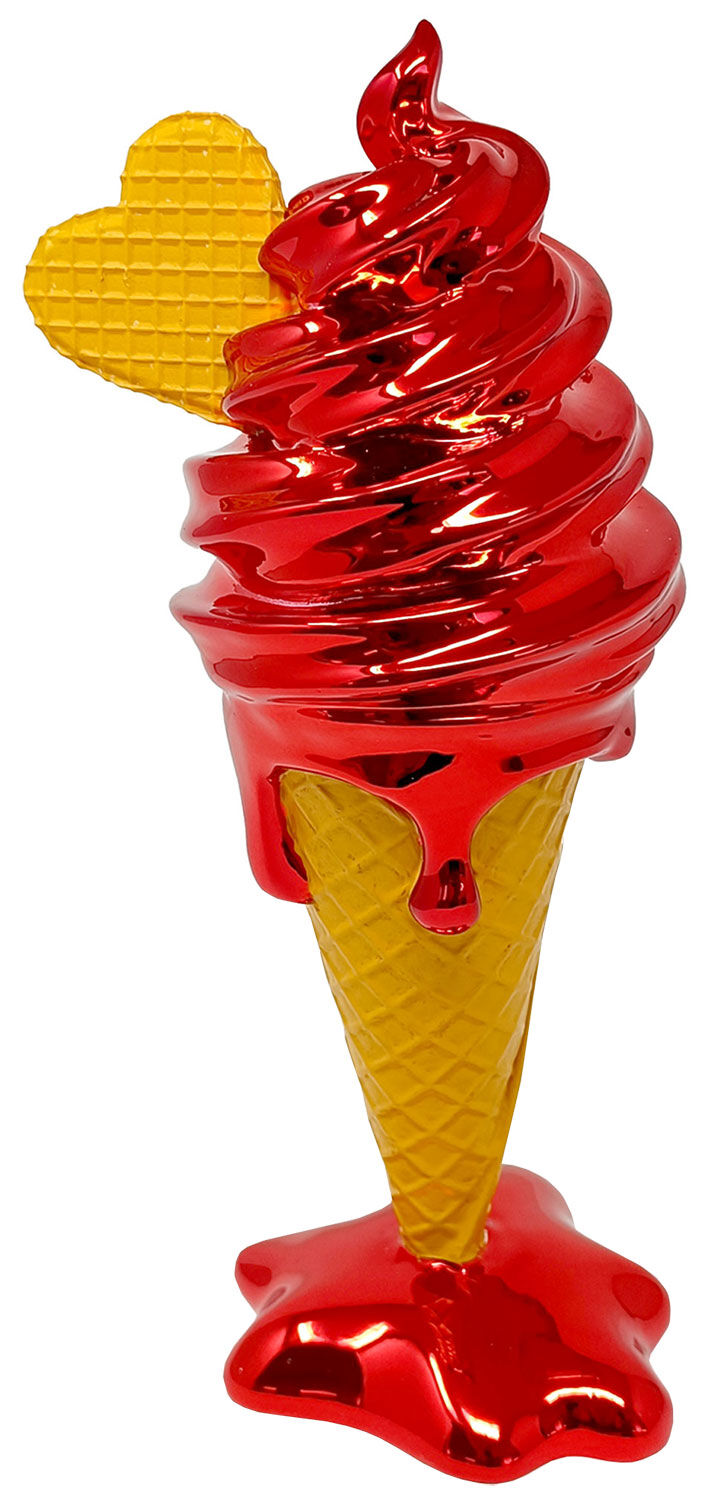
Decorative object "Ice Cream", red version
Quick info
resin | enamelled | numbered | stamped | certificate | size 32 x 12 x 12 cm (h/w/d) | weight approx. 2.2 kg
Detailed description
Decorative object "Ice Cream", red version
Happiness is ice cream - anytime you want!
"Ice Cream" enchants with its ice-cream cone-shaped silhouette, where the sweetness comes to life. The ice cream is painted in vibrant metallic colours, capturing light in a shimmering interplay. The combination of playful shape and radiant highlights transforms this sculpture into an ode to joy and the pleasures of summer. An artistic touch that celebrates the aesthetics of flavour, turning "Ice Cream" into a fun and lively visual experience.
Sculpture made from resin. Enamelled. Numbered edition, stamped by the artist. With certificate. Size 32 x 12 x 12 cm (h/w/d). Weight approx. 2.2 kg. Red version.
Producer: ars mundi Edition Max Büchner GmbH, Bödekerstraße 13, 30161 Hanover, Germany, [email protected]
About Sequenze
The Italian design label Sequenze stands for extraordinary, humorous design and creates objects in a blend of chrome shine and metallic aesthetics that are more than decoration - they are real statements.
Collective term for all casting processes that ars mundi carries out with the help of specialised art foundries.
Stone Casting
Similar to artificial marble, with the difference that instead of marble powder, the stone to be replicated is used in powder form.
Bonded Bronze (Cold-Cast-Bronze)
Bronze powder is polymer-bonded. Through special polishing and patination techniques, the surface of the cast takes on an appearance similar to that of bronze.
Imitation Wood
In order to guarantee absolute fidelity to the original, an artificially manufactured imitation wood is used as a base material that features typical wood characteristics: density, workability, colour, and surface structure.
Ceramic Mould Casting
Ceramic mould casting usually requires the use of casting clay, which is then fired and optionally glazed. Instead of the usual rubber moulds, plaster moulds are often used in ceramic casting and porcelain production.
Cast Bronze (Lost-Wax-Casting)
For the cast bronze, the thousand-year-old lost-wax technique is used. It's the best, but also the most complex method of producing sculptures.