
Quick info
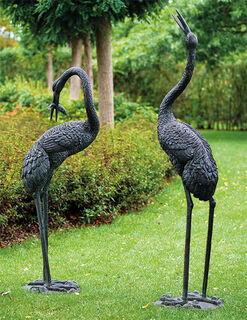
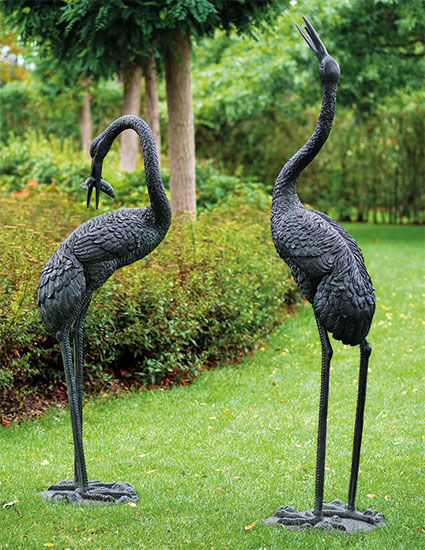
bronze | patinated | crane left: size 153 x 51 x 61 cm (h/w/d), weight 20 kg | crane right: size 183 x 51 x 61 cm (h/w/d), weight 20 kg
Detailed description
Set of 2 garden sculptures "Cranes", bronze
If the word "majestic" applies to an animal, it certainly does to the crane. High-legged, long-necked and with a powerful beak, it strides gracefully through its territory. Bronze, cast using the Lost-Wax-Process. Green patinated.
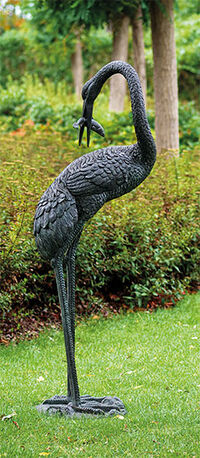
"Crane with fish": size 153 x 51 x 61 cm (h/w/d). Weight 20 kg.
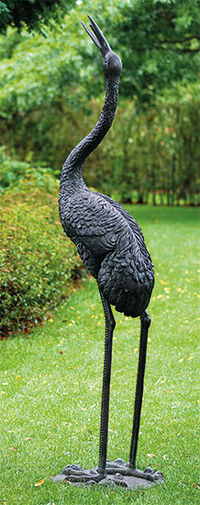
"Crane with stretched neck": size 183 x 51 x 61 cm (h/w/d). Weight 20 kg.
Set of two cranes.
Producer: ars mundi Edition Max Büchner GmbH, Bödekerstraße 13, 30161 Hanover, Germany, [email protected]
This set contains the following products
An alloy of copper with other metals (especially with tin) used since ancient times. It is an ideal metal for high-quality artistic castings, capable of enduring for millennia.
When casting bronze, the artist usually applies the lost-wax technique which is dating back more than 5000 years. This is the best, but also the most complex method of producing sculptures.
First, the artist forms a model of their work. This model is embedded in a liquid silicone rubber mass. Once the material has solidified, the model is cut out, leaving a negative mould. Liquid wax is then poured into the negative mould. After cooling down, the wax cast is removed from the mould, provided with sprues and dipped into ceramic mass. The ceramic mass is hardened in a kiln, where the wax melts away (lost mould).
Finally, the negative mould is ready, into which the 1400° C hot molten bronze is poured. After the bronze had cooled down, the ceramic shell is broken apart, reavoling the sculpture.
Next, the sprues are removed, the surfaces are polished, patinated and numbered by the artist or by a specialist, following their instructions. Thus, each casting is an original work.
For lower-quality bronze castings, the sand casting method is often used, which, however, does not achieve the results of a more elaborate lost-wax technique in terms of surface characteristics and quality.