
Garden stele "Life Is Not a One-Way Street"


Garden stele "Life Is Not a One-Way Street"
Quick info
handmade and -painted | ceramic | metal | wood | size approx. 55 x 140 x 30 cm (w/h/d) | weight approx. 43 kg | weatherproof
Detailed description
Garden stele "Life Is Not a One-Way Street"
A focal point or directional sign in the garden, or a massive accent indoors: The head is made of hand-modelled and hand-painted ceramic, the arms of metal, and the body is made of a 200-year-old oak stele. Size approx. 55 x 140 x 30 cm (w/h/d). Weight approx. 43 kg.
Producer: ars mundi Edition Max Büchner GmbH, Bödekerstraße 13, 30161 Hanover, Germany, [email protected]
Customer reviews
Toll
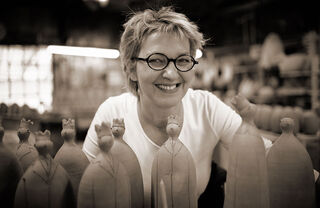
About Susanne Boerner
Susanne Boerner, born in Göttingen, Germany, has been working successfully for many years as a designer of ceramics, wood and metal. She is an expert in handicraft, and this is how her weatherproof sculptures are created in limited quantities. Her sculptures, which are often made of unusual material mixes like ceramics, wood and metal, are shaped and painted by hand. Boerner's distinctive objects are colourful, a little quirky - and always full of fantasy and humour.
Her works have also been spreading cheerfulness in Brussels since March 2017: On the 60th anniversary of the Treaties of Rome, her large ensemble of figures "European Citizens", was set up as a permanent exhibition in front of the European Commission building. 13 life-size figures made of metal and clay adorn Jean Monnet Square, named after one of the founding fathers of European unification.
Ceramic product made of kaolin, quartz, and feldspar.
Porcelain is formed by turning or pressing, and figurative objects are cast. Complex objects have to be cast in separated steps and sections, and then "assembled". After the moulding, the pieces are dried and undergo an initial firing at about 900°C. Next, the glaze will be applied and fired at temperatures between 1,240 °C and 1,445 °C. In renowned manufactories, the porcelain is painted by hand, with each colour being fired individually under strict temperature tolerances.
Porcelain was invented in China and became widespread in Europe from the 16th century onwards. The first European porcelain factory was founded in Meissen, Germany in 1710.
Other famous European porcelain factories include Fürstenberg, Höchst, Schwarzburger Werkstätten, Lladró, Nymphenburg, KPM, Augarten, Sèvres, Limoges, Royal Copenhagen, Worcester. Each factories label their products with their personal porcelain stamps to indicate their origin.