
Picture "Composition IX, Opus 18 (Abstraction of Card Players)" (1917), framed



Picture "Composition IX, Opus 18 (Abstraction of Card Players)" (1917), framed
Quick info
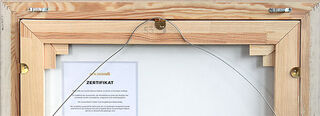
limited, 499 copies | numbered certificate | reproduction, Giclée print on canvas | on stretcher frame | framed | size 82 x 75 cm (h/w)
Detailed description
Picture "Composition IX, Opus 18 (Abstraction of Card Players)" (1917), framed
Theo van Doesburg founded "De Stijl" together with Piet Mondrian in 1917 and formulated a highly reduced concept of art based on rational, mathematical principles, which he called "concretism".
Gicleé on canvas, stretched on a stretcher frame. Limited edition of 499 copies, with a numbered certificate on the back. In high-quality shadow gouge. Size 82 x 75 cm (h/w).
Producer: ars mundi Edition Max Büchner GmbH, Bödekerstraße 13, 30161 Hanover, Germany, [email protected]
Term for paintings and sculptures that are detached from representational depiction, which spread across the entire western world and parts of the eastern world from around 1910 onwards in ever new stylistic variations. The Russian painter Wassily Kandinsky, born in 1866, is considered the founder of abstract art. Other important artists of abstract art are K.S. Malewitsch, Piet Mondrian, and others.
Works of abstract art
> Abstract pictures
> Abstract sculptures
Giclée = derived from the French verb gicler "to squirt, to spray".
The Giclée method is a digital printing process. It is a high-resolution, large-format print produced with an inkjet printer using special different-coloured dye- or pigment-based inks (usually six to twelve). The inks are lightfast, meaning they are resistant to harmful UV light. They provide a high level of nuance, contrast, and saturation.
The Giclée process is suitable for art canvases, handmade paper and watercolour paper as well as silk.