
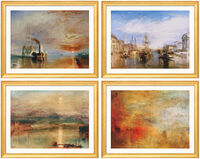
Picture "Canal Grande" (1835), golden framed version


Picture "Canal Grande" (1835), golden framed version
Quick info
ars mundi Exclusive Edition | reproduction on paper | framed | glazed | size 38 x 48 cm (h/w)
Detailed description
Picture "Canal Grande" (1835), golden framed version
During his European travels, Turner was particularly fascinated by Venice because of the colours and the intense power of the light. The English painter used pure, unmixed colours and juxtaposed them to create light. The result was a series of light-flooded vedute in which landscape and architecture merge into a vibrant surface.
Original: 1835, Oil on canvas, Metropolitan Museum of Art, New York.
High-quality edition on handmade, heavy 250g Gmund Tactile. Framed in a sophisticated, golden solid wood frame, glazed. Size 38 x 48 cm (h/w). ars mundi Exclusive Edition.
Producer: ars mundi Edition Max Büchner GmbH, Bödekerstraße 13, 30161 Hanover, Germany, [email protected]
This object is part of the following sets
Customer reviews
Frame variant: Framing 1
Schnelle und sorgfältig verpackte Lieferung. Ein schönes Bild, das mich jeden Tag erfreut.
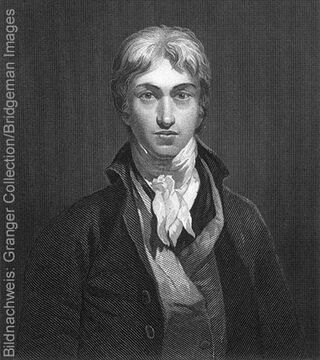
About William Turner
1775-1851
English oil and watercolour painter. He mainly painted landscapes, history paintings and seascapes.
Already at a young age, William Turner achieved the highest technical perfection and was appointed to the Royal Academy as one of Britain's most important artists; nine years later he was one of its members.
Experiments with new techniques and an intensive study of Goethe's theory of colour, together with extensive travels, sparked an important change in Turner's style. He courageously abandoned the established rules of pictorial tradition and Object Realism and devoted himself intensively to the effects of light and movement.
Turner earned much criticism for his completely new type of painting. But his precise observation of nature and the flowing light in the paintings of the great Romantic paved the way for the Impressionists and the development of modern painting.
The majority of his works are exhibited in the Tate Gallery in London.
Graphic or sculpture edition that was initiated by ars mundi and is available only at ars mundi or at distribution partners licensed by ars mundi.
> All ars mundi Exclusive Editions
An intellectual movement that spread from literature and philosophy into the visual arts, it was established around 1800 but failed to produce its own style in the visual arts.
The art of Romanticism was determined by the content of the awareness of life and the sensations triggered by it. Inner feelings and emotions, dreams and fantasy, world and nature, the power of myth, and the striving towards infinity became central themes. The actual realm of Romanticism lies in painting and drawing. Landscape, in particular, came to the fore as a recurring theme, depicting the relationship between humans and nature while reflecting emotional states. Alongside a newfound appreciation for nature, there was a renewal of religious attitudes and a return to the past, tradition, history, old legends, and fairy tales, as well as to the art of old masters and epochs. Especially in the case of Germany, this was strongly national-oriented art.
The main representatives in Germany include C.D. Friedrich, P.O. Runge, J.A. Koch, M. v. Schwind, and the Nazarene group of artists. The French branch of Romanticism, which followed different tendencies than its German counterpart, is best exemplified by the art of Delacroix.
Romanticism lasted until around 1830.