
Picture "Laocoon" (ca. 1610/1614), framed
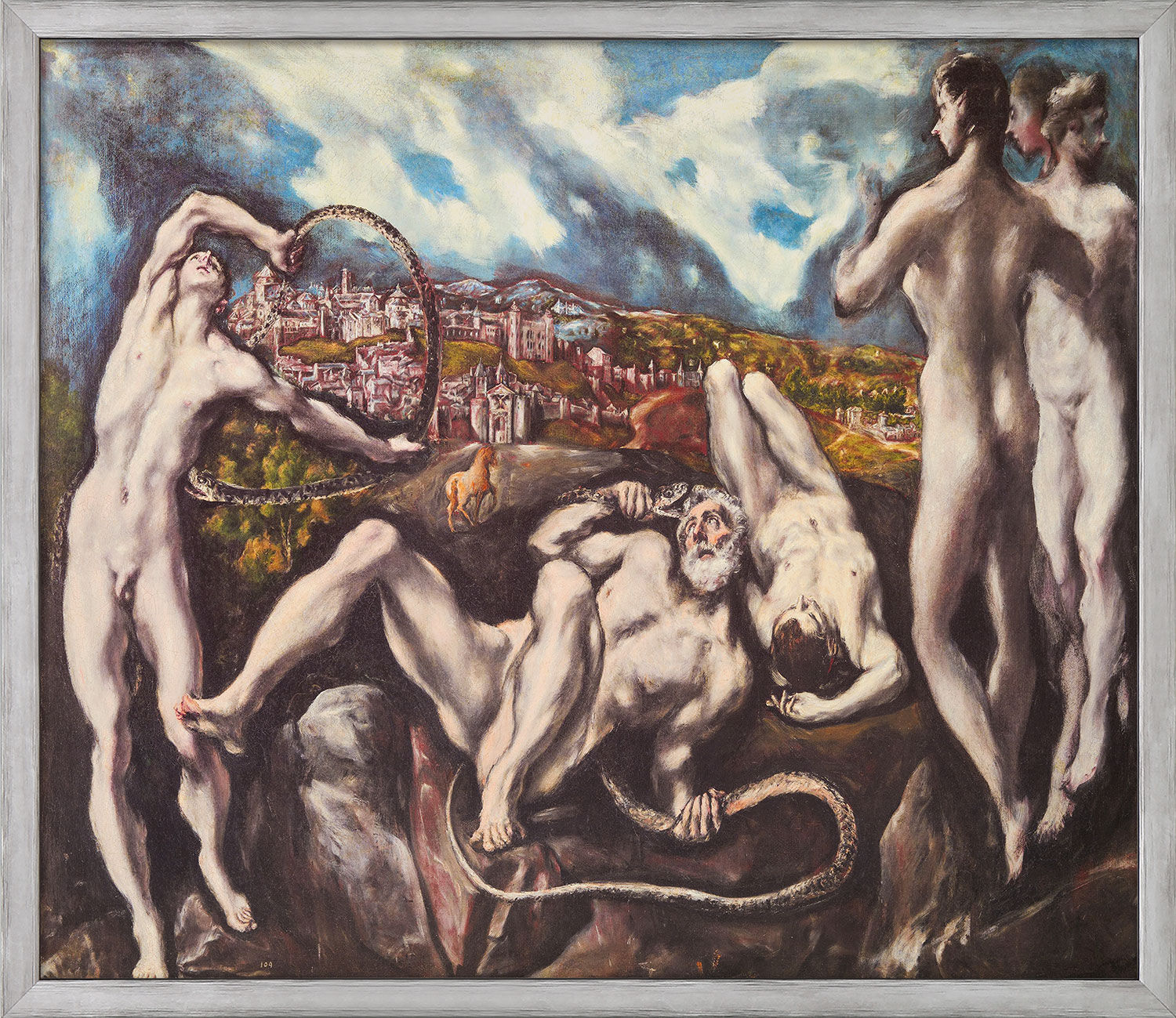


Picture "Laocoon" (ca. 1610/1614), framed
Quick info
reproduction on paper | framed | glazed | size 74 x 94.5 cm (h/w)
Detailed description
Picture "Laocoon" (ca. 1610/1614), framed
Original: ca. 1610/1614, oil on canvas, 137.5 x 172.5 cm, National Gallery of Art, Washington.
High-quality edition on paper. Framed in silver-coloured solid wood frame, glazed. Size 74 x 94.5 cm (h/w).
Producer: ars mundi Edition Max Büchner GmbH, Bödekerstraße 13, 30161 Hanover, Germany, [email protected]
About El Greco
El Greco (1541-1614) was born in Crete under the civil name Dominikos Theotokopoulos. The artist known as "El Greco" (Spanish: "the Greek") because of his origins was one of the most outstanding painters of the Late Renaissance and Mannerism.
In Italy, he worked in the studio of Tizian and received important inspiration from Tintoretto. In Rome, he encountered the works of Michelangelo. In the Spanish city of Toledo, he became court painter to Philipp II. and maintained a large workshop.
With his progressive painting, El Greco was far ahead of his time: He combined Greek-Byzantine influences with Mannerism, thereby giving Renaissance art a reinterpretation towards the visionary and immaterial. He painted his figures elongated, slender and fine-limbed against backgrounds from which individual colours shine brightly.
(Rebirth). Term used to describe art from around 1350 until the 16th century.
Beginning in Florence, by the late 14th century, a mindset developed that, in retrospect, was classified as the rebirth of the classical ideals of ancient Greece and Rome. During the 15th and 16th centuries, the Renaissance spread first through Italy and then across Western Europe, influencing the entire artistic creation. Brilliant artists such as Donatello, Leonardo da Vinci, Michelangelo, Raphael, Dürer, Holbein, Cranach and Fouquet created their immortal works by following the humanistic premises and placing the human being in the centre of all thinking.
In literature, the Renaissance reached its pinnacle through the dramatic works of William Shakespeare.
By the end of the 16th century, the Renaissance had to give way to the opulence of the Baroque, before its ideas experienced a rebirth in the Classicism of the 18th century.