
Picture "Les pommes" from "Si le mourais là-bas" (1962)
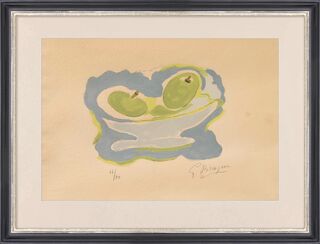


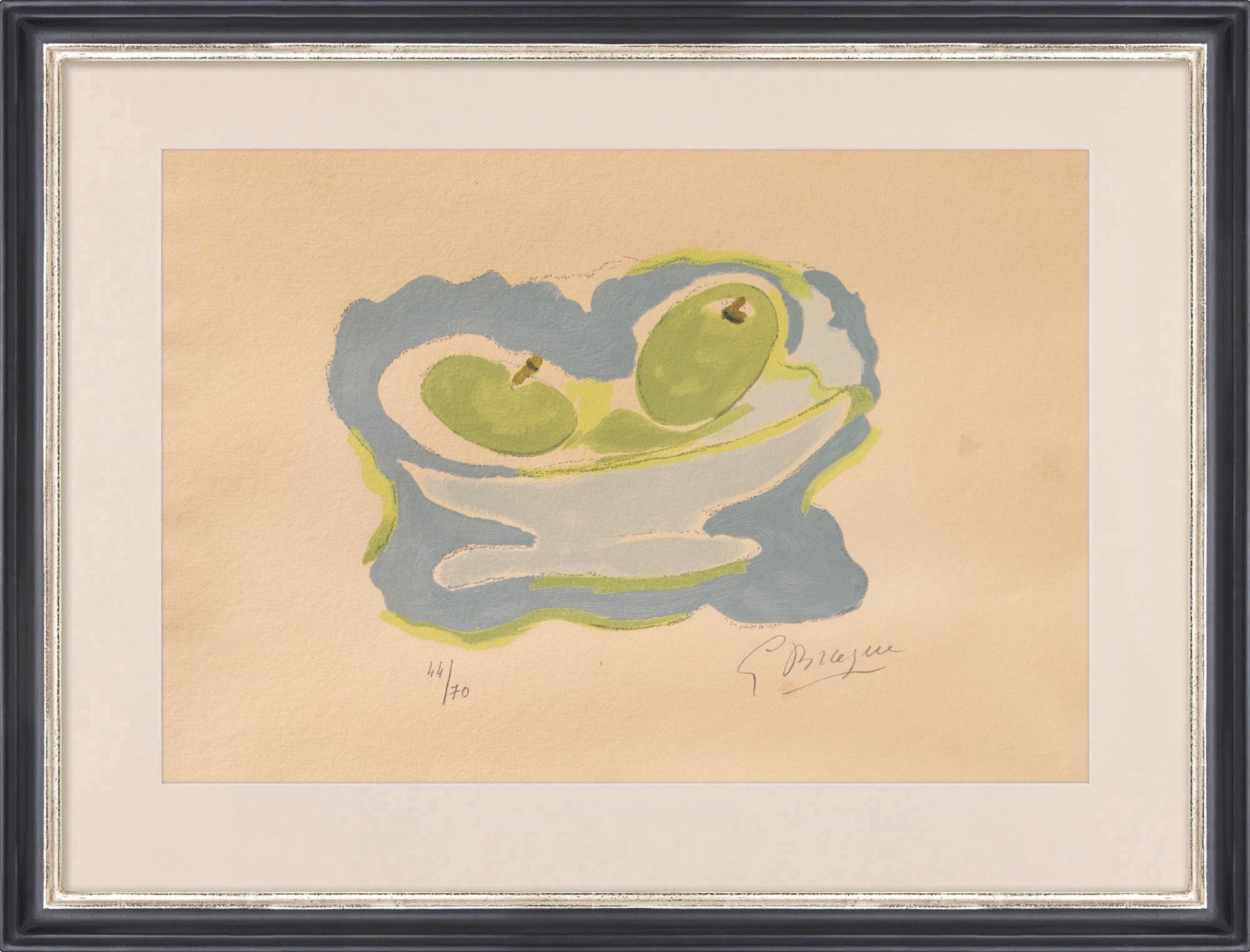
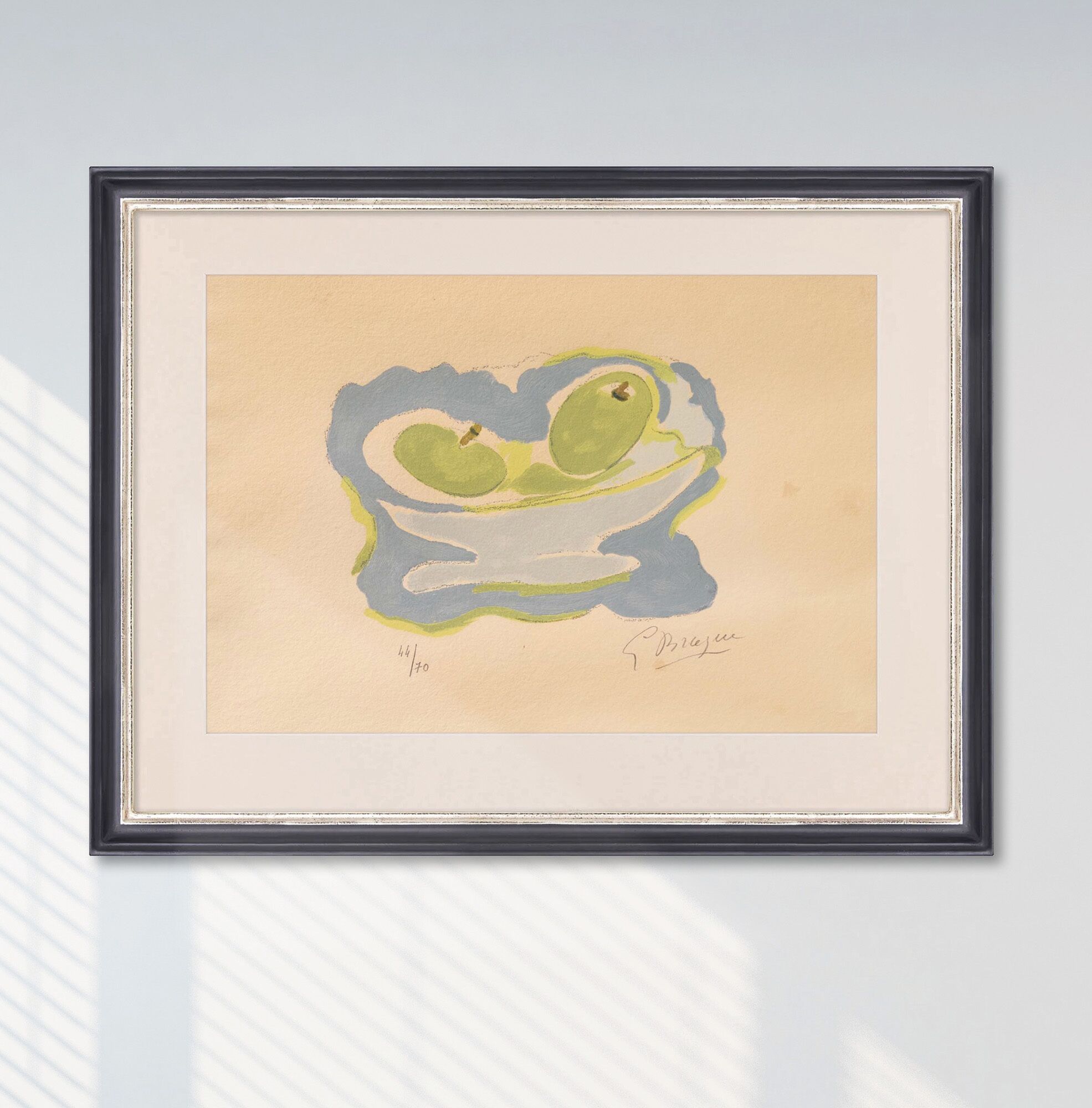


Picture "Les pommes" from "Si le mourais là-bas" (1962)
Quick info
limited, 70 copies | numbered | signed | colour woodcut on handmade paper | framed | size 48 x 55 cm
Detailed description
Picture "Les pommes" from "Si le mourais là-bas" (1962)
Colour woodcut, 1962. Edition of 70 copies on handmade paper + a few copies on Japanese paper. Numbered and signed. Illustration from the book "Si je mourais là-bas" by Guillaume Apollinaire, for which Braque designed 18 colour woodcuts. Published by Louis Broder, Paris. Printed by Féquet et Baudier, Paris. Catalogue raisonné: Vallier 181. Motif size 18 x 27 cm. Sheet size 36 x 47.5 cm. Framed size 48 x 55 cm as shown.
Producer: ars mundi Edition Max Büchner GmbH, Bödekerstraße 13, 30161 Hanover, Germany, [email protected]

About Georges Braque
1882-1963
Georges Braque, the revolutionary of modern art and a classic figure of French art, left behind a magnificent oeuvre of prints: around 300 etchings, copperplate engravings, lithographs, and book illustrations. His life's work bears witness not only to an extraordinary joy in experimentation but also to a highly idiosyncratic pictorial imagination and creative power.
Braque stated the following essential observation: "We must be content with discovery and renounce explaining. There is only one valuable thing in art: the thing you cannot explain. A work that does not have a magical effect is not a work of art."
Before the First World War, Cubism emerged in 1908 in France, with its founding fathers being Georges Braque, who was born in Argenteuil, Val-d'Oise on May 13, 1882, and his friend and companion Pablo Picasso. Returning from the war, however, Braque pursued different artistic paths from Picasso, which in turn linked him to Henri Laurens and Juan Gris.
The guitar, vases and tables were central motifs in the Cubist paintings. The pure colours that still dominated his early fauvist landscape paintings subside to a grey-brown colour palette. As an antithesis to Cubism, Braque developed the collages, creating a new pictorial reality with scraps of wallpaper and newspaper clippings. This was followed by landscapes again in the 1930s, which, however, bear witness to a still-life-like structure. From 1938 onwards, the traditional theme of the studio became important to the artist, enriched by the motif of birds with a mystical component.
In the last years of his life, the artist presented himself not only as a painter and sculptor but also as a jewellery designer. His "Bijou Braque" combined the art of jewellery with the aspiration of the artist. He incorporated Greek motifs into over 100 designs. A dozen of them were even purchased by France. His art was so highly regarded that, in 1961, he became the first artist to have an exhibition dedicated to him in the Louvre during his lifetime. When Braque died on August 31, 1963, in Paris, the French Minister of Culture, André Malraux, made his status clear once again: "He is at home in the Louvre with the same right as the Angel of Reims in his cathedral."
The overlaps and saturations in Braque's works do not appear intensely spatial but are an integral part of the picture plane. This is why his paintings appear aesthetic and sensitive. His works "activate" the sense of seeing, and the pictorial impression is always ambiguous. The motifs are dissolved into colourful and formal structures. The form has autonomy and, at the same time, is integrated into larger constellations. All major museums exhibit his work in prominent positions.
The field of graphic arts, that includes artistic representations, which are reproduced by various printing techniques.
Printmaking techniques include woodcuts, copperplate engraving, etching, lithography, serigraphy, among others.