
Picture "Vase of Flowers" (ca. 1670)
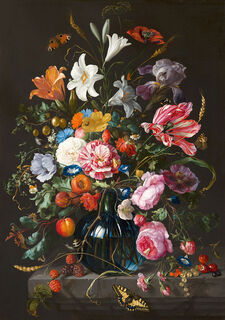


Picture "Vase of Flowers" (ca. 1670)
Quick info
ars mundi Exclusive Edition | limited, 980 copies | numbered | signed certificate | reproduction on aluminium dibond behind acrylic glass | size 70 x 49 cm (h/w) | suspension device
Detailed description
Picture "Vase of Flowers" (ca. 1670)
Original: ca. 1670, oil on canvas, 74 x 52.5 cm, Mauritshuis, The Hague, Netherlands.
Edition behind 3 mm thick acrylic glass on aluminium plate. Limited to 980 copies and numbered. Includes signed certificate. Size 70 x 49 cm (h/w). With suspension device. Due to the smooth surface, there may be reflections depending on the incidence of light. ars mundi Exclusive Edition.
Producer: ars mundi Edition Max Büchner GmbH, Bödekerstraße 13, 30161 Hanover, Germany, [email protected]
About Jan Davidsz de Heem
Jan Davidsz de Heem (1606-1683/1684) was the most gifted representative of a great Dutch-Flemish family of artists. His style of depiction was unsurpassed in elegance and refinement.
He is renowned for his still lifes especially for the ones with the motifs of flowers and fruit of the Dutch School. He combined the microscopic delicacy of workmanship with the finest arrangements. He mainly painted vases with bouquets, often populated with insects and butterflies.
A form of presentation favoured by professional photographers and exhibition organizers. Increasingly, artists are creating works for this carrier made of high-tech composite aluminium. The metallic surface creates a synthesis with the colours. White areas of the image are shimmering matt-metallic, depending on the light source, giving the image an elegant and puristic appearance. Thanks to the direct colour pigmentation the details are depicted precisely. Alu-Dibond is long-lasting and resistant.
Term used to describe the art of the 17th century. The Baroque art style, which originated in Rome around 1600, quickly spread through the visual arts, literature, and music across nerly all of Europe, lasting in the visual arts until 1770. The final phase is generally characterised by Rococo.
Characteristic features include: the pulsating movement of all forms, the abolition of boundaries between architecture, painting, and sculpture, leading to the typical "Gesamtkunstwerk" ("total work of art"), and, above all, the purposeful use of light, which became an important artistic component. The subordination of the individual parts to the whole resulted in the creation of a unified yet dynamic space, which is fully expressed in the magnificent buildings of this period.
The Baroque art, with its penchant for grandeur, splendour, and rushing abundance, clearly reflects the desire for representation, which was a concern of secular and ecclesiastical, especially the Catholic patrons strengthened by the Counter-Reformation. In painting, characteristic features of the Baroque, are manifested in altar and ceiling painting, history scences and portraits.
Typical representatives include artists such as Anthony van Dyck, Peter Paul Rubens, as well as Gian Lorenzo Bernini in the field of sculpture.