
Picture "Fishing Boats on the Lagoon" (1913), framed


Picture "Fishing Boats on the Lagoon" (1913), framed
Quick info
reproduction on paper | framed | passe-partout | glazed | size 77.6 x 84.1 cm (h/w)
Detailed description
Picture "Fishing Boats on the Lagoon" (1913), framed
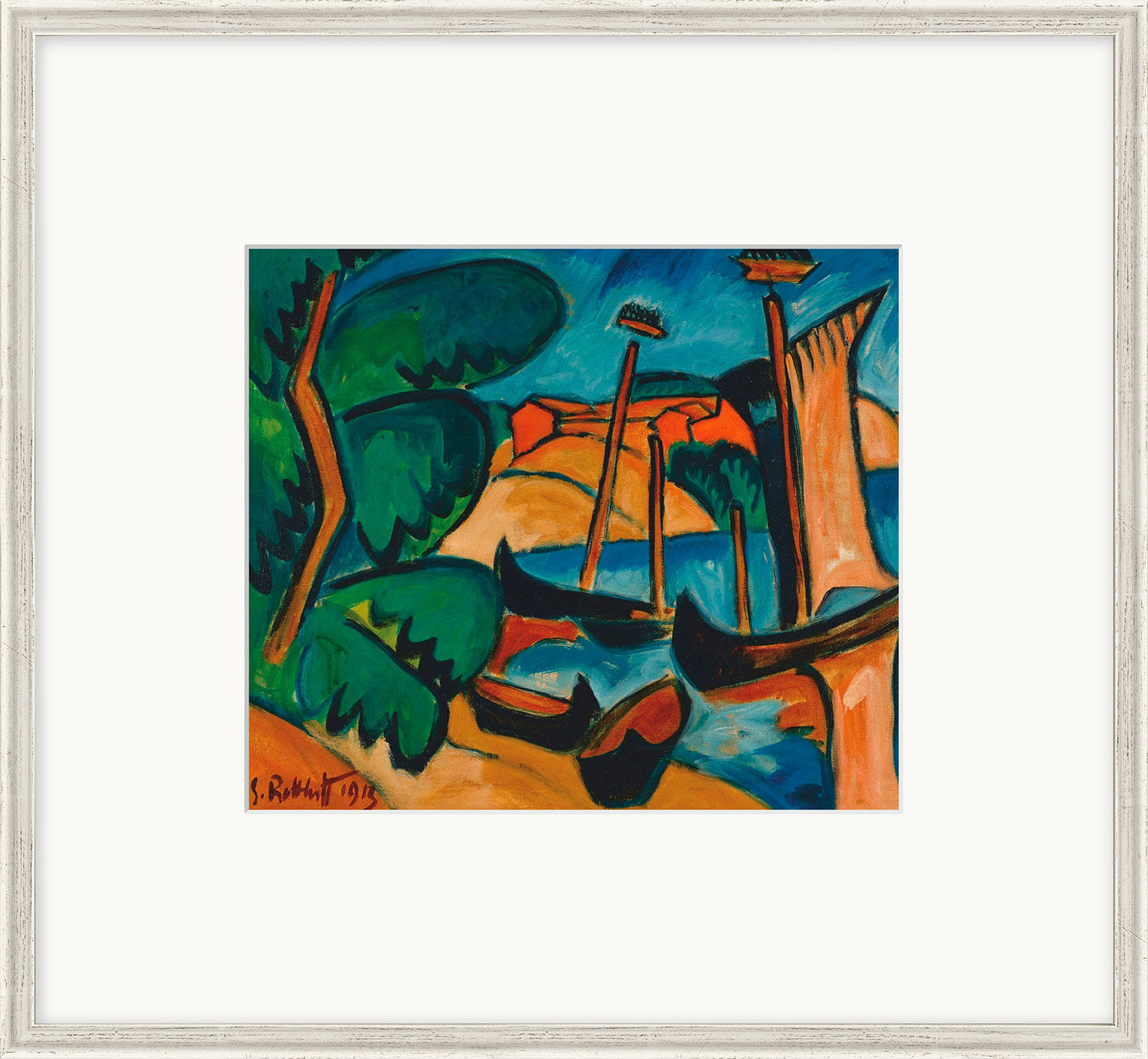
From mid-1910 onwards, Karl Schmidt-Rottluff increasingly produced landscapes and figure paintings characterised by bold outlines placing one area against another, dispensing with many details and restricting himself to only a few, often complementary colours. In the artists' colony of Nidden on the Curonian Spit, Schmidt-Rottluff painted several scenes of boats, harbours, and seascapes.
On the Curonian Spit, alongside a flourishing spa trade, everything revolved around fishing. The painting "Fishing Boats on the Lagoon" depicts the extensive fishing industry of the resort town of Nidden, with boats lying peacefully in the coastal bay.
Original: 1913, oil on canvas, 88 x 101 cm, Folkwang Museum.
4-colour edition on 200g FocusArt paper. Framed in a solid wood frame with a passe-partout, dust-proof glazing. Size 77.6 x 84.1 cm (h/w). © Museum Folkwang, Essen © VG-Bildkunst, Bonn 2022
Producer: ars mundi Edition Max Büchner GmbH, Bödekerstraße 13, 30161 Hanover, Germany, [email protected]
About Karl Schmidt-Rottluff
1884-1976
He loved the seclusion of nature, the landscapes of the North Sea and the Baltic Sea, which became the place of creation and motif of Karl Schmidt-Rottluff's works. Along with Fritz Bleyl and Ernst Ludwig Kirchner, he was a co-founder of the artists' association "Die Brücke", which was founded in 1905. Around that time, he changed his surname by adding his native town of Rottluff.
When he moved to Berlin in 1911, he got inspired by the Futurist, Cubist and African styles of art, which later influenced his work. The artist suffered from the defamation of his art by the Nazi Party. In 1936 they banned him from exhibiting, which was followed five years later by a ban on painting. In a desperate state of mind, Schmidt-Rottluff returned to his hometown and accepted a professorship at the Hochschule für Bildende Künste in Berlin in the late 1940s. Through his teaching position, he found interest in working on large-format watercolours, which later became characteristic of his work.