
Sculpture "Gentleman in an Armchair - Anniversary Edition", bronze New


Sculpture "Gentleman in an Armchair - Anniversary Edition", bronze New
Quick info
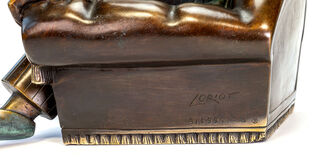
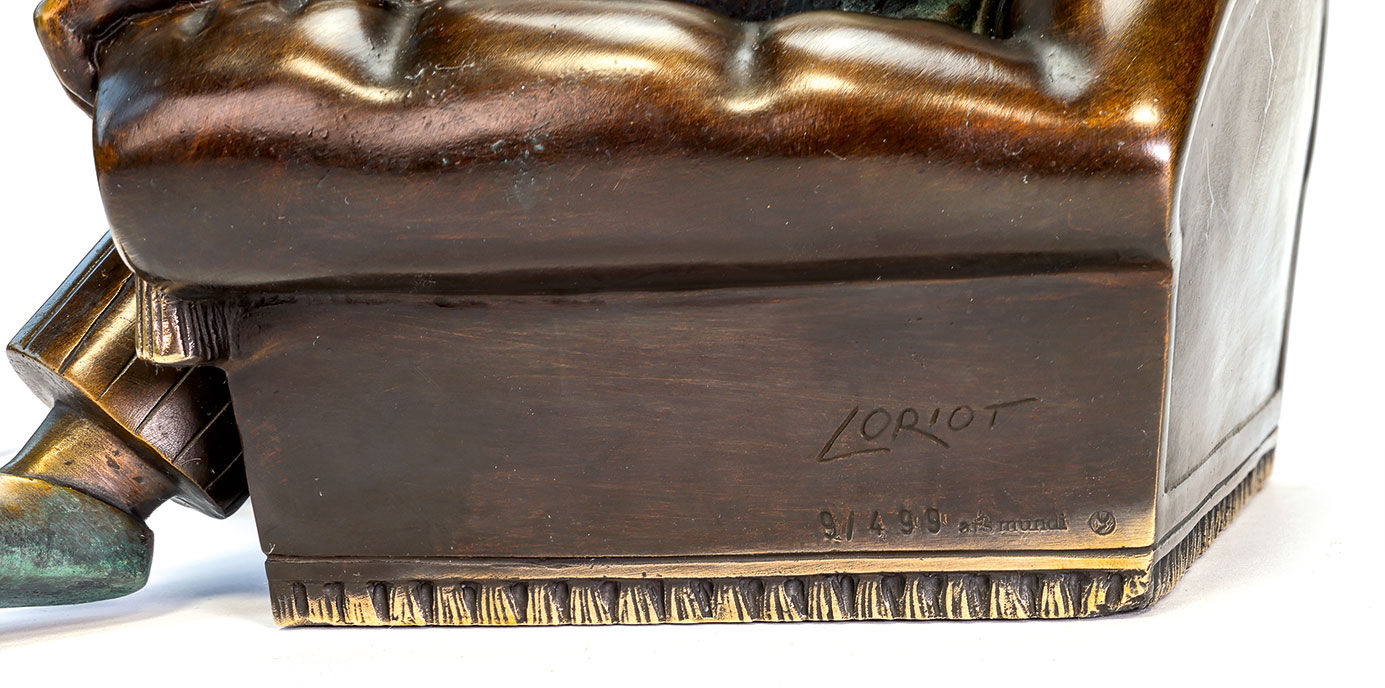
ars mundi Anniversary Edition | limited, 499 copies | numbered | signed | hallmarked | certificate | bronze | chiselled | polished | patinated | size approx. 20 x 19 x 19.5 cm (h/w/d) | weight approx. 4 kg
Detailed description
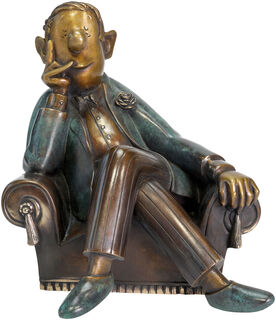
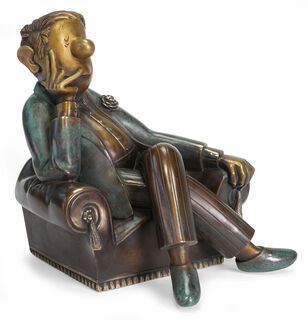
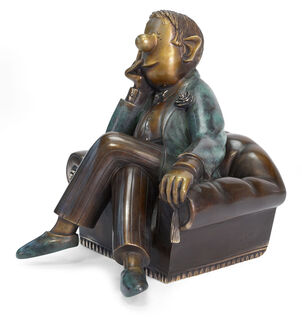
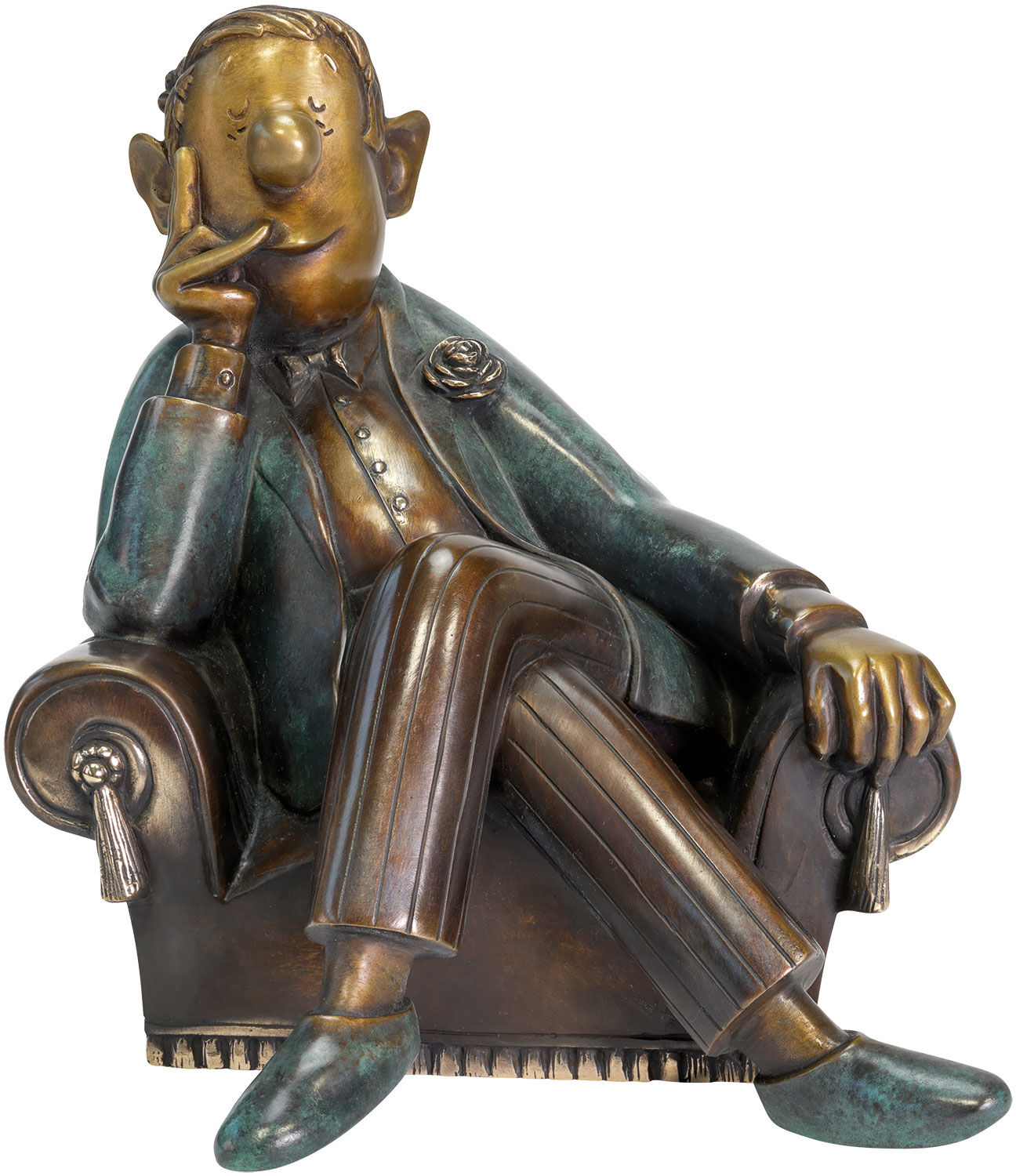
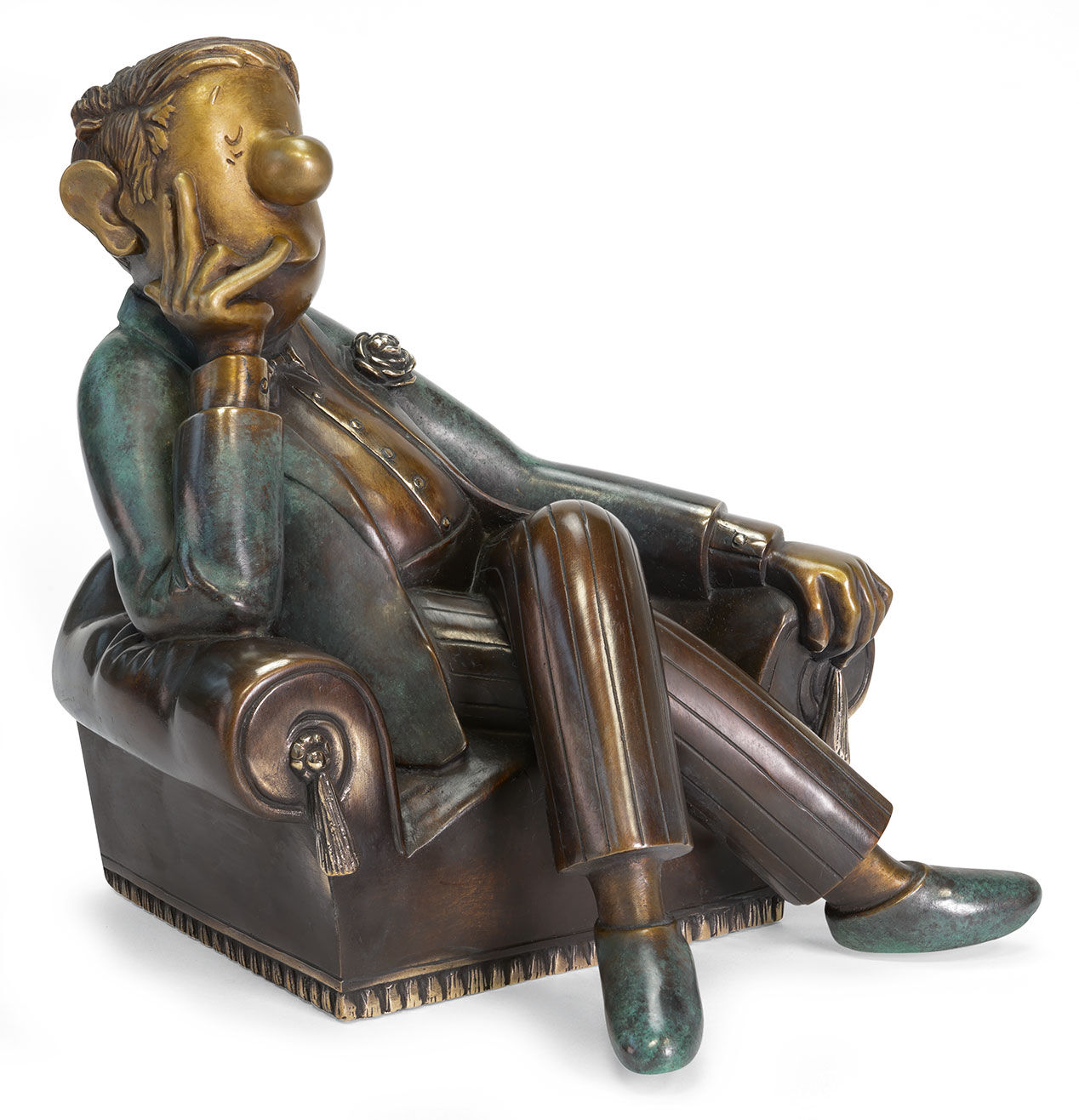
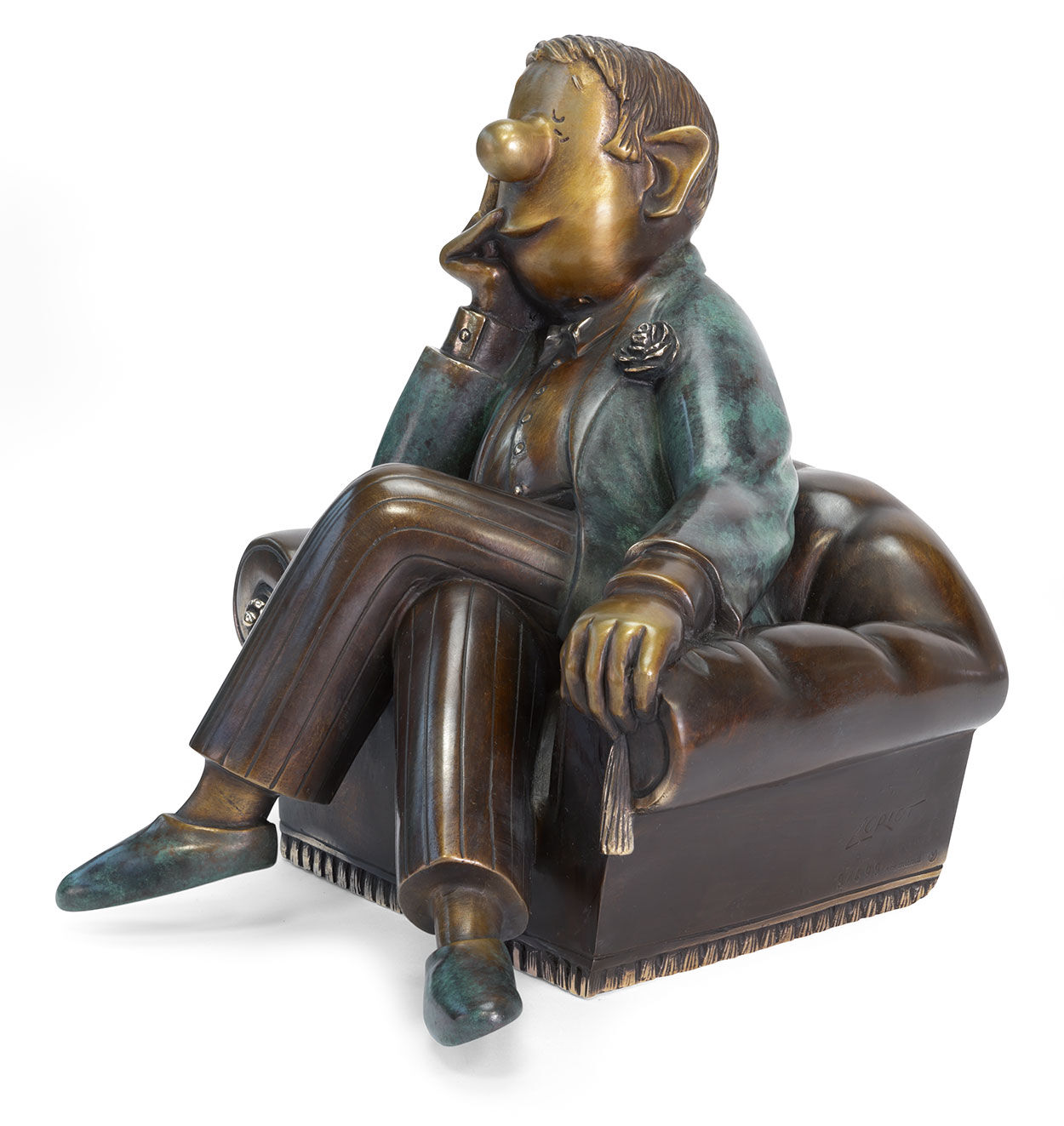
Sculpture "Gentleman in an Armchair - Anniversary Edition", bronze
ars mundi Exclusive Edition marking the 103rd anniversary of Loriot's birth.
Loriot's extraordinary success was due above all to his keen powers of observation. From this perceptive eye, he developed his inimitable sense of comedy, which often lies only a hair’s breadth away from the seemingly normal and socially acceptable. His great theme was misunderstanding and its consequences - but also the little rituals, vanities and shortcomings of everyday middle-class life.
"Gentleman in an Armchair" takes us right into the heart of this world. The subject itself could hardly be more quintessentially Loriot: a gentleman, an armchair and a moment of seemingly perfect comfort. Nothing more is needed. Yet the armchair is far more than a mere piece of furniture. It appears as a refuge, an expression of middle-class domestic culture and a small private bastion against the impositions of the outside world. Anyone seated here wants nothing more, for a moment, than to enjoy some peace and quiet. But in Loriot’s world, idyll is famously a fragile state. Comedy always lurks wherever the carefully maintained order of everyday life threatens to lose its balance.
Bronze sculpture, cast using the Lost-Wax-Process, hand-chiselled, polished and patinated. Limited edition of 499 copies, numbered, signed and hallmarked with the foundry and ars mundi stamp. With numbered certificate of authenticity and limitation. Size approx. 20 x 19 x 19.5 cm (h/w/d). Weight approx. 4 kg. ars mundi Exclusive Edition to mark the 103rd anniversary of Loriot's birth.
Producer: ars mundi Edition Max Büchner GmbH, Bödekerstraße 13, 30161 Hanover, Germany, [email protected]

About Loriot
1923-2011, a german draughtsman, cartoonist, author, humourist, opera director
He won several german "golden" awards: two Golden Cameras, two Golden Records, the Golden Screen, the Golden Gramophone and the Golden Lion of Honour. Not to mention the Ernst Lubitsch and Adolph Grimme prizes, the Telestar or the Sonderbambi... He was awarded the Order of Merit of the Federal Republic of Germany for his special services.
Loriot is best known for his cartoons and sketches with the characters feature of bulbous noses. For example, two popular characters are Mr Müller-Lüdenscheid and Dr Klöbner, who - unawares - get into the same hotel bathtub and argue so delightful about whether the rubber duck should be allowed in the water or not... In his books, Loriot has dealt intensively with the passage of time. "Loriot's Diary - Zeitgeschehen von Meisterhand" or "Loriot's Heile Welt - Neue gesammelte Texte und Zeichnungen zu brennenden Fragen der Zeit" are just two out of many examples.
Vicco von Bülow, alias Loriot, was without a doubt the "grand seigneur" of German humour. His sketches are often known by heart by a lot of people and no matter the art he was creating - whether as a caricaturist, a humourist, an actor or director - he always achieved something special and memorable.
"Comedy, as I understand it, always deals with self-irony, otherwise something is missing. You have to include yourself." This is the secret to his success and noticeable in all his works. That‘s why his humour is never disparaging, never hurtful. Loriot was always extremely tender even with the characters in his most accurate parodies and precisely observed exposures of middle-class narrow-mindedness. Loriot’s humour, one could say, is not a sharp dagger for grim confrontations, but a fine scalpel that ultimately works towards healing the world with every cut.
The "grand seigneur" of German humour died in August 2011.
An alloy of copper with other metals (especially with tin) used since ancient times. It is an ideal metal for high-quality artistic castings, capable of enduring for millennia.
When casting bronze, the artist usually applies the lost-wax technique which is dating back more than 5000 years. This is the best, but also the most complex method of producing sculptures.
First, the artist forms a model of their work. This model is embedded in a liquid silicone rubber mass. Once the material has solidified, the model is cut out, leaving a negative mould. Liquid wax is then poured into the negative mould. After cooling down, the wax cast is removed from the mould, provided with sprues and dipped into ceramic mass. The ceramic mass is hardened in a kiln, where the wax melts away (lost mould).
Finally, the negative mould is ready, into which the 1400° C hot molten bronze is poured. After the bronze had cooled down, the ceramic shell is broken apart, reavoling the sculpture.
Next, the sprues are removed, the surfaces are polished, patinated and numbered by the artist or by a specialist, following their instructions. Thus, each casting is an original work.
For lower-quality bronze castings, the sand casting method is often used, which, however, does not achieve the results of a more elaborate lost-wax technique in terms of surface characteristics and quality.
Graphic or sculpture edition that was initiated by ars mundi and is available only at ars mundi or at distribution partners licensed by ars mundi.
> All ars mundi Exclusive Editions
Term for an art object (sculpture, installation) that, according to the artist’s intention, is produced in multiple copies within a limited and numbered edition.
Multiples enable the "democratization" of art by making the work accessible and affordable for a wider audience.
A plastic work of sculptural art made of wood, stone, ivory, bronze or other metals.
While sculptures made of wood, ivory, or stone are carved directly from the material block, in bronze casting, a working model is prepared at first. Usually, it is made of clay or other easily mouldable materials.
The prime time of sculpture after the Greek and Roman antiquity was the Renaissance. Impressionism gave a new impulse to the sculptural arts. Contemporary artists such as Jorg Immendorf, Andora, and Markus Lupertz also enriched sculptures with outstanding works.