
Picture "Italian Landscape - Tuscany" (1913), black and golden framed version New
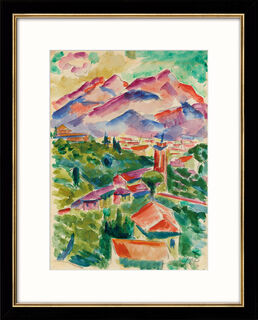


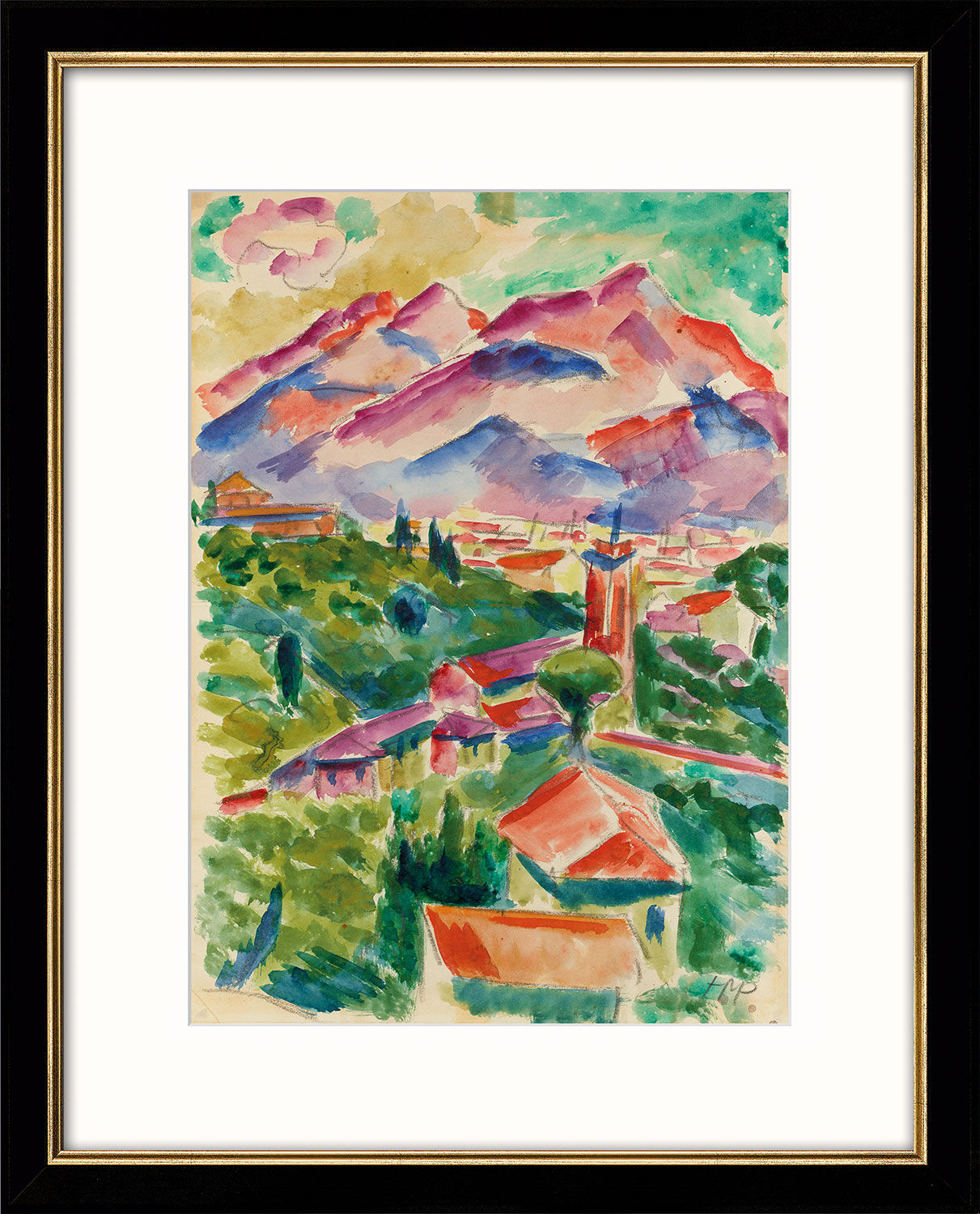


Picture "Italian Landscape - Tuscany" (1913), black and golden framed version New
Quick info
ars mundi Exclusive Edition | limited, 199 copies | numbered | certificate | reproduction, Giclée print on Hahnemühle handmade watercolour paper | framed | passe-partout | glazed | size approx. 71 x 57 cm (h/w)
Video
Detailed description
Picture "Italian Landscape - Tuscany" (1913), black and golden framed version
When autumn bathes the landscape in warm gold and nature reveals the full splendour of its colours, our longing for places filled with light and warmth grows. Max Pechstein's "Italian Landscape – Tuscany" captures precisely this feeling to impressive effect. The watercolour was created during his trip to Italy in 1913 and depicts the Tuscan landscape with powerful colours and a sophisticated sense of depth. Pechstein was so fascinated by the subject that he later also rendered it as an oil painting, which is now considered lost.
Original: 1913, watercolour over pencil on paper, privately owned.
Edition reproduced from the original using the Fine Art Giclée process on Hahnemühle genuine handmade watercolour paper. Limited edition of 199 copies, numbered, with certificate. Motif size approx. 50 x 36 cm (h/w). Sheet size 65 x 51 cm (h/w). Framed in a black and golden solid wood frame with passe-partout, dust-proof glazing. Size approx. 71 x 57 cm (h/w). ars mundi Exclusive Edition. © 2026 Pechstein Hamburg/Berlin.
Producer: ars mundi Edition Max Büchner GmbH, Bödekerstraße 13, 30161 Hanover, Germany, [email protected]
Frame configurator
Customised picture frame

Frame configurator
Customised picture frame


Customer reviews
Frame variant: Framing 1
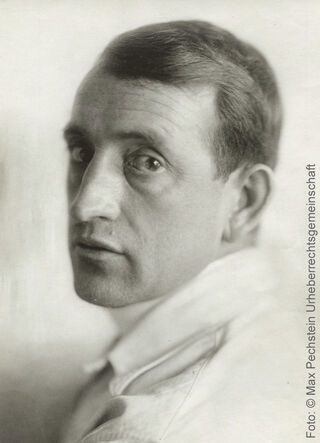
About Max Pechstein
1881-1955
Max Pechstein is considered today, as he was then, one of the most important representatives of German Expressionism. In spring 1906, he joined the artists' group "Die Brücke", which had been founded the previous year by Kirchner, Heckel, Schmidt-Rottluff and Bleyl. In the field of graphic art, he produced an oeuvre of over 850 woodcuts, lithographs and etchings in addition to his paintings.
What Tahiti was to Paul Gauguin, the Baltic Sea coast was to Max Pechstein: a paradise where he found peace, but above all great inspiration. From 1909 onwards, he travelled several times to Nidden on the Curonian Spit, where Lovis Corinth had worked as a young art student more than a quarter of a century earlier. However, when the Treaty of Versailles placed the Curonian Spit under Allied administration in 1920, the way there was blocked. In his own words, Pechstein had to "once again go in search of a spot of earth that was not overrun by painters, tourists and bathers". He found it in Leba, where from then on he spent his summers on a regular basis.
"For more than twenty years Max Pechstein went to the Baltic coast every summer, first to the Curonian Spit, then to Pomerania, which naturally connected him closely to our house. When he rented a room here with his first wife in 1921, he had no idea how attached he would soon feel to the small harbour town of Leba, for he fell in love with Marta Möller, the daughter of his innkeeper. The pristine nature with its beach lakes and the fishing boats in the harbour, the pipe in his mouth, tanned and the anchor tattooed, those things stayed with the passionate angler Pechstein until the end of his life, even when he and his wife could no longer go to Pomerania after the Second World War." (Dr. Birte Frenssen, Deputy Director at the Pomeranian State Museum in Greifswald)
Graphic or sculpture edition that was initiated by ars mundi and is available only at ars mundi or at distribution partners licensed by ars mundi.
> All ars mundi Exclusive Editions
Artistic movement that replaced Impressionism in the early 20th century.
Expressionism is the German form of the art revolution in painting, graphic art and sculpture, with its precursors found in the works of Paul Cézanne, Vincent van Gogh, and Paul Gauguin at the end of the 19th century. The expressionists sought to reach the fundamental elements of painting. Using vibrant, unbroken colours in large areas, emphasising lines, and aiming for suggestive expressiveness, they fought against the artistic taste established by the bourgeoisie.
The most important representatives of Expressionism were the founders of "Die Brücke": Ernst Ludwig Kirchner, Erich Heckel, Karl Schmidt-Rottluff, Max Pechstein, Otto Mueller and Franz Marc, August Macke and others.
Masters of Viennese Expressionism are Egon Schiele and Oskar Kokoschka. Among sculptors, Ernst Barlach is the most famous.
Fauvism is the French form of Expressionism.
Giclée = derived from the French verb gicler "to squirt, to spray".
The Giclée method is a digital printing process. It is a high-resolution, large-format print produced with an inkjet printer using special different-coloured dye- or pigment-based inks (usually six to twelve). The inks are lightfast, meaning they are resistant to harmful UV light. They provide a high level of nuance, contrast, and saturation.
The Giclée process is suitable for art canvases, handmade paper and watercolour paper as well as silk.