
Picture "Creatino Di Adamo (Creation of Adam)", framed


Picture "Creatino Di Adamo (Creation of Adam)", framed
Quick info
reproduction on paper | framed | passe-partout | glazed | size 36 x 42 cm (h/w)
Detailed description
Picture "Creatino Di Adamo (Creation of Adam)", framed
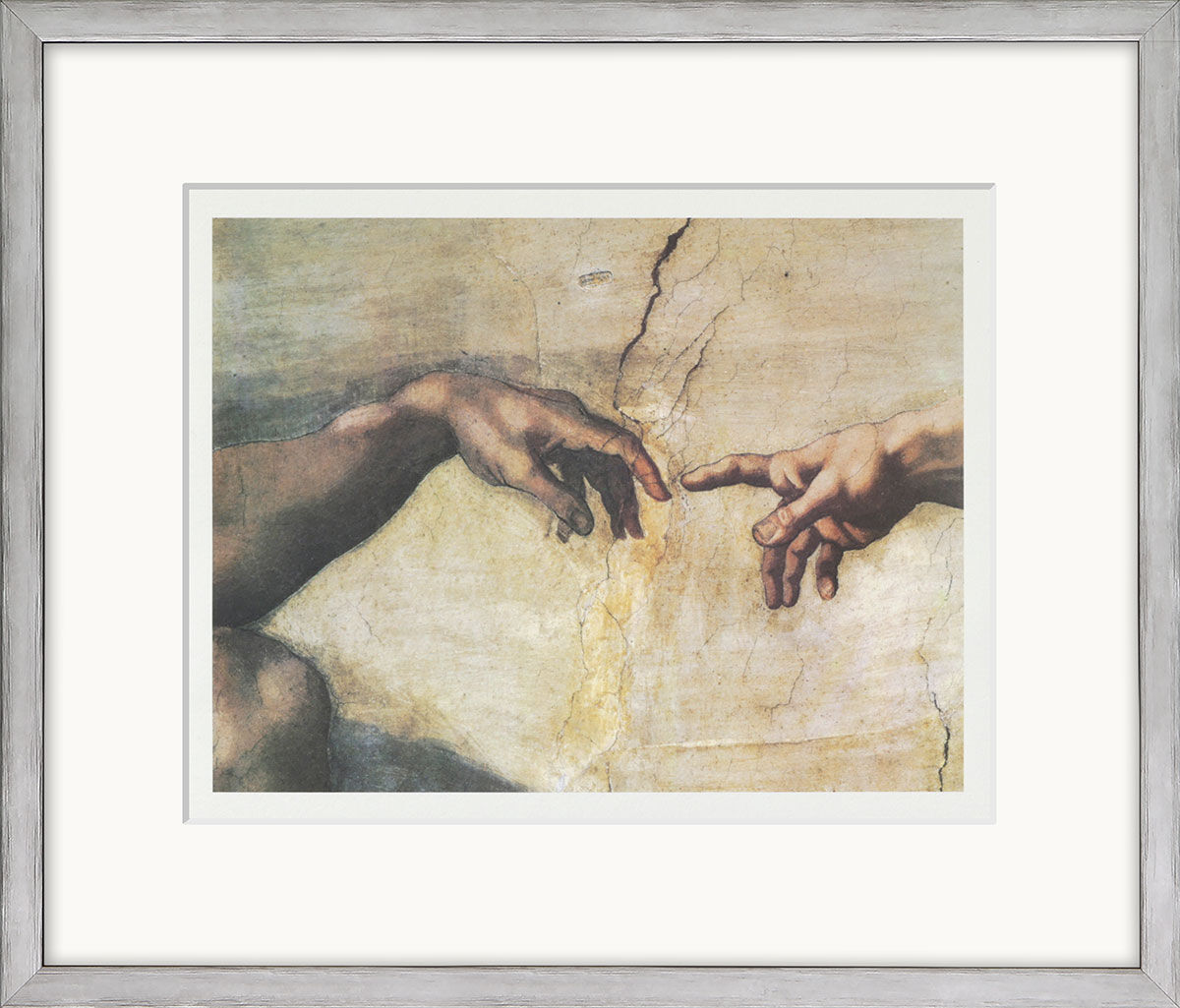
Probably the most famous section of Michelangelo's wall and ceiling paintings from around 1510 from the Sistine Chapel in Rome.
High-quality edition on paper. Framed in silver-coloured solid wood frame with passe-partout, glazed. Size 36 x 42 cm (h/w).
Producer: ars mundi Edition Max Büchner GmbH, Bödekerstraße 13, 30161 Hanover, Germany, [email protected]
About Michelangelo Buonarroti
1475-1564
Michelangelo depicted pain and despair but also hope in his prehistory of mankind: the Sistine Chapel in the Vatican. When he created these vaulted frescoes between 1508 and 1512, the main representative of the High Renaissance and pioneer of Mannerism was already playing a central role in Italian artistic and intellectual life as a sculptor and painter.
Michelangelo Buonarroti was born in Caprese, Tuscany, in 1475. He trained as a painter under Domenico Ghirlandaio, and as a sculptor probably under Bertoldo di Giovannis, whereby the study of antiquity was a major influence.
From 1496 to 1501, Michelangelo worked in Rome, where among other projects he created the "Pietà" for St Peter's Basilica. Until 1504, he worked in Florence on the monumental statue of "David", which still shows the close connection to antiquity. The following sculptures mark the transition to Mannerism through intense moments of movement.
In 1505, Michelangelo received the commission for the tomb of Pope Julius II. However, it was only completed in a reduced way after his death in 1513 because the stubborn artist could not come to an agreement with the client. The "Bound Slaves" and "Moses" were created in 1516. He was to work as an architect for the Medicis but was unable to realise the planned building and instead implemented the design he had developed in the staircase of the Biblioteca Laurenziana in Florence, starting in 1521.
As of 1534, Michelangelo lived in Rome for good.
Michelangelo's late work is characterised by an intensive preoccupation with religious themes but also with architectural plans, such as the supervision of the construction of St. Peter's Church or the Palazzo Farnese. Through his letters and sonnets, we can also discover Michelangelo the poet, who died in 1564.
(Rebirth). Term used to describe art from around 1350 until the 16th century.
Beginning in Florence, by the late 14th century, a mindset developed that, in retrospect, was classified as the rebirth of the classical ideals of ancient Greece and Rome. During the 15th and 16th centuries, the Renaissance spread first through Italy and then across Western Europe, influencing the entire artistic creation. Brilliant artists such as Donatello, Leonardo da Vinci, Michelangelo, Raphael, Dürer, Holbein, Cranach and Fouquet created their immortal works by following the humanistic premises and placing the human being in the centre of all thinking.
In literature, the Renaissance reached its pinnacle through the dramatic works of William Shakespeare.
By the end of the 16th century, the Renaissance had to give way to the opulence of the Baroque, before its ideas experienced a rebirth in the Classicism of the 18th century.