
Picture "Church at Auvers-sur-Oise" (1890) - LITO Masters, framed


Picture "Church at Auvers-sur-Oise" (1890) - LITO Masters, framed
Quick info
limited, 999 copies | numbered | certificate | LITO Hi-Rnd© process on paper | framed | size 78.5 x 62.5 cm (h/w)
Detailed description
Picture "Church at Auvers-sur-Oise" (1890) - LITO Masters, framed
Vincent van Gogh spent the final months of his life in Auvers-sur-Oise. His atmospheric painting from 1890 shows the early Gothic church of the French town. It rises monumentally against the empty, dark blue sky. Not rendered with perspective, but for its own expressive sake. It stands at a fork in the road.
Original: oil on canvas. Musée d'Orsay, Paris.
High-quality edition using the LITO Hi-Rnd© process on paper, produced in collaboration with the Musée d'Orsay, Paris. Limited edition of 999 copies. Numbered and with certificate. Framed in white aluminium frame with shadow gap. Size 78.5 x 62.5 cm (h/w).
LITO Masters - Facsimiles in the Highest Perfection:
The name LITO Masters stands for a new era in the reproduction of artworks. The Austrian company has developed a technology, the patented LITO Hi-Rnd© process, that allows original artworks to be scanned in intricate detail and reproduced in the highest quality. Every brushstroke, every nuance of colour, and every fibre of the original canvas is preserved. LITO Masters already works with several renowned art institutions, including the Musée d'Orsay in Paris and the Musée Magritte in Brussels.
Producer: ars mundi Edition Max Büchner GmbH, Bödekerstraße 13, 30161 Hanover, Germany, [email protected]
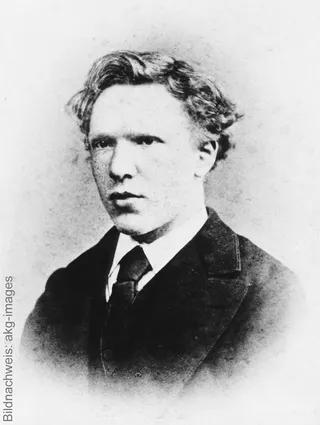
About Vincent van Gogh
1853-1890 - Pioneer of Expressionism
"This man will either go mad or he'll leave all the rest of us far behind," predicted Camille Pissarro about Vincent van Gogh, who was born in 1853 as the son of a priest. And indeed, the Dutchman became a precursor of modernism, ushering in Expressionism with his curved lines and bright colours. While during his lifetime van Gogh could hardly earn enough money from his paintings to buy paint and canvases and had to depend on financial support from his brother Theo, today his works regularly reach multi-million dollar prices at spectacular auctions.
Van Gogh (1853-1890) came from a Protestant pastor's family in Groot-Zundert in Brabant. He first came into contact with art through an uncle who was an art dealer. Initially van Gogh worked in branches of Goupil & Cie Gallery in The Hague, London and Paris, but also as a tutor in England and as a Methodist preacher. He first began to draw as a preacher coal-mining district of Borinage. Afterwards, he attended the Brussels Academy for a few months but mainly continued his education as an autodidact.
His first oil paintings depict poor peasants and workers. These pictures are very dark and painted with simple, broad lines. Via Antwerp, where he stayed for three months and became acquainted with the lightness and elegance of Japanese woodblock prints, he came to Paris. Here he discovered the sun and bright colours. He studied the Impressionists, Pointillists and early Symbolists and painted cityscapes, landscapes and portraits.
Seeking more light and freedom, he went to Arles in the south of France in 1888, where his friend Paul Gauguin followed him. Van Gogh planned to establish an artist commune there and invite all his painter friends to live and work with him, but the plan failed. After a dramatic confrontation with Gauguin, in which van Gogh injured his ear, he had to spend several long periods in hospitals due to mental breakdowns. These crises later intensified and eventually led to his suicide.
Van Gogh's most famous paintings were created during his time in Arles. All the luminosity of the sun can be seen in these paintings; fields, trees and clouds reflect the power of nature in an impressive way. For us viewers today, it is hard to imagine the strength that may have been needed to produce such joyful masterpieces in the midst of personal psychological misery. It remains van Gogh's secret - and it remains the secret of his late work to this day.
The style of Impressionism, which emerged in French painting around 1870, owes its name to Claude Monet's landscape 'Impression, Soleil Levant'. After initial rejection, it began a veritable triumphal procession.
Painters such as Claude Monet, Edgar Degas, Edouard Manet, Auguste Renoir and others created motifs from everyday life, urban and landscape scenes in bright, natural light.
Impressionism can be seen as a reaction to academic painting. Rather than emphasizing content with a structured composition, it focused on the subject as it appears in the moment, often in a seemingly random snapshot. The reality was seen in all its variety of colours in natural lighting. Outdoor painting replaced studio painting.
Through the brightening of the palette and the dissolution of firm contours, a new approach to colour emerged. In many cases, the colours were no longer mixed on the palette but placed side by side on the canvas, so that the final impression emerged in the eye of the viewer with a certain distance. In "Pointillism", (with painters such as Georges Seurat or Paul Signac), this principle was taken to the extreme.
Outside France, Impressionism was taken up by painters such as Max Slevogt, Max Liebermann and Lovis Corinth in Germany, and by James A. M. Whistler in the United States.
However, Impressionism was only expressed to a limited extent in the art of sculpture. In the works of Auguste Rodin, who is considered one of the main representatives, a dissolution of surfaces is evident, in which the play of light and shadow is included in the artistic expression. Degas and Renoir created sculptures as well.