Michelangelo and da Vinci – The Duel of the Renaissance Geniuses
Leonardo da Vinci and Michelangelo Buonarroti – two brilliant artists who both had a decisive influence on the Renaissance art. At the beginning of the 16th century, they met in Florence, whereupon a passionate rivalry soon developed. This reached its climax in a commission for frescoes in the Florentine Palazzo Vecchio. In the end, however, there were only losers.
The Historical Context: Florence in Upheaval
Both Michelangelo and da Vinci had already made a name for themselves at the turn of the 15th to the 16th century and had undertaken prestigious public commissions. At that time, Florence was an exceptionally fertile place for the visual arts. The citizens of the city had just put an end both to the rule and to the life of Girolamo Savonarola, a radical and tyrannical church reformer. Immediately afterwards, Florence was declared an independent city-state.
The new government of the republic was extraordinarily supportive of the visual arts, having recognised the great power they contained. It wanted to use architecture, painting and sculpture to win acceptance among the population for its actions and ideas. As a result, numerous commissions were awarded to visual artists and Florence was made into a centre of art.
Michelangelo and da Vinci also benefited from these circumstances. The following will examine how the now legendary rivalry between da Vinci and Michelangelo came about in Florence. Their very contrasting characters, the direct confrontation in 1504 and the consequences of the events for art history will be considered in greater detail.
Michelangelo and da Vinci – Two Very Different Characters
Even during their lifetimes, Michelangelo and da Vinci were among the most sought-after artists in Europe. Beyond that, however, they had little in common. They held fundamentally different views of art, but also differed clearly from one another in character. The rivalry between da Vinci and Michelangelo revealed a duel of artistic generations.
Leonardo da Vinci – The Universal Genius of the Renaissance
Leonardo da Vinci (1452 – 1519) was the epitome of the Renaissance artist. This applied both to his intellectual outlook and to his painting style. He was regarded as a scientific polymath. As a visionary engineer, architect and natural philosopher, he researched and developed ideas in numerous fields. At the same time, he also possessed great artistic talent. In his opinion, art and science were not mutually exclusive. Rather, he regarded both disciplines as a unity and as an expression of human creativity and productivity. Thus, he also allowed his scientific insights to flow into his artistic work.
Just as he analysed nature and its phenomena in his studies, he also brought them onto the canvas. He attached great importance to an anatomically correct and detailed depiction of his subjects. He also developed sfumato painting, in which the contours of the objects in the picture blur very slightly and colour transitions appear very fluid. In this way, he tried to imitate the perception of the human eye and create spatial depth.
He regarded painting as the queen of all the arts. Sculpture, on the other hand, he considered more a craft than a true art form. Even though he himself created several sculptures, he publicly mocked sculptors. Their work, he said, was dirty and not very intellectual.
Despite all his scientific and artistic genius, Leonardo da Vinci was also regarded as a very amiable and popular contemporary. It is said that he was good-looking and eloquent and always wore elegant, probably also extravagant, clothing. He was considered a refined spirit and enjoyed high social standing.
Michelangelo – The Ambitious Art Worker
Michelangelo Buonarroti (1475 – 1564) likewise possessed multiple artistic talents. His signature discipline was sculpture, but he also distinguished himself as a painter, architect and poet.
At the turn of the 15th to the 16th century, Michelangelo had already undertaken several important public commissions, including the Pietà (1499) and his David sculpture, which he completed in 1504. With the latter, he was to succeed in entering the first rank of the visual artists of Florence. His powerful depiction of the fearless young man who defeated the seemingly overpowering Goliath corresponded exactly to the Florentines' idea. The sculpture became a symbol of the resilience of the small, newly founded Republic of Florence.
Even though Michelangelo later also devoted himself to other arts, at heart he always saw himself only as a sculptor. For his often monumental sculptures, he frequently toiled to the point of physical and mental exhaustion. With hammer and chisel, he sought to "liberate" the desired form from the stone. He was driven by an irrepressible striving for perfection – and by the conviction that he was following a spiritual calling. He saw himself as a tool that was to make God's creation visible.
Michelangelo had completly devoted himself to art and was therefore regarded as a loner. Because of his obsession with art, he was described as difficult to deal with. This also applied to his professional work. He is said to have been so convinced of his artistic vision that he was not prepared to make compromises. It is said to have happened more than once that he fell out with patrons because he could not reach agreement with them about the execution of his works.
Two Frescoes for the Palazzo Vecchio – The Climax of the Rivalry Between da Vinci and Michelangelo
When da Vinci and Michelangelo were commissioned to create the frescoes for the Palazzo Vecchio at the beginning of the 16th century, tensions between the two were practically inevitable. Two successful and self-confident artists from different disciplines were to work on the same art project. Friction was bound to arise. The rivalry between the two, however, had already been brewing in the preceding years.
Things Had Long Been Tense Between da Vinci and Michelangelo
There are said to have been several incidents before 1504 in which the two had clashed. It is said that Michelangelo first teased da Vinci about the Forza monument. In 1482, da Vinci had received the commission to create the largest equestrian statue in the world in honour of the prince Francesco Forza, but he failed. A first design could not be implemented because of the structural stability. A second design was also not realised because the large quantities of bronze required for it were not available. Michelangelo apparently used this failed project more than once as an opportunity to make fun of da Vinci in public.
Another Conflict Flared Up Over "David"
On another occasion, the mutual animosity openly came to light in 1503. This time, the conflict flared up over the sculpture of David, which Michelangelo had created for the young Republic of Florence. A place had to be found for it to be installed. The decision lay with a jury, to which Leonardo da Vinci also belonged.
Even beforehand, da Vinci had expressed himself disparagingly about the public display of Michelangelo's sculpture. He criticised above all the nude depiction of David. With a mixture of jealousy and contempt, he argued that the sculpture should be placed in the Loggia dei Lanzi. There, it would have been only one work among many others. But his proposal was rejected. Instead, the David was given a prominent place in front of the Palazzo della Signoria.
The Showdown Was to Take Place in the Palazzo Vecchio
The rivalry between Leonardo da Vinci and Michelangelo reached its climax in 1504. In that year, a direct artistic contest between the two Renaissance geniuses began to take shape.
A year earlier, da Vinci had personally received the commission from the head of government, Piero Soderini, to decorate a huge hall in the Palazzo Vecchio with paintings. The city parliament of Florence, consisting of 500 members, was to meet here. For the prestigious project, da Vinci received clear specifications regarding the content. The mural was to show the Battle of Anghiari in 1440, in which the Florentines defeated the Milanese.
Apparently, however, Soderini was of the opinion that competition could stimulate business. Thus, about a year later, he commissioned another fresco for the representative hall – this time from Michelangelo. The subject of his picture was to be the victory in the decisive battle on 29 July 1364 in the war between Florence and Pisa. This fresco was to be created in the hall directly opposite da Vinci's planned work. This meant that the two great egocentrics of the Renaissance would have had to work together in one room. But it did not come to that.
When Michelangelo accepted the offer, da Vinci had already begun his mural. Michelangelo, for his part, initially worked in a workshop outside the Palazzo Vecchio. But the fact that Michelangelo, as a young sculptor who had not yet made a name for himself as a painter, challenged Leonardo da Vinci in his specialist field, painting, was nothing less than an affront to him.
Why Did the Monumental Paintings in the Palazzo Vecchio Remain Unfinished?
Yet the supposedly great duel between the two artists ultimately ended quite unspectacularly. A direct encounter in a painterly contest in the Palazzo Vecchio was never to take place. Worse still: neither of the two frescoes was ever completed.
Leonardo da Vinci failed because of the high goals he had set himself. He wanted to impress with the unusually luminous colours of his fresco and developed a new painting technique with oil and pigments for this purpose. However, his new colour mixture proved impractical, because it dried poorly and smeared. Faced with his failure, he withdrew from this commission, left Florence and devoted himself to new tasks in Rome.
His great rival would now have had every opportunity to secure all the glory for himself. Yet Michelangelo, for his part, did not even get beyond a draft with his battle picture. Immediately after da Vinci, he too ended his work on the mural. Nothing is known about his motives. Perhaps without da Vinci's presence he lacked the challenge, or perhaps he already had new commissions in mind. Of the great artistic contest, only a few preliminary drawings by da Vinci and copies of Michelangelo's sketches remain today.
Michelangelo vs. da Vinci – A Model Example of the Paragone
A sculptor and a painter compete for the perfect fresco – this makes the feud between da Vinci and Michelangelo a prime example of a fundamental debate within the visual arts. Who deserves supremacy among the arts – painting or sculpture?
In the dispute also known as the "Paragone", people have argued passionately for many centuries about which art form is the most important and superior. Is painting, sculpture or architecture the perfect art form? Or perhaps music, dance, rhetoric or literature after all? Discussions and theories about this have existed since antiquity.
Aristotle had already formulated the standard by which all the arts would have to be measured: the common goal of all the arts was the most perfect possible imitation of nature. How well a discipline succeeded in this made it possible to read off its perfection and thus its position in the hierarchy of the arts.
During the Renaissance, the contest came to a head above all in the relationship between painting and sculpture. Thus, the representatives of painting put forward the following arguments, among others:
- Painting is older than sculpture.
- Painting can imitate nature more perfectly than sculpture.
- Painting is the more difficult technique, requiring greater skills, for example in the depiction of light, shadow and spatial depth.
- A painter can create special moods through colour and perspective, which sculptors cannot achieve.
- A sculpture depends on lighting from outside, whereas painting carries the light within itself.
Sculptors countered with the following points, among others:
- Sculpture creates genuine closeness to nature ("truth") through its materiality, whereas painting shows only deceptive illusions ("lies").
- Through the great representative power of sculptures, they are of great use to the state and the church.
- A sculpture appeals to more senses than paintings.
- Through the three-dimensionality of sculptures, they are superior to the painting.
- Sculptures are longer-lasting because of the robust material.
To this day, neither painting nor sculpture could be identified as the "winner" of the contest of the arts. However, there have been several attempts in art history to settle or defuse the dispute.
Still during the Renaissance, the painter and art theorist Giorgio Vasari (1511 – 1574) took up the question of supremacy among the arts. In doing so, he endeavoured to bring out their common features. Painting, sculpture and architecture were not so different after all, but had a common denominator – drawing. It stood at the beginning of every work from all three disciplines. For this reason, he also saw no real competition among the visual arts and grouped them together under the term "Arti del Disegno".
In 1766, Gotthold Ephraim Lessing (1729 – 1781) also devoted himself to this subject in his work "Laocoon: An Essay on the Limits of Painting and Poetry". In this text, he worked out the fundamental differences between the arts. In the course of this, he stated that they were not in fact comparable with one another and thus, in his view, deprived the Paragone of any foundation.
Michelangelo and da Vinci Became Icons of the Renaissance – Even Without the Frescoes in the Palazzo Vecchio
The commission for the painting of the Palazzo Vecchio did not become a great moment in the career of either Leonardo da Vinci or Michelangelo. Both withdrew from the project without fanfare. Little remains of the great "duel of the Renaissance giants". Today, only a few sketches, drafts and written documents bear witness to the planned monumental frescoes. It is therefore hardly possible to speak of a "winner" in this contest.
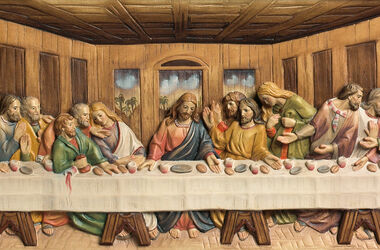
But Leonardo da Vinci and Michelangelo are undoubtedly regarded today in equal measure as great geniuses of the Renaissance. Art history owes numerous masterpieces of painting and sculpture to both of them. Thus, with the "Mona Lisa", Leonardo da Vinci created probably the most famous painting of all time. But other works such as "The Vitruvian Man", "The Last Supper" or "Salvator Mundi" also form high points of painting and drawing.
No less significant is the legacy of Michelangelo Buonarroti. With his David, he succeeded in creating a sculpture that was considered impossible at the time. Equally imposing and famous are the ceiling frescoes of the Sistine Chapel in Rome, which he completed in 1512. No winner may have emerged from the rivalry between Michelangelo and da Vinci at the beginning of the 16th century. Yet with their unique talent, creativity and ambition, both created important milestones in art history.