Everyone Should Know Them: Van Gogh's Five Most Famous Paintings
Vincent van Gogh (1853–1890) is regarded as one of the most fascinating personalities in art history. Numerous milestones in painting originate from the hand of the Dutch artist, such as his Starry Night pictures, his Sunflowers or the atmospheric landscape pictures of Provence.
Because of his revolutionary way of painting and his artistic pioneering spirit, he is today considered one of the most important artists of all time. He resisted the tradition that painting had to depict the world faithfully and developed a very individual style with influences from Impressionism and Pointillism.
Because of his expressive and emotional manner of painting, van Gogh is also regarded in art history as a pioneer of Expressionism.
More Shadows Than Light in His Private Life
But, as so often, artistic genius and tragedy lay close together in van Gogh's life. Far beyond the art world, the legendary incident of van Gogh's ear is well known. Under circumstances still unexplained today, the painter mutilated his left ear on 23 December 1888.
But van Gogh had many other setbacks to cope with in his life. Before turning to painting, he had failed in his attempt to become a preacher. As an artist, too, he remained largely unsuccessful during his lifetime. He could hardly sell any works and was regularly dependent on the financial support of his brother Theo. In addition, he suffered from mental health problems and alcoholism and entered therapeutic treatment several times. Probably because of these afflictions, he also committed suicide in 1890.
Despite his at times difficult fate, van Gogh is not known as a painter who directly incorporated his personal experiences into his paintings. Nevertheless, many famous paintings by Vincent van Gogh are connected with various important stages in his life.
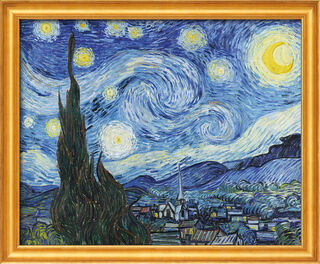
Van Gogh’s Famous Work "Starry Night"
Among Vincent van Gogh's most famous paintings is without doubt the "Starry Night". At the centre of the painting is a deep-blue night sky with clouds, sparkling stars and a shining moon. The lower third of the painting shows a large cypress tree, a mountain range as well as some houses and the church tower of a small village.

One might easily mistake the painting for an impression of the real landscape around Saint-Rémy-de-Provence. But Vincent van Gogh blended memory, fantasy and reality here. The depicted scene does not correspond to the actual view from the clinic building onto the surroundings. Van Gogh arranged the buildings of the town differently and also improvised with the church. However, the hilly landscape corresponds again to reality, as does the night sky. Astronomers consider it quite plausible that the constellation of the moon and some stars might have looked roughly like this in the middle of 1889.
From Vincent van Gogh himself, no statements have been handed down about what he intended to express with this painting. However, various theories circulate regarding the meaning of the picture:
- For example, the dynamic sky is interpreted as a symbol of his agitated state of mind.
- The dark atmosphere of the entire painting is also seen as an indication of his depressive mood.
However, there are indications that he himself did not consider this work particularly significant. In fact, he is said to have regarded it as a preliminary study or sketch. Today, however, this famous painting by van Gogh is among the most frequently reproduced motifs of all time. Since 1941, the original has belonged to the collection of the Museum of Modern Art in New York.
"Fifteen Sunflowers"
Vincent van Gogh not only excelled in particularly atmospheric landscape painting, but also mastered the classical genre of the still life. Several famous paintings by Vincent van Gogh feature sunflowers. From August 1888 onwards, he created four paintings in the southern French town of Arles with the titles:
- "Three Sunflowers",
- "Five Sunflowers",
- "Twelve Sunflowers in a Vase", and
- "Fifteen Sunflowers".
Three further paintings are also counted among the series today, in which he once again took up the motif of the "Twelve Sunflowers" and twice that of the "Fifteen Sunflowers". Above all, the painting with the fifteen flowers is today considered one of van Gogh's most famous works. Its creation and meaning are, however, best understood in the context of all the other paintings of the series.

The paintings from this series are today among van Gogh's best-known works. He had painted all the works in this series quickly and in one go, because he feared that the flowers might wither quickly. For this, he applied the traditional technique of alla prima painting.
His painterly approach:
- First, he defined the contours of the blossoms, the leaves, the stems and the vase.
- He then worked out the flowers. In doing so, he painted both with long and broad brushstrokes as well as with a point-shaped application of paint.
- He applied the oil paints partly in thick layers onto the canvas.
Another special feature of the sunflower painting: Van Gogh essentially used only one base colour. He coloured the flowers, the vase and the background of the picture – that is, almost the entire motif – in various shades of yellow. Although he essentially used only yellow, he succeeded in creating sharp contrasts and making the sunflowers glow.
Regarding "Fifteen Sunflowers" and the other pictures in the series, there are numerous findings in art historical research. Thus, the genesis of the paintings was documented in another artwork: Paul Gauguin, for whom van Gogh originally created the pictures, honoured this friendly gesture with a work of his own.
Furthermore, an X-ray examination by the Van Gogh Museum in Amsterdam revealed that some of the oil paints van Gogh used undergo a chemical transformation process as a result of exposure to light. This would cause the colours to darken continuously. It must therefore be assumed that the sunflower paintings were originally much brighter.
"Café Terrace in the Evening in Arles"
The small town of Arles in the south of France was originally planned only as a stopover, but it was to play a significant role in Vincent van Gogh's biography. In February 1888, van Gogh had left Paris for several reasons. He wanted to escape the loud and hectic big city. In the south of France, he hoped for peace as well as new artistic impulses from the light and the landscape. He also had plans to establish an "Atelier of the South" with other artists.
Van Gogh had originally chosen Marseille as his destination for this, but he did not manage to get that far. Instead, he settled in Arles and stayed there for over a year. During his time in Arles, van Gogh experienced a particularly productive creative phase. In the small town and the region near the Mediterranean, he painted about 180 works.

In the "Café Terrace", the way in which Vincent van Gogh interpreted the night is particularly striking. He saw a colourful play of colours in the darkness. Therefore, for this painting he aimed to depict the night sky in a fundamentally different way from what was usual in painting. He did not want to show the nocturnal sky as black and colourless, but painted it in various dark shades of blue. For the stars, he even used yellow, pink and light blue. He returned to this type of depiction of the night sky in other works, for example in "The Starry Night" or "The Starry Night over the Rhone" – several other very well-known paintings by Vincent van Gogh.
The café is, however, not located at the site where van Gogh created the painting. Since the original street was destroyed in bombing raids during the Second World War, the bistro relocated to Place de Forum. Since its opening, the "Van Gogh Café" had been one of the popular sights in Arles. In June 2023, however, the café had to close because proceedings were initiated against the operators.
"Bedroom in Arles"
Many famous paintings by Vincent van Gogh show atmospheric landscapes or still lifes. His painting "Bedroom in Arles", which shows a simple room without people, therefore appears to be a rather unusual motif. The painting offers a view into his room in his house in Arles at Place Lamartine 2, which he had bought shortly before. The furnishings are very simple. In the room stand a bed, a table and two chairs.
Vincent van Gogh created a total of three versions of this motif. However, he did not paint the pictures as a series. The first version was created in October 1888 on site in the house. He completed the two subsequent pictures a little over a year later, when he was staying at the sanatorium in Saint-Rémy-de-Provence.
The three versions differ slightly in the colours and the dimensions of the objects depicted. The essential variation that van Gogh added, however, is the paintings on the walls. In the first version, a landscape painting and portraits, presumably of Eugène Boch and Paul-Eugène Milliet, hang here, while in the other two, there is a self-portrait and the picture of an unknown woman.
As spartan as the room is furnished, van Gogh's visual language here is equally clear and direct:
- For almost all the objects depicted, he defined the contours with black lines.
- He filled the surfaces largely monochromatically with strong colour tones.
- Very remarkable here is his handling of spatial perspective and proportions: The entire room seems to have slipped out of alignment and appears almost surreal. There are only few straight lines and right angles.
- The pictures on the right-hand wall seem to tilt into the room, and the foot end of the bed appears unnaturally large.
Van Gogh commented extensively on his intention for this picture. In a letter to his brother Theo, he wrote that the painting should serve rest and relaxation. With the simplified depiction, he wanted to give the objects a greater expression. Instead of many details, colour should have the greatest significance here.
However, van Gogh had presumably designed the colour composition differently from how we know it today. Above all, the blue of the walls and the doors, which largely shapes the impression of the painting, was presumably not planned by him in this way. In 2016, researchers at the Art Institute of Chicago discovered during an examination that the colour particles on the reverse side that appear blue today are violet. It is assumed that the violet changed into blue over the decades due to UV radiation and LED light. Van Gog'’s "Bedroom in Arles" was therefore originally not blue but purple.
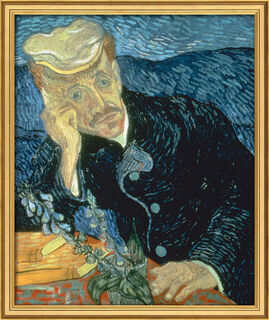
"Portrait of Dr Gachet" (First Version)
Many of Vincent van Gogh’s famous pictures date from the last two years of his life. This is also true of the "Portrait of Dr Gachet". Van Gogh painted it shortly before his suicide on 29 July 1890. It is therefore considered one of his final works. The painting depicts Dr Paul-Ferdinand Gachet, who had treated him for several weeks.
In May 1890, van Gogh had left the sanatorium in Saint-Rémy-de-Provence, where he had spent over a year due to his poor mental health. As he no longer felt at ease in the clinic, he travelled to Auvers-sur-Oise near Paris. Here he met Dr Paul-Ferdinand Gachet, who was regarded as both a competent psychiatrist and an art lover.
Van Gogh was under his care for several weeks. During this time, he had an ambivalent relationship with his doctor. On the one hand, he harboured a certain mistrust of Dr Gachet, as he considered him to be mentally unstable as well. On the other hand, van Gogh saw him not only as a psychiatrist, but also as a friend and a kind of kindred spirit. This may also explain the rather rare circumstance of an artist painting a portrait of his doctor.
In his painting, van Gogh depicts the doctor in an almost exhausted posture with a melancholic expression. In a letter, he wrote that he had wanted to portray Dr Gachet as sad, gentle, clear-minded and intelligent. Perhaps, however, the significance of this painting goes far beyond that. Because of the pained expression, it is often interpreted not as a portrait of the doctor, but as a self-portrait of van Gogh.
The Portrait of Dr Gachet is now one of Van Gogh’s most famous pictures. In addition to the first version, Van Gogh produced another oil picture as well as a print featuring this motif. The second version is now on display at the Musée d’Orsay in Paris, whilst the print forms part of the collection at the Van Gogh Museum in Amsterdam. The first version, however, which is considered the best known and most famous, has presumably changed hands 13 times. After it was last auctioned in 1990 for 82.5 million dollars, it was regarded as the most expensive painting for many years. Following the auction, however, it disappeared from public view – and its current whereabouts are also unclear.

Selected articles on the five most famous Van Gogh pictures