5 Famous Sculptures You Should Know More About
Sculpture has been an integral part of human cultural history for tens of thousands of years. Famous sculptures such as the "Lion Man from Hohlenstein-Stadel", the "Venus of Willendorf", and the "Venus of Hohle Fels" are estimated to be between 30,000 and 40,000 years old. Since its beginnings, sculpture has continuously developed through the art eras.
Famous Greek sculptures such as the "Nike of Samothrace", the "Discobolus", and the "Venus de Milo" bear witness to the great craftsmanship of antiquity. During the Renaissance, Baroque, and Classicism, sculptors perfected the depiction of people in their statues. In the 20th century, progressive styles such as Expressionism, Abstraction, and Pop Art brought new energy to sculpture.
Many sculptures by well-known artists have become icons of their respective epochs. Below, we would like to introduce you to five famous sculptures that are not only milestones in art history but also have fascinating backstories.
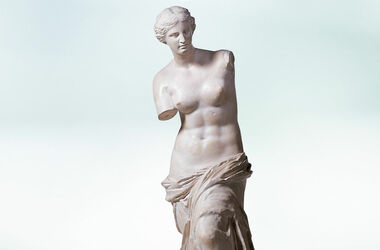
The Venus de Milo - The Mysterious Beauty of Antiquity

When discussing famous sculptures, one cannot overlook the Venus de Milo. The 2.02-metre-tall statue is one of the most significant finds of Hellenistic art.
The Venus de Milo dates back to the late 2nd century B.C. The sculpture was made of marble and, like many famous Greek sculptures, was likely painted in bright colours. However, the colours faded over the centuries.
There is no definitive information about the artist who created the statue. It is also not fully proven that the sculpture represents the goddess Venus. Some researchers believe it could depict the sea goddess Amphitrite, while others suggest it might be the goddess of victory, Victoria.
An Incomplete Masterpiece Full of Myths
Today, the Venus de Milo is probably one of the most famous female portraits in art history. It remains a major attraction in the Louvre in Paris - despite being incomplete, as its arms and hands are missing. It is unclear whether these were lost during transport to France, or were never found. However, some speculate that it is precisely these missing fragments that contribute to the mystique character of the statue.
Many theories exist about what the missing body parts look like. Some theories assume that the Venus could have been holding a shield, while others propose she was carrying an apple as a symbol of victory. Other theories mention a bow, a spear, an amphora, or a thread and spindle as possible objects.
To this day, there is no definitive answer as to which version is correct - just as so many other myths surrounding the Venus de Milo. Yet, these mysteries only add to its allure. Its influence on art and culture continues to this day. Like other famous sculptures, the Venus de Milo is still present in contemporary art, as it is frequently referenced and reproduced in contemporary works.
Michelangelo's "David" - One of the Most Famous Sculptures of the Renaissance

A visit to the Galleria dell'Accademia di Firenze is a must-do when travelling to Florence. Here, in the museum of the Accademia di Belle Arti, you will find various famous sculptures, including David by the Italian sculptor Michelangelo Buonarroti (1475-1564).
This statue is one of the most renowned sculptures of the Renaissance and depicts the biblical figure of David. According to the Old Testament, David defeated the feared giant Goliath using only a slingshot. Michelangelo portrayed the brave shepherd boy in a marble sculpture. It is said to show David just before his battle with Goliath.
Michelangelo mastered the naturalistic moulding of this nude sculpture perfectly. He defined the muscular arms and abdomen, the prominent veins, and the expressive facial features with remarkable realism. However, Michelangelo deviated from the true-to-life depiction of the right hand and modelled it disproportionately large. This was a deliberate choice, symbolising strength and energy.
Yet the world-famous marble colossus did not always meet with unqualified admiration: his rival at the time, Leonardo da Vinci, made disparaging remarks about Michelangelo’s masterpiece in the run-up to its installation, criticising the nude depiction in particular. You can read more about the fascinating and deeply contentious relationship between these two great Renaissance geniuses in our article "Michelangelo and da Vinci – The Duel of the Renaissance Geniuses".
The Path From Raw Material to Artistic Icon
Michelangelo began work on the 5.17-metre-tall statue in 1501. It took him over three years to carve the figure from a single block of marble. This monolith stone had originally been intended for a different art project nearly 40 years earlier. It was meant to be used for twelve statues adorning the outer walls of Florence Cathedral. However, after several sculptors failed to complete the task, the marble block was stored away and only rediscovered for "David".
When Michelangelo completed the sculpture in 1504, a debate arose over its placement in Florence. A 30-member commission was formed to make this decision. They ultimately decided to install the sculpture on the Piazza della Signoria in front of the main entrance to Palazzo Vecchio, the seat of government at the time. There, the statue was meant to symbolise the power of the government and serve as a warning to enemies at home and abroad.
By the late 19th century, the sculpture was moved to the Galleria dell'Accademia to protect it from environmental damage. A full-scale replica was placed in its original location in the early 20th century. Today, the original in the Galleria dell'Accademia remains one of the city's most popular sights.
"The Thinker" - From the Gates of Hell to a World-Famous Sculpture

"The Thinker" by Auguste Rodin (1840-1917) is one of the most significant sculptures of the 19th century and has gained recognition beyond the art world. Over the decades, Rodin's masterpiece has become a true cultural icon.
"The Thinker" is often used as a symbol for creative thinking, reason, or philosophy. It has been copied, referenced, and parodied countless times. For example, it appears in works of art by artists like Nam June Paik or Edvard Munch, as well as in cartoons, memes, and advertisements.
The original "Thinker" is part of the collection at the Musée Rodin in Paris. A copy also stands at Rodin's gravesite in Paris. Additionally, around 40 bronze and plaster casts of the original are said to exist worldwide. These are highly sought after by collectors and rarely appear at auctions, and when they do, they are usually sold for tens of millions of dollars.
How the "Poet" Became "The Thinker"
In 1880, Rodin was commissioned by the French state to design a monumental relief for the planned "Musée des Arts Décoratifs" in Paris. The work was to be based on Dante Alighieri's "Divine Comedy". The sculpture, known today as "The Thinker", was initially called "The Poet", or "Dante" and was one of around 200 figures on the portal.
It was only 72 centimetres high and was enthroned above the "Gate of Hell". In 1888, Rodin removed the figure from this design and turned it into an independent, approx. 1.80-metre-tall, sculpture under the now-famous title.
Rodin worked on "The Gates of Hell" for over 30 years. However, since the museum’s construction was eventually abandoned, the original work - including, "The Thinker", in its intended form - was never completed. The first full bronze casting of "The Gates of Hell" was finally made in 1926.
Today, Auguste Rodin is regarded as a key pioneer of modern sculpture. Early on, he distanced himself from traditional moulding and sought his own individual style. Like many of Rodin's famous sculptures, "The Thinker" did not conform to the contemporary artistic ideals of the late 19th century.
Although Rodin initially based his work on a real person - the French boxer and wrestler Jean Baud - he later deviated significantly from his model’s actual appearance. He did not adhere to realistic proportions, making the hands and feet appear unnaturally large. Additionally, he left the surface of the sculpture rough and uneven, with visible tool marks. The introspective and hunched posture of "The Thinker" was also rather unheroic and unconventional for its time.
What Is "The Thinker" Thinking?
This statue is particularly interesting, not just because of its unusual style. For decades, art historians and the public have been speculating about the meaning of "The Thinker". The most obvious interpretation, based on the title, emphasises the figure’s deep concentration, making it a universal symbol of creativity, philosophy, and reason.
Other interpretations suggest that the figure represents the poet Dante, engaged in self-reflection as he observes the events and characters of his "Divine Comedy". A completely different theory proposes that "The Thinker" is actually Rodin himself, contemplating his own work.
Whether any of these theories are correct or whether Rodin had something entirely different in mind, may never be definitively answered. The question "What is 'The Thinker' thinking?" will likely continue to intrigue future generations.
"The Floating Angel" - Barlach's Famous Bronze Sculpture and its Eventful History

The German Expressionist Ernst Barlach (1870–1938) created renowned sculptures characterised by unique sensitivity and intense symbolic power. His work consistently centred on the human experience, exploring emotions, struggles, and hardships. Barlach’s sculptures often tell small stories while simultaneously conveying deeper symbolic meanings.
Barlach also addressed serious and socially critical themes in his work, largely shaped by his personal experiences during World War I and under the Nazi dictatorship. The Nazi regime labelled him a "degenerate" artist, removed his works from exhibitions and public spaces, and constantly threatened him with a professional ban.
The Famous Sculpture as a Response to War
Throughout his career, Ernst Barlach created many famous works, including "The Floating Angel", one of the most well-known sculptures of the 20th century. The piece features a monumental bronze angel suspended by chains, appearing to float in mid-air. Barlach created this work in 1927 to commemorate the 700th anniversary of Güstrow Cathedral.
The sculpture was intended as a memorial to the soldiers who died in World War I. However, Barlach deliberately avoided the traditional war memorials of his time, which typically glorified soldiers as heroes. Instead, he depicted an introspective angel radiating serenity and peace. Through this "floating figure of fate", Barlach sought to express the sense of emptiness he had felt during the war.
Despite its deeply sensitive interpretation of war, the sculpture faced strong opposition. The Nazis deemed it disrespectful and "an insult to every soldier".
In August 1937, the Floating Man was removed from Güstrow Cathedral and later melted down. Fortunately, the original plaster model of the sculpture survived, allowing friends of Barlach to create a replica in 1939. This version has been displayed in Cologne's Antonite Church since 1952.
Later, the plaster model was also lost in a bombing raid. However, a third bronze cast was made based on the Cologne version, which was donated to Güstrow Cathedral by the Antonite Church in 1953. This allowed, "The Floating Angel" to return to its original location.
Famous Animal: Jeff Koons' "Balloon Dog"

American artist Jeff Koons, born in 1955, has been at the forefront of contemporary art for many years. He is known above all, for his provocative and polarising works. In his oeuvre of paintings, sculptures, photographs and installations, he skilfully moves between kitsch and high culture.
Following the tradition of Pop Art, Koons incorporates everyday objects and pop culture elements into his works. He usually alienates them or places them in new contexts. With his works, he scrutinises familiar objects and their meanings, challenging both consumer culture and the art world.
Jeff Koons created numerous famous sculptures, for example, the 12-metre-tall installation "Puppy" consisting of 17,000 flowers or his famous balloon sculptures, including the "Balloon Dogs". These were created as part of his "Celebration" series, which explores objects, motifs, and rituals associated with birthdays, holidays, and other festivities. Several famous sculptures belong to this series.
The Balloon Dogs were produced between 1994 and 2000. Koons drew inspiration from balloon animals typically made for children at birthday parties. Initially, he designed them as over-three-meter-tall stainless-steel sculptures, later creating smaller porcelain versions.
The process began with small models, which were then digitally rendered into 3D animations. Based on these digital designs, individual stainless-steel segments were produced, welded together, polished, and finally coated with transparent layers in blue, magenta, yellow, orange, or red.
Jeff Koons' Balloon Dogs have since become iconic symbols of modern art. Other artists, including Banksy and Mr. Brainwash, have referenced them in their own works. Original Balloon Dogs are also highly sought-after at auctions - one orange version was sold at Christie’s in 2013 for a record-breaking 58.4 million dollars.
Sculpture Today: Innovative, Contemporary, and Diverse
A look back at the history of sculpture reveals that it has always been in constant transformation. As social and cultural contexts change, sculpture evolves with new themes and design principles.
Several factors influence contemporary sculpture. One of the most significant shifts occurred when abstraction became dominant in visual art. Moving away from traditional figurative forms opened up vast new possibilities. Artists began experimenting with abstract structures and shapes, creating entirely new experiences.
Technological progress also played a major role. Modern sculptors frequently incorporate new materials and industrial techniques into their work. While traditional materials like wood, stone, and metal are still widely used, new materials such as glass, porcelain, and various plastics have expanded the artistic landscape.
Moreover, artistic possibilities are constantly expanding thanks to modern technical production processes. Today, sculptors are increasingly utilising digital computer models, drilling, sawing, and milling machines and other industrial technologies.
In addition, a lively exchange between styles and techniques contributes to the further development of sculpture. This ensures that it always remains vital and up-to-date. And so, modern sculptures at the beginning of the 21st century exhibit a wide variety of themes, techniques and styles.