Pablo Picasso's "Guernica" – A Memorial Against War
26 April 1937 is inextricably linked with one of the most devastating military operations in European history: On this day, German combat bombers, acting on behalf of the right-wing General Franco, razed the small Basque town of Guernica to the ground. When Pablo Picasso (1881–1973) heard about it, he processed the pain and suffering of the population in a painting measuring 349 x 776 centimetres. His "Guernica" was to become one of the most powerful works of art of the 20th century. To this day, it is a timeless memorial against war and an icon of the peace movement. But what lies behind this painting, which continues to arouse the interest and emotions of the public unchanged? The following Guernica picture analysis traces the paths of this masterpiece of modern art.
Picasso Processed the Suffering of the Victims in "Guernica"
The attack on Guernica counts among the greatest atrocities of the Spanish Civil War. It was triggered in July 1936 by the coup of General Francisco Franco against the democratically elected government.
For Franco, Guernica was an important strategic target. He was a declared opponent of any aspirations for autonomy, such as those pursued by the Basques. Guernica had a long tradition as a centre of Basque culture. This made the small town a target with high symbolic value.
For the conquest of Guernica, the Spanish putschists received support from both the Italian fascists and Nazi Germany. Hitler had sent the air squadron "Legion Condor" for the air raid. During the bombardment lasting several hours, the town was almost completely destroyed.
Even though the German leadership always denied it, the air raid was aimed solely and exclusively at the civilian population. The goal was to demoralise the people who had joined the resistance against Franco. Even if the exact number of victims is not known (they vary depending on the source between 300 and 1600), Guernica has become a symbol of ruthless warfare against the population.
Pablo Picasso was deeply shaken when he heard about the destruction of Guernica. At the time of the attack, he was working on a mural for the Spanish pavilion at the Paris World Exhibition. When the news of the annihilation of Guernica reached him, he abandoned his original idea for his exhibition contribution. Instead, he decided to process the suffering of the civilian population in a monumental mural. At the World Exhibition, the painting Guernica became a public accusation of this inhumane war crime.

Guernica Picture Description: The Most Important Elements of the Painting
Even though Pablo Picasso painted Guernica to draw attention to suffering and destruction, this painting differs significantly from other images of war. Picasso avoided depicting a realistic combat scene. The picture shows neither a battlefield nor the bombing raid or the destroyed city. Instead, he created an allegory. He translated his own emotions and the pain of the victims into a metaphorical visual language. Even though he omitted explicit atrocities, his artistic processing of the events is no less impressive.
Picasso illustrates the fate of the population using the example of six people:
- On the left side of the picture, a woman mourns her deceased child, directly below lies another corpse.
- On the right side, a person who apparently cannot escape the fire raises their hands into the air seeking help.
- Two other people appear to be trying to escape the inferno.
In addition to the people, Picasso added some depictions of animals to the picture:
- In the centre of the painting, he positioned a horse with its mouth wide open, which appears to be frightened.
- At the left edge of the picture, a bull rises up. This plays a major role in Spanish culture, but can also serve as a symbol of strength, brutality, or vitality.
In addition to people and animals, the painting also contains various other fragments and amorphous elements that cannot be clearly identified. In almost every interpretation of Guernica, reference is also made to the light bulb. However, opinions differ as to its meaning. Sometimes it is considered to be the light or the eye of God, sometimes a symbol of technological progress. Picasso himself did not provide detailed explanations as to what message he wanted to convey with the individual pictorial objects. Ultimately, it is left to the viewers to interpret the painting in their own individual way.
Picasso supported the tragic theme of his painting with various painterly means. The many fragments from which he composed the scene create a permanent sense of unrest. The painting style, which is strongly influenced by Cubism, without any spatial depth and with sharp contours and contrasts, intensifies the disturbing atmosphere of his work. He further emphasised the mourning and the serious message of the painting through his colour palette, in which he exclusively used tones between black, grey, and white.
Various Interpretations of Guernica Are in Circulation
Pablo Picasso created a moving statement against war with "Guernica". The monumental work developed into an icon of the global peace movement. With its great emotionality, Guernica became one of the most famous paintings of the 20th century and the epitome of political art.
Likewise, Pablo Picasso did not require an explicit and detailed depiction of violence, injuries, or death in Guernica. The cruelty and pain are nevertheless almost palpable. In addition, Picasso completely refrained from demanding consequences for the devastating attack. The painting contains no reckoning with the perpetrators. It neither calls for retaliation nor does it incite hatred against the war criminals. Rather, Picasso dedicated this work exclusively to the suffering of the population. He trusted that the obvious pain of the people would be sufficient to guide towards responsible and ethical action.
However, not all interpretations of Guernica follow such common patterns of interpretation. Frequently, the direct reference to the attack on Guernica is questioned. These interpretations refer to statements made by Picasso himself. He is quoted as saying that the painting was intended to express his "abhorrence of the military caste" of Spain – especially General Franco. Picasso therefore did not intend per se to create an anti-war painting or to address the suffering of the civilian population. Rather, he was concerned with a fundamental critique of the right-wing putschists in his country.
There are even theories according to which the painting Guernica has nothing at all to do with the civil war in Spain or the bombardment of the Basque city. Instead, the meaning of the painting is said to be found in Picasso's biography. According to this interpretation, Guernica reflects the life of the painter or certain phases of his life. Depicted are:
- an earthquake in Malaga that he experienced in his childhood,
- his relationship problems, as well as
- the suicide of his friend Carlos Casagemas.
None of the many readings of Guernica can be conclusively proven. The master himself is quoted as saying that it is "not the painter's business" "to define the symbols". The public that views the picture must interpret the symbols as it understands them.
Picasso's Guernica Still Possesses Great Radiance
In the same year in which Pablo Picasso painted Guernica, the painting was shown at the World Exhibition in Paris. Afterwards, it was exhibited in over 30 cities in the USA and Europe. A loan to Spain, however, did not take place for many years at first. Picasso had decreed that the work was only to be shown after Franco's death and the restoration of democracy in Spain.
Thus, Guernica initially hung for around 40 years in the Museum of Modern Art in New York, until it returned to Spain in 1981. Since 1992, it has found its final place in the Museo Reina Sofia in Madrid. Due to its poor condition, however, the painting is no longer loaned to other institutions. Even an exhibition in the Basque Country, which has been demanded many times, has not yet been approved. Today, Guernica is undoubtedly the most famous work in the Museo Reina Sofia. Not least because of this highlight of 20th-century art, over 1.5 million people visit the museum every year.
The painting Guernica does not only fascinate the public. How great the impact and influence of the painting can be was demonstrated by an incident in the UN building in New York. Here, a copy of Guernica hung as a wall tapestry. When US Secretary of State Colin Powell delivered his momentous speech on 5 February 2003 about the alleged arsenal of weapons of mass destruction of Iraq, "Guernica" was covered with a blue UN flag. Apparently, there were fears that the impressive painting could influence the mood in the Security Council as well as public opinion.
Picasso Repeatedly Took a Stand on Political Issues
When Pablo Picasso created Guernica, he wanted to express his horror at the war atrocities of the right-wing general and later dictator Franco. With this painting, Picasso took a significant step towards a political and socially critical art.
In his further career, he repeatedly engaged with current events in his works and campaigned for peace and reconciliation. He considered it almost the duty of artists to position themselves on political issues:
"It is my wish to remind you that I have always been and still am convinced that an artist who lives and works with spiritual values cannot remain indifferent in the face of a conflict in which the highest values of humanity and civilization are at stake."
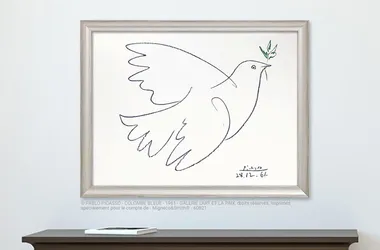
He repeatedly addressed injustice, war, and suffering in his work. His pictorial themes included, among others, the war crimes during National Socialism and the Spanish dictatorship, the war in Korea, or the Cuban Missile Crisis.
However, to describe him as a purely political artist would go too far. A large part of his work eludes any possible political interpretation.
With "Guernica", Pablo Picasso undoubtedly created his most powerful anti-war statement. With this monumental painting, he reminded viewers that it is always the population that suffers most from military conflicts. Unfortunately, this message has lost none of its relevance to this day. And as long as wars rage worldwide between nations, ethnic groups, and religions, there is a need for stirring works of art such as the painting Guernica.
Would you like to learn more about the artist? Read our articles about Picasso's women or discover Picasso's most famous works.